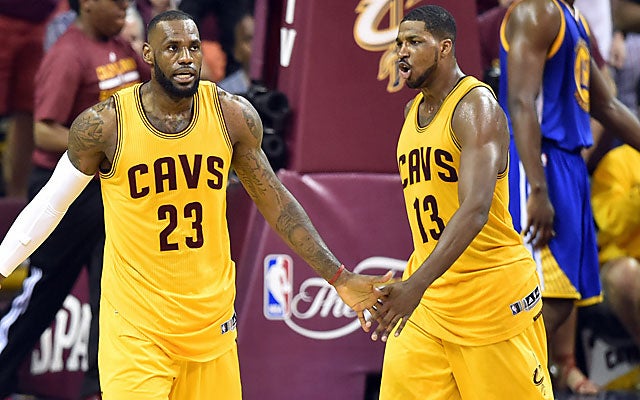
Out of options, Tristan Thompson's holdout looking pretty hollow
With options limited for restricted free agent Tristan Thompson, the 24-year-old forward and the Cleveland Cavaliers must come to an agreement on a multi-year deal -- before the impasse becomes a distraction.

By
Ken Berger
•
2 min read

Tristan Thompson and the Cavaliers remain at a contract impasse, and now the 24-year-old forward will be considered a holdout from training camp.
But don't hold your breath for Thompson to take his bruised ego elsewhere this season. As is the case with most restricted free agents, his options are extremely limited -- especially in October.
The Cavs no longer have to make the one-year, $6.8 million qualifying offer available to Thompson; the deadline for him to accept that was 11:59 p.m. ET on Thursday, and he didn't. Now it's a matter of whether the Cavs and Thompson's agents, Rich Paul and Mark Termini, can come to a long-awaited agreement on a long-term deal.
It's simple, really: The Cavs don't want to pay a reserve the max, even one as valuable as Thompson, because that's not what the market bears. Typically, a restricted free agent gets the max from his current team because another team offered it. (See Enes Kanter, whose four-year, $70 million offer sheet from Portland was matched by Oklahoma City.)
The Blazers, having lost LaMarcus Aldridge to the Spurs, understand the value of 20-something big men who are productive. (Hint: Their value is considerable.) But once they were rebuffed in their pursuit of Kanter, I always expected GM Neil Olshey to make a max offer to Thompson. He never did, and it's always puzzled me why he didn't.
(Sensible rationale, according to one executive in the league: The Blazers don't think Thompson is worth the max?)
As it turns out, the Blazers and perhaps the Sixers are the only teams who still have sufficient cap room left to make Thompson such an offer. And even if one of them does, the Cavs will match it.
As Jeff Zillgitt of USA Today points out, that's how then-restricted free agent Anderson Varejao's holdout with the Cavs ended in 2007 -- when Charlotte eventually made a mid-level offer and the Cavs matched. Varejao's holdout lasted into December, costing him 21 games.
Short of that, it's easy to understand why the Cavs are reluctant to pay Thompson the max this summer when no one else has put it on the table. (Rule No. 1 of negotiation is don't negotiate against yourself.)
The free-agent market will be flooded with cap space next summer, and Thompson's leverage -- if he'd chosen to sign the qualifying offer by midnight Thursday -- was the threat of leaving as an unrestricted free agent next July. With the Cavs no longer required to make the one-year qualifying offer available, Thompson is stuck. His only leverage would come from the Sixers or Blazers (or someone else, if they can somehow create cap space) delivering a max offer sheet or close to it.
Beyond that, the Cavs and Thompson's camp (which not coincidentally also is LeBron James' camp) now have to buckle up and agree on a multi-year deal. At this point, the most logical middle ground is a deal for less than maximum length (three years plus an option?) somewhere between the max that Thompson is seeking and the less-than-max that the Cavs are offering. That way, the Cavs don't overpay, and Thompson gets security while also being able to hit the unrestricted market in 2018, when he'll still be only 27 -- and maybe, with a championship or two on his resume.
In negotiation, there's always a middle ground that both sides can live with. In Thompson's case, the longer it takes to find it, the more disruptive this impasse will become for the Cavs.