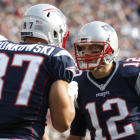

Brady, Gronk, and Marty B are just as unstoppable as we thought they'd be
It's only been two games, but the Patriots trio is already proving to be a nightmare to defend

By
Jared Dubin
•
6 min read

We all knew this would happen once they got on the field together, but it's still important to note that through two weeks, the combination of Tom Brady throwing to his tight end duo of Rob Gronkowski and Martellus Bennett looks nigh unstoppable.
The Patriots have scored 33 and 35 points in the two games Brady has played, an average of 34 points per game that would lead the league if they kept it up over the full season. Brady himself has thrown for 406 and then 376 yards in those two games, figures that yield an average of 391 yards per game that would also, unsurprisingly, lead the NFL.
Brady's accumulated those numbers by doing what he does best -- getting the ball out of his hands and into the hands of playmakers quicker than anybody in football. Nobody reads the defense before the snap better than Brady, and the New England offense is designed with route combinations that allow him to exploit the weakest point of the defense very soon after the ball is snapped. That's how you wind up with a 76 percent completion rate, 10.4 yards per attempt, and a 135.5 passer rating through two games.
Amazingly, though, Brady has been even better than that when targeting his two monster-sized tight ends. He's thrown to Gronkowski or Bennett 29 times in those two games, and he's completed 23 of those passes for 386 yards and four touchdowns. That's a 79.3 percent completion rate. It's 13.3 yards per attempt. And it all yields a perfect 158.3 passer rating.
The Patriots operate out of two-plus tight end sets more than almost any other team in football. Even last season, before acquiring Bennett, the Pats had two or more tight ends on the field for 54 percent of their plays, per Pro Football Focus; the average NFL team used multiple tight ends on around 25 percent of its plays.
Through the first four weeks of this season, the Pats did not use multi-tight end looks nearly as often as they did last season. They were in two or three tight-end looks on only 29 percent of snaps, per PFF. It makes sense -- Gronkowski sat the first two games of the season due to injury, then played only 14 and 39 snaps in Weeks 3 and 4 as the Patriots blew out the Texans and then were shut out by the Bills.
Once Brady returned, though, Bill Belichick and Josh McDaniels ramped things right back up. New England used multiple tight ends on 76 of its 144 snaps in Weeks 5 and 6, with 72 of those snaps featuring both Gronkowski and Bennett -- a rate of exactly 50 percent. It's on those plays where the offense has been at its most dangerous.
Most teams that run two-tight sets tend to use their tight ends as exactly that -- tight ends. Maybe one on either side of the line of scrimmage, or two stacked toward one side. And the Patriots definitely do that sometimes. But they're also not afraid to move these guys around. Both players have lined up in the slot or out wide nearly as often as they've been inline as traditional tight ends, per tracking data from PFF.
| PLAYER | INLINE | SLOT | WIDE |
| Gronkowski | 64 (52%) | 40 (33%) | 18 (15%) |
| Bennett | 53 (57%) | 23 (25%) | 17 (18%) |
Take this play from Week 5 against the Browns, for example:
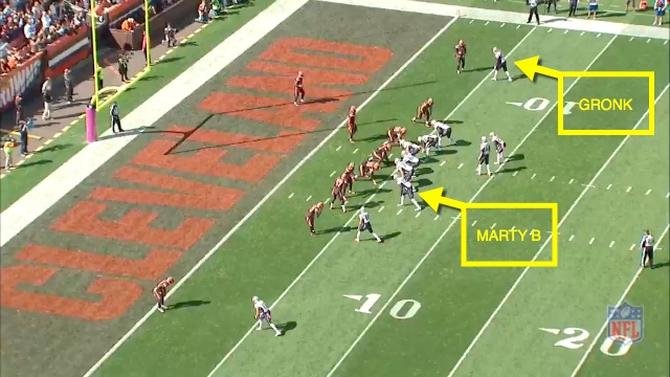
The Patriots are in 12 personnel here (one running back and two tight ends) but they're lined up as though they're in an 01 grouping (no tight ends and one back). Gronk is split out wide right as a receiver, while Bennett is lined up in the slot to the left side of the formation.
Just lining them up this way creates chaos for the defense. The Browns know they can't single-cover Gronkowski with a cornerback -- he's too big. So they rotate a safety over for an inside double-team to take away the slant. With both linebackers to that side of the field coming on a blitz, Bennett is left one-on-one on the back side. All he has to do is get inside his man, and Brady has a free lane to toss him a quick touchdown pass, which is exactly what happened on the play. Gronk ran both his men into the back of the end zone on a slant, Bennett came across the formation, boxed his man out, and scored.
Later in the game, the Pats brought out a personnel grouping with three wide receivers and two tight ends. Yet, they lined up Gronk and Bennett both in the slot this time, on opposite sides of the field.
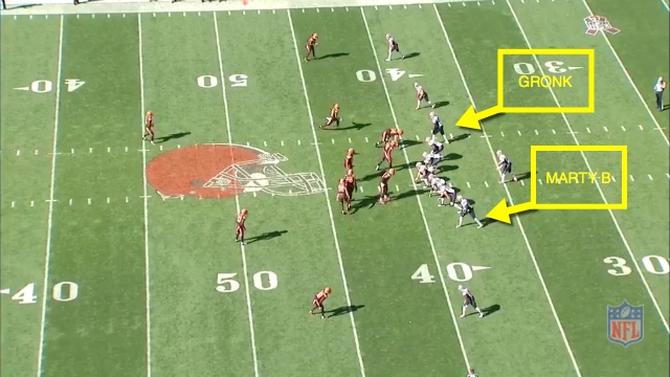
Again, this is a near-automatic mismatch. There are only so many underneath defenders available, and you can't devote enough resources to stop both of Gronk and Bennett. Look how confused the Browns are just before the ball is snapped, then watch as two of them chase Bennett on his route, leaving Gronkowski with one-on-one coverage to the (offense's) right side of the field.
That is just way too easy, but it somehow got even easier later in the drive.
The Patriots, back in 12 personnel this time, lined Gronkowski and Bennett up right next to each other on the right side of the formation, this time as inline tight ends. They also brought Julian Edelman in close to the formation on the back side, showing a clear run look.
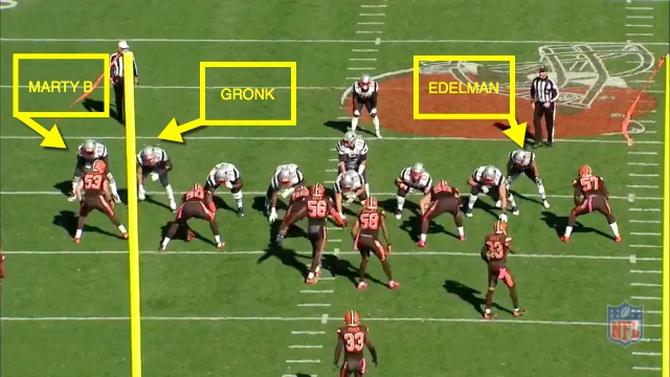
Except, of course, they did not run the ball, and both Gronk and Bennett wound up wide the heck open down the field.
The unfairness continued in Week 6, though not so much until after halftime. Near the goal line, the Pats again lined up in 12 personnel, this time with Bennett slot left and Gronk as a receiver to the right side, but in tight to the formation.
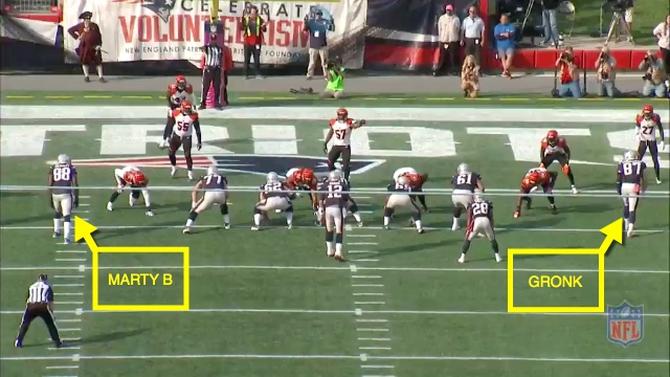
This is practically giving Brady a free touchdown. All he has to do is recognize which of his monster tight ends will be seeing one-on-one coverage, then look off any possible help and fire away. Because Brady is Brady, that's exactly what he does.
I'd say it's almost too easy, but there's no almost about it. That's just too easy.
The operative question here, of course, is whether anyone can stop the Patriots when these two guys are on the field together, especially near the goal line. Neither the Browns nor Bengals was able to do it, and it seems unlikely the Steelers can either.
The best way to disrupt the Pats' passing game is likely the same as it has always been: get pressure on Brady quickly. Doing so might mean sending extra rushers, though, and that's a dangerous proposition. Every extra man you devote to the pass rush is one less man that can help out in coverage against these two gigantic targets.
The team best-equipped to do it will be one that is able to generate a rush while rarely blitzing -- like the Bills and Seahawks, who they play in their two games following this week's tilt with the Steelers, though Rex Ryan may get over-aggressive and send a ton of extra rushers. Or one that has good enough defensive backs and safeties to hold up on the back end when extra men are rushing the quarterback -- like the Broncos defense that flustered the Patriots in last year's playoffs.
With the additional weaponry the Patriots have added this year, though, it may just be too difficult to shut them down.