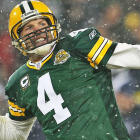
In conversation, the indestructible Brett Favre can still sling it
The Fantastic No. 4 reflects on his remarkable life ahead of his Hall of Fame induction

•
6 min read

The ol' gunslinger has still got it.
That easy, Southern charm still resonates even when making small talk. He can make the sanitized, homogenized environment of a national conference call with a bunch of people he doesn't know on the speaker feel intimate and homespun. That schoolboy quality -- the kid who just loved to play the game and never stopped 'til he had to -- still pours forth. The twinkle in his eye, as he recounts some of his old gridiron glories, is almost visible through the phone line.
Football remains very much in Brett Favre's heart, and, with his induction into the Pro Football Hall of Fame in Canton, Ohio, now just a few weeks away, it remains very much on his mind as he prepared for a speech that I suspect will leave not a dry eye on the lawn. Favre doesn't seem to have changed much, and I doubt he ever will.
He's always wore his passion and enthusiasm for the game like a second logo on his helmet, and those qualities dominated his question-and-answer session Tuesday morning. You could still picture him as a John Wayne figure, the NFL's Iron Man who defied the odds, and his body at times, to capture America's imagination with his wild comebacks. He played with reckless abandon, with a little Eddie Haskell thrown in.
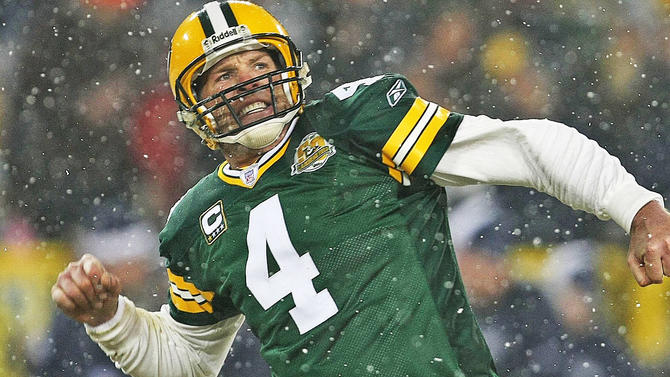
He was and always will be a throwback, something Favre clearly embraced. While the latter stages of his career may have made him less endearing to some -- the rift with a young Aaron Rodgers; the phone saga with the Jets; the endless retirement drama with the Vikings; the now-repairing relationship with the Packers -- no one can ever accuse Favre of trying to be something he's not, or shirking a challenge.
Over time, his iconic wins, his overcoming a debilitating painkiller addiction, his Lombardi Trophy, his performance in the immediate aftermath of his father's death, his records for longevity and productivity, will further trump his peccadilloes, I surmise.
Few can tell a story like Favre, and he has a lifetime of yarns to cull upon for this one. But his narrative is simple at its core and quintessentially American in many ways: If you believe deeply enough and work hard enough, anything is possible. A kid from Kiln, Miss., can marry his high-school sweetheart, go on to lead a small college program (Southern Miss) to new heights, watch his draft stock fall due to a potentially serious hip condition, battle addiction early in his career, get traded to a storied but dormant franchise, lead that team to its first Super Bowl in a generation and go down as one of the greatest to ever play the game.
"I was a day dreamer," Favre said Tuesday morning. "I was a devoted hard worker to my dreams. I was determined I was going to be Roger Staubach one day, and I was going to play for the Dallas Cowboys, and nothing was going to stop me ...
"I never, never dreamed of Pro Bowls or MVPs, quite frankly, or how many games I would play -- in other words, stats stuff. And the Hall of Fame, I never dreamed of that. I just dreamed of playing. I can sit here and honestly say that every dream I had as a child -- day dream, night dream, it didn't matter -- came true. And for that I was forever thankful. Wow, who can say that?"
Yes, there was certainly some Favre Fatigue over the swirling drama at the end of his NFL run, but the allure of Favre's career arc is undeniable. We tend to forget what he accomplished in college, but taking Southern Miss on the road and knocking off Alabama and Auburn in the same season is no small feat.
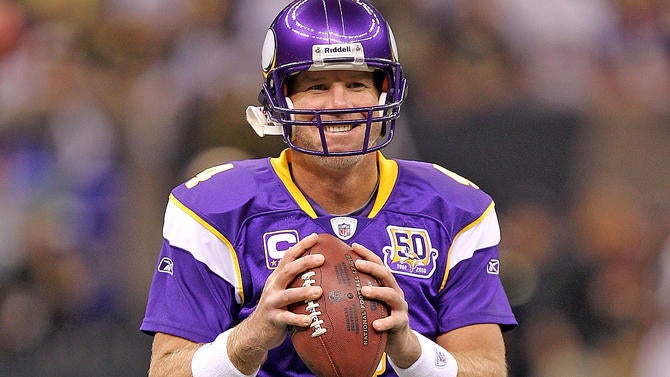
"Not many people can say they beat those two teams in the same season at their place," Favre noted, and he also orchestrated a huge win at Florida State. This is not a program that goes around whacking national powers, especially away from home. Even before that, Favre's flair for the late-game comeback shined through in victories over Cincinnati and Tulane.
"That jumpstarted my NFL career, the Cincinnati game," Favre said, "and I never looked back from the Tulane game."
A serious hip injury, suffered in the East West Shrine Game, nearly derailed it all, however, and the prognosis from some doctors was dire. The Falcons decided to select him in the second round in 1991, against the wishes of brash coach Jerry Glanville, but he was unable to grab hold of the job and wasn't ready to blossom yet. Everything changed when the Packers, and new general manager Ron Wolf, dealt a first-round selection for Favre following his rookie season. The trade was nearly scuttled when a physical revealed the hip may be deteriorating more than previously expected, revealing an avascular necrosis (similar to what ended Bo Jackson's career).
"I was more or less flunked (in the physical) if you will," Favre said, "and Ron overruled that."
Some doctors estimated Favre might get 5-7 healthy years out of the hip; other opinions varied. Few would have suspected he'd end up making 297 straight starts (321 including the playoffs), but at the time Wolf was determined to get his man.
"Ron said more or less, I'll take whatever good years he can possibly give us."
Favre went on to give the Packers 16 Hall of Fame years, including three MVP awards and the bulk of his 11 Pro Bowl seasons. The move forever bonded the two, with Wolf, who was inducted into Canton a year ago, never forgetting what Favre did for him, and vice versa.
"The debt of gratitude is, with or without that scenario, is forever payable," Favre said. "I've told Ron that over and over again, and as matter of fact, I had a conversation with him last night. We're both so thankful to each other. You'd think we'd get over that at some point, but It's really a wonderful story of -- in his case, sticking your neck out there in a case where he just got a new job ... with an historic franchise. What a gamble, and I'm forever thankful for that. And he's said over and over to me how thankful he is it worked out."
Favre repaid Wolf Sunday after Sunday, and the sincerity of their bond was evident as the soon-to-be Hall of Famer spoke. In some ways it's hard to imagine that Favre is now 46, given that devilish, boyish way he still talks about the fun he had playing the game. And, on the other hand, it's somewhat incongruous to me that he's just 46, not even five years older than me, him always seeming so grizzled and battle-hardened through his career. Limping into the huddle, dragging his body around, always finding one more rocket deep throw out of a tiring arm.
While the Hall of Fame is keeping everyone's presenter under wraps before official announcements next week -- an official from Canton jumped on the line when Favre was asked about that very motion on the conference call, making sure the candid quarterback didn't spill the beans -- one couldn't help but wonder if Wolf will be involved in some way. If not for the passing of Favre's father in 2003 -- Favre honored him with a Monday Night Football performance for the ages the day after his death -- there would be no doubt as to who would be doing the honors next month.
"My dad definitely would've been doing it," Favre said, "and I'll talk about that during the induction."
That's yet another story that few could tell the way Favre can. He'll be direct, down-to-earth, relatable as always. Whether you cheered for Favre's teams or not, there'll be plenty of reason to tune in. Whether you loved him, or hated him, there is plenty to champion here, and soon the football world will be celebrating once more a career that was buoyed by a distinct love for the game, that was embraced by teammates and opponents alike, that was never boring, and that at times seemed larger than life.