
Why Hue Jackson's clash with sports science is bad for analytics in Cleveland
Jackson's disagreement with the staff is an indication that the analytics revolution isn't really a revolution

•
3 min read

When the Cleveland Browns hired Paul DePodesta from Moneyball this offseason, they seemingly sided with the nerds in the ongoing analytics debate. Finally, after watching stat heads carve out meaningful roles in baseball (like DePodesta did with multiple ballclubs) and basketball, the analytics revolution was coming to the NFL with Cleveland serving as its initial testing ground.
It would be unfair, though, to judge the value of analytics in football based on whatever the heck ends up happening to the Browns in the next few seasons. Based on some recent comments made by head coach Hue Jackson, the stat heads in Cleveland aren't really in a position of power.
According to Jackson, the sports science staff advised him to adjust his padded practice schedule. That advice went ignored, which is whatever -- after all, we're talking about padded practices in June -- but the reason Jackson disregarded their advice is alarming.
He cited his "feel."
"Honestly, they got kind of mad at me,'' Jackson said Tuesday, per Cleveland.com. "I'll be very honest with you. We had a very candid conversation where they said, 'Hue, you might want to double check your padded days schedule.' I told them, 'No.' I know how to take care of a football team. I get a feel for when the guys, when we're pushing them a little too far and we need to reel it in.''
In other words, Jackson went with his gut -- the exact opposite decision-making method of using science.
"We're only going to build our football through playing football and good football teams play football, real football,'' Jackson said. "They line up and they go after each other and they come out and they do it again the next day and somewhere in there, Coach Jackson's got to be smart enough to say, 'OK, that might be enough. We need to pull off.'
"That's part of being the head coach as well and it's part of having a sports science team. I'm sure they'll give me all the statistical data that you can to forewarn me, but I'm going to trust my instincts on that one and see if we can get our team to be the best that they can be."
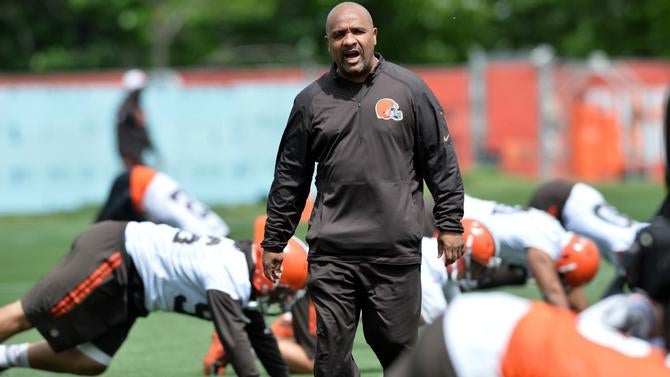
While padded practices won't dictate whether the Browns transition from incompetent to competent, Jackson telling the stat heads a simple "no" and then essentially explaining how his "feel" overrides their science is significant -- it shouldn't be ignored.
If the analytics staff's recommendations can be shot down due to one person's "feel," then how are its ideas ever going to impact the team? If Jackson can ignore suggestions that conflict with his gut, then the stat heads won't be working in an environment that allows for them to implement their ideas. All they'll be doing is supplying a head coach with data that will be accepted when it supports his beliefs and rejected when it clashes with his opinions.
That's not a revolution. That's using analytics when you like what it indicates and ignoring it when it challenges your beliefs, which -- again -- goes against the very fundamental function of adopting an analytical approach in game that struggles to move away from old-school beliefs.
This might be the only dispute between that's surfaced thus far, but don't be surprised if more follow. As ESPN The Magazine reported in April, Jackson "favors gut, eye and instinct over data," which this case so clearly demonstrates.
Maybe that's a good thing. Maybe Jackson does possess the magic touch that trumps science. Maybe the analytics crew has more influence in other areas like scouting, player development, drafting, and free agency. Maybe analytics don't belong in football at all.
Based on Jackson's recent comments, we'd be foolish to answer that by using the Browns as a case study. If this recent issue serves as an indication, Jackson has the power to trump the stat heads by citing something as ambiguous as his "feel."
It's important to note, of course, that this is just one data point, meaning we don't know if he has the ability to trump the stat heads on every issue. If he does have complete authority, we don't know if he's been consistently flexing it. We don't know if he'll keep using it in the future. Perhaps, prior to this recent issue, he had accepted unconventional ideas and only resisted against this particular change.
Despite those unknowns, this is still an important data point to track, because if analytics are continually trumped by "feel," it'll render this so-called revolution in Cleveland insignificant.