NBA Draft Combine is no sweat for top prospects like Brandon Ingram
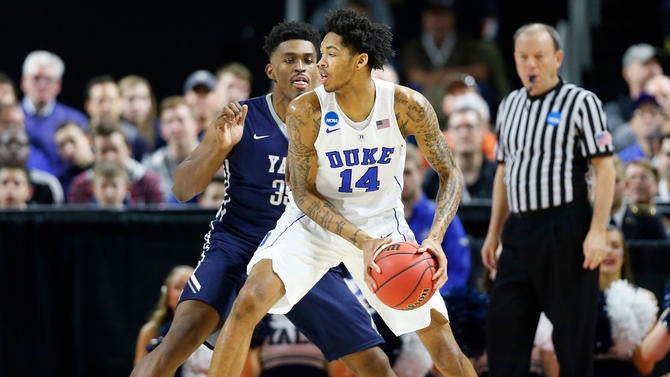
Duke's Brandon Ingram, Oklahoma's Buddy Hield, and Kentucky's Jamal Murray, among others, are not going through some of the front-facing events. However, here's why it won't affect their draft standing.

By
Sam Vecenie
•
2 min read
CHICAGO -- Over the last few years, it has become a ritual that most of the top prospects skip the NBA Draft Combine. At this point, it's simply a reality of the situation.
In 2013, Anthony Bennett didn't show while he was rehabbing his shoulder. In 2014, neither Andrew Wiggins nor or Joel Embiid were here in their battle for the No. 1 overall pick. Last year, Karl-Anthony Towns and Jahlil Okafor skipped the proceedings.
This season, it's Ben Simmons who didn't show up at all. Plus, Brandon Ingram, Jamal Murray, and Buddy Hield are in town, but not doing any of the athletic testing involved with the combine. Neither Murray nor Ingram did anything beyond team interviews. Oh, and Dragan Bender, another potential top-five pick, is not here as his season is still finishing over in Israel.
Don't fret though, if you're a fan of any of those players. It's really not a big deal that players don't show up and do things at the combine, especially if they come for the interview portion. Again, it's one of those things where the empirical numbers that we get from the combine -- the vertical leap test, lane agility, and wingspan measurements -- often far overshadow the most important parts of the process: the interview and medical exams. And those things -- along with the other empirical measures -- are capable of being grabbed later in the process.
At the top of the draft, the potential player pool is much smaller than that of, say, the 20th pick. That means, logistically, it's not necessarily as difficult to work to bring in the guys that you want due to the more narrow field. Plus, the teams at the top making high-level investments will want to bring in players for private workouts as it is where they'll meet and greet with everyone from ownership to the coaching staff. In some cases, I think you can actually argue that it's of greater benefit to more teams that the elite players turn down invites, again, simply due to the fact the more narrow field of potential teams that will be in the hunt for these players. It allows teams to get a look at more players that have much more suspect draft stock than those at the top of the draft.
The downside is, of course, it does allow agents to hide guys from teams they don't really want to go to. The story of the 76ers and Kristaps Porzingis, as reported by The Vertical's Adrian Wojnarowski last year, is a strong example. Plus, agency-based medical exams may or may not be quite as rigorous as the one the NBA puts players through at the combine. But on the other, private workouts and pro days allow for a bit more of a thorough interview than the half-hour that is afforded in Chicago. Also, agents are going to do what they can to direct players to the teams they want anyway, and the teams will draft the players they want even if the group around the player has made things a bit more difficult.
In other words, don't get too caught up in the machinations of who attends the combine and who doesn't among the elite players. Given the draft success of past players who didn't attend, it's clear that it doesn't really affect much in the way of draft stock, and it's clear that the dog and pony show that is the combine will continue to go on in a substantive way with or without their attendance.