NCAA Tournament 2017: Which Final Four matchup should Oregon, Gonzaga want?
How do the Ducks and Bulldogs stack up against the remaining regional finalists?

•
5 min read

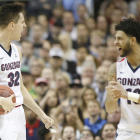
Half of the Final Four bracket is set: Oregon emerged from the Midwest Region with a stunning 74-60 triumph against top-seeded Kansas while Gonzaga ended the Cinderella run for Xavier, running away with an 83-59 victory to reach the Final Four for the first time in program history.
The moment is huge for both programs, but the job is not done. Mark Few told his team that if they’ve gotten this far, further than any Gonzaga team ever, “we might as well go win it.” Oregon’s swagger comes from its underdog status, with Jordan Bell and Tyler Dorsey leading a team that feels like its been overlooked throughout the NCAA Tournament.
The presence of two teams from the Pacific Time Zone is a first for the Final Four, per the NCAA’s David Worlock, and it’s only the sixth time that two teams west of the Central Time Zone have been in there together.
6x with 2 FF tms from Pac/Mnt time zones:'42 (Stan,Colo), '55 (San Fran, Colo), '66 (UTEP,Utah), '70 (UCLA,NMexSt), '98 (Utah, Stan).Now '17
— David Worlock (@DavidWorlock) March 26, 2017
“Don’t sleep on the West Coast, wake up!” Oregon shouted as it set the stage for one of the most anticipated Final Fours in recent memory. Now we just have to figure out who these West Coast teams are playing, and how they match up to each potential Final Four foe.
(1) Gonzaga
If it’s (4) Florida ...
If this is 2014, or 2007 or any year that Billy Donovan is on the sidelines of the Gators, you would give a coaching edge to Florida against Mark Few, making his first Final Four appearance. But the coaching edge against Mike White, still on a hot streak in his inaugural NCAA Tournament appearance as a head coach, goes to Gonzaga. The key for Florida will be to get the best defensive performance possible from its bigs against Przemek Karnowski. The 7-foot-1, 300-pound big man was limited by Xavier’s collapsing zone defense but that same commitment to the block opened up the outside for one of the best 3-point shooting performances Gonzaga fans have seen all season.
One theme of this tournament has been how teams respond from losing key players to injury. Oregon lost Chris Boucher in the Pac-12 tournament, but Florida has been playing without John Egbunu since mid-February. The Gators are getting a lot of huge minutes from senior Justin Leon and sophomore Kevarrius Hayes right now, but need Devin Robinson to be a difference maker on the defensive end as well for Florida.
For Gonzaga, Florida presents a much tougher foe on paper. But this tournament has proven that being better on paper doesn’t necessarily play out on the court.
If it’s (7) South Carolina ...
The 2017 Gonzaga Bulldogs have been one of the best defensive teams under Mark Few, tremendous at communicating on the floor and making you beat them with contested jump shots. But in this moment in the NCAA Tournament, it’s impossible to ignore the out-of-body play that Gonzaga showed in the Elite Eight and how that might tie to the urgency felt by players on the back end of the transfer process.
Some criticize the transfer process and call it an epidemic, but I look at the inspired play by Nigel Williams-Goss, Johnathan Williams III and Jordan Matthews in this tournament and celebrate the feeling of victory with a second chance. These players asked for a new hand from the dealer and have ended up cashing in on the biggest run in program history. When Williams, Williams-Goss and Matthews are suddenly sparking huge offensive runs in this tournament, it shouldn’t come as a surprise.
South Carolina, however, has the same urgency with Sindarious Thornwell. When Thornwell committed to South Carolina in 2012, he had other options. Four-star prospects coming out of Oak Hill Academy usually do, but the Lancaster, South Carolina, native wanted to play in his home state for the Gamecocks. He has been the best player on the court in every game that South Carolina has played, another credit to how urgency can play a role in determining college basketball’s national championship.
(3) Oregon
If it’s (1) North Carolina ...
Oregon’s matchups gave Kansas a lot of problems. The Jayhawks did a lot to hurt themselves with poor shot selection and losing 50-50 balls to the Ducks, but they also never overcame or adjusted to mismatches on the floor, like Landen Lucas getting beat off the dribble in penetration situations. The way Oregon is playing right now, with four out and 6-foot-9 forward Jordan Bell (the Most Outstanding Player for the Midwest Region) in, it could present similar problems for North Carolina on defense.
The Tar Heels have length on the perimeter, thanks to Theo Pinson and Justin Jackson, but the defensive responsibility for those players has never been bigger than if they face the Ducks in the Final Four next weekend. Oregon has a shot to establish that same advantage against North Carolina, but replicating the outcome will be dependent on keeping UNC off the offensive glass, where they are the best in the nation.
If it’s (2) Kentucky ...
Oregon’s positionless basketball could be a problem for the Tar Heels, but that advantage gets negated against Kentucky. Freshman big man and future NBA Draft pick Bam Adebayo is a good enough athlete to guard almost every position on the court, so if he’s out there as Kentucky’s anchor, the rest of the team’s collective length and athleticism should negate the Ducks’ edge.
What Kentucky would need to hang with Oregon is what Kansas didn’t get, a star performance from its freshman phenom. Luckily for John Calipari, De’Aaron Fox is playing his best basketball of the season right now, and Malik Monk has already shown the capability to go off for 20-30 points in 20 minutes on any given night. Josh Jackson was a non-factor against Oregon and it probably cost the Jayhawks a shot at the title, but Kentucky can put three Josh Jacksons on the floor at once.
If Oregon fans are looking for a rooting interest, North Carolina looks a lot more like Kansas and Kentucky looks like the team you don’t want to face in the Final Four.