Common sense reforms to clean up and save college football
Enough has gone wrong in the sport of college football over the last few weeks -- not to mention the last few years -- and it's time to fix it

By
Dennis Dodd
•
6 min read

Baylor, Jeffery Simmons, violence against women. Usually, that would qualify as a tough year for college football. Instead, it's been a depressing past two weeks.
The sport always seems bent on soiling its reputation. If you've had it up to here, you're not alone.
There's a clean-up in order that has been a long time coming. Please don't interpret this as an blast from the mountaintop. These are realistic common sense changes that are more than possible.
They should be mandatory.
Revise the National Letter of Intent: Recruits are reminded constantly that they are signing with a school, not a coach. (Here's the proof.) Fair enough, even though it's not very realistic.
Recruits commit to a head coach, an assistant coach, even a sexy uniform combination. Heck, former Missouri/USC/Arizona coach Larry Smith once told me a kid committed because of the soft serve ice cream at the training table.
I shot holes through the NLI's fallacies two years ago on its 50th anniversary. But if we're going to hold to this antiquated tradition, here's a more than fair trade off: That NLI should contain language that states a recruit can get out of his letter if his coach is guilty of "serious misconduct."
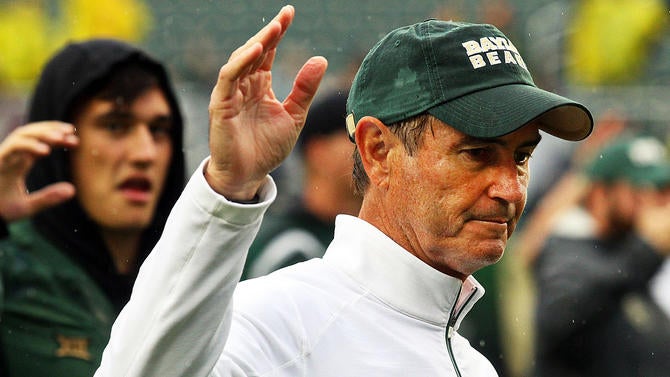
Define serious misconduct any way you want. That's nothing but a detail. It's clear something must be done. Call it the Art Briles Rule.
"I'd rather do that," said one high-ranking source involved with the NLI, "instead of a blanket waiver if a coach leaves."
Never thought we'd be having this conversation, but it's time. The SEC and Pac-12 ban transfers guilty of serious misconduct. It's time coaches are held to the same standard.
Vet recruits in a more stringent manner: The day is coming, soon, when incoming recruits are going to be held to their own higher standard. The Jeffrey Simmons case was the tipping point. Most of us agree that the five-star recruit who punched a woman shouldn't be rewarded with a scholarship. The penalty was even more of a joke: a one-game suspension. http://www.cbssports.com/college-football/news/th...
That possibility can't exist -- anywhere. I saw some arguments that if Simmons was cut loose, some other program would have picked him up. So what? Make a larger statement. That type of conduct isn't tolerated.
If the NCAA doesn't take the lead, conferences and/or the National Association of Collegiate Directors of Athletics should.
By their previous inactions, schools have forfeited the right to vet incoming recruits. There needs to be a central authority, whether it's the NCAA or the leagues themselves.
The language of rules such as these can also be determined later. Let's start with this: Any recruit found guilty of punching a woman cannot be awarded a scholarship.
Remove coaches and athletic directors from the disciplinary process: This has long been a pet peeve. The coach and his athletic director have an inherent conflict of interest in disciplining athletes. Coaches and ADs are hired to win games. The best way to win games is to have the best players on the field. The best players aren't always the best people.
While Baylor provided a worst-case example of that conflict, the culture has existed for a while. Lawrence Phillips was allowed to play again at Nebraska in the mid-1990s. Tom Osborne ultimately admitted it was a mistake to bring back the talented tailback after he had assaulted a woman.
Last year, Nick Saban brought in Jonathan Taylor with what should have been predictable results.
Sorry, but whatever authority coaches and ADs had in player discipline should now and forever be surrendered. School presidents should be making the call on serious disciplinary issues -- or the board of regents, or a student committee made up of an athlete's peers.
If players are truly students first, then this change has to be made. Last time I checked, each school has a student conduct handbook that lays out a disciplinary process for "normal" students. That's the hypocrisy.
We're constantly told athletics are a mere enhancement of the educational experience. We all know, at the highest level, that isn't true. A coach saying they know "what's best" for one of their guys insults our intelligence. Players are attending a university, not a football program. They should subject to the rules and regulations as anyone walking the campus.
Hire a female commissioner: Speculating on a college football commissioner has become low-hanging fruit this offseason. First, it's never going to happen. Never. Do you hear me? Imagine someone telling Nick Saban he can't recruit Jonathan Taylor. No one is going to tell Jim Delaney what to do. And don't even try to picture a leash on Jim Harbaugh.
All that said, this is the wrong discussion. It shouldn't be about a commissioner, it should be about a female commissioner. The sport is owed that at the moment.
Why not? It would send a huge message to an antiquated football culture and strike a blow for gender equity. And don't tell me there aren't enough qualified women. Here are five off the top of my head:
1. Condoleezza Rice, Stanford faculty/College Football Playoff Selection Committee member, former Secretary of State and national security advisor: Condi would be a shining example of why we need a commissioner. There probably isn't a person more qualified. She is steeped in football knowledge and is a huge fan. She has proved her chops on the CFP committee. Her authority would be hard to question given her experience in the Bush administration. You think Rice would have a world view of college football? It was once her job to view the world.
2. Chris Plonsky, Texas women's athletic director: If the haters can get past the fact Plonsky is from Texas, they'd be wise to admit her experience qualifies her because ... she is from Texas. Plonsky oversees part of the nation's largest athletic budget. Her expertise helped establish the Longhorn Network. She has shown little interest in becoming Texas' AD lately but that only makes per more valuable as overseer of all of college football.
3. Amy Perko, Knight Commission executive director: The former NCAA staffer has been an influential leader in college sports. She's now in her 17th year with the Knight Commission, which is basically the conscience of college sports. With its wide-ranging research and reporters, the commission holds the NCAA accountable. Perko's steady hand would make her a perfect college football commissioner.
4. Donna Shalala, former Miami/Wisconsin president, former health and human services secretary in President Bill Clinton's administration: Shalala may be best known in football circles being Miami's president during the Nevin Shapiro scandal. But when the NCAA admitted it had screwed up the investigation, Shalala went on the attack. Sure, she was pictured accepting a check from Shapiro during the scandal. In the end, Shalala owned it all. The administrator nicknamed "Boom Boom" would be a tough, fair leader of the sport.
5. Lynda Tealer, Florida executive associate athletic director: Don't be fooled by Tealer's responsibilities within the department -- lacrosse, softball, women's basketball. Florida's senior women's administrator is one of AD Jeremy Foley's top lieutenants. She is known as a contract guru and was key in the negotiations with Jim McElwain.