Michigan football's Mount Rushmore: How do you limit it to four?
Michigan is one of the most historic college football programs in the country, but who are the four people who really helped make it what it is today?

By
Tom Fornelli
•
4 min read

College football is filled with historic figures, some of whom have become bigger than life as the years have passed. These are the kind of figures who would be carved in stone somewhere in South Dakota as a monument to all they accomplished.
With that in mind, we here at CBS Sports have decided to build Mount Rushmores for some of college football's most historic programs. Today, we look at the people who have helped make Michigan football what it is today.
Now, make no mistake about it, taking all of Michigan's football history and whittling it down to four people was not an easy process. This is a school that played its first game in 1879, and has won 925 games -- more than any other program -- since then. It's won 11 national titles, 42 conference titles, has had 78 consensus All-Americans, and three Heisman Trophy winners.
So, yeah, limiting this to four people was not easy.
That said, while there are numerous candidates, I believe we named four Michigan greats that are hard to argue against, so without further ado, let's get to them.
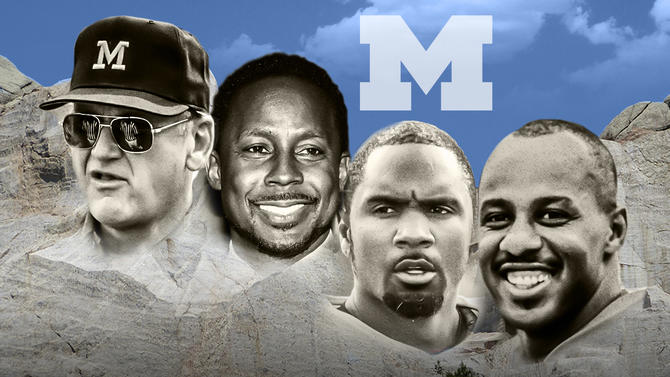
Bo Schembechler, coach, 1969-1989: Bo Schembechler was so accomplished as Michigan's coach for 21 seasons that simply calling him Bo suffices. Everybody will know who you're talking about when you say it.
Bo set the tone the minute he stepped on campus at Michigan. His first training camp in 1969 began with roughly 140 players -- scholarship limits were non-existent -- and by the time the grueling competition was over, only 75 remained. As he told the players at the time, "those who stay will be champions," and he wasn't lying. While Schembechler never won a national title at Michigan, ever single player who played under Bo at Michigan for four years won at least one Big Ten title. Nobody ever experienced a losing season, as the worst year Michigan had in Schembechler's tenure was a 6-6 mark in 1984.
Accolades: College Football Hall of Fame, 194-48-5 record, 13 Big Ten titles, 10 Rose Bowls
Charles Woodson, defensive back, 1995-97: Woodson did not need much time to make an impact at Michigan. He started his third career game with the Wolverines as a freshman and then started the next 34 before leaving for the NFL.
Before moving on, he took the time to become one of, if not, the greatest players in the history of the program. While he was listed as a defensive back, he did far more than that. Woodson also spent time as a punt returner, and he played wide receiver a bit as well. In 1996, as a sophomore, Woodson set a school record with 15 passes defended, but that was just a prelude to his junior season.
In 1997, Woodson helped lead Michigan to its first national title since 1948, and he won the Heisman Trophy (beating some guys names Peyton Manning and Randy Moss) in the process. Woodson remains the only primarily defensive player to win the Heisman, though his impact on special teams and offense certainly played a role in winning the award.
Accolades: Heisman Trophy (1997), 1997 national title, First Team All-American, Walter Camp Award, Bronko Nagurski Award, Chuck Bednarik Award, Jim Thorpe Award
Desmond Howard, wide receiver, 1989-91: Howard remains one of the most iconic players in Michigan football history, even 25 years after he last donned the maize and blue on the field. During his time in Ann Arbor, Howard set or tied 12 Michigan records and five NCAA records. One that still stands today is his 19 touchdown catches during the 1991 season.
Howard, who originally came to Michigan as a tailback, would go on to win the Heisman Trophy during the 1991 season, becoming the second Michigan player to do so and the first since Tom Harmon in 1940. Howard received 85 percent of the first place votes in Heisman balloting, providing him the largest margin of victory at the time, as Florida State's Casey Weldon finished 1,574 points behind Howard.
In 2015, he became the eighth player in program history to have his number (21) retired.
Accolades: Heisman Trophy (1991), College Football Hall of Fame, Walter Camp Award, Maxwell Award, First Team All-American, No. 21 retired by Michigan
Anthony Carter, wide receiver, 1979-82: If you just look at the numbers Carter put up as a wideout, particularly when you compare them to what we see today, they don't seem all that impressive. Carter never caught more than 51 passes,or had 1,000 receiving yards in a single season.
What those numbers alone don't tell you, however, is the offense Carter played in. This was the Schembechler era, when saying that Michigan was a run-first team was an understatement. Running the ball was typically the first three options. From 1980-82, Michigan quarterbacks completed 366 passes with Carter catching 144 of them.
Carter also had an impact on special teams, as he became only the third player in FBS history to total over 1,000 return yards on both kickoffs and punts during his career.
Accolades: College Football Hall of Fame, All-American (three times), Big Ten MVP, fourth place in Heisman Trophy voting
Just missed the cut: Fielding Yost (coach 1901-23, 1925-26), Tom Harmon (tailback 1938-40)