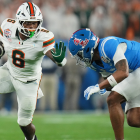
Michigan punter's Australian rules past may have contributed to mishap
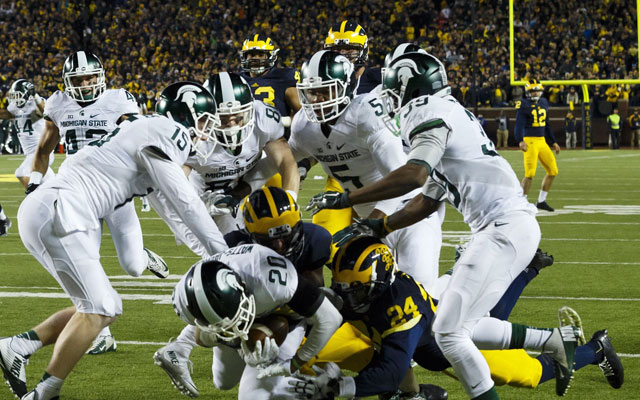
Michigan's game Saturday night was one punter Blake O'Neill will want to forget. He won't be able to any time soon, but luckily he's mature enough to handle any criticism headed his way.

By
Jon Solomon
•
5 min read

“In a sense, it was quite an innate reaction to still kind of kick it,” Chapman said. “Yeah, he probably should have jumped on it, but jumping on the ball is not what we do here. We pick it up and we move it forward by hand or foot. If the ball is on the ground and two teammates jump on you (in Australian rules football), it can be called holding the ball -- I get penalized and you receive the ball because I didn’t attempt to get the ball out and continue the game on.”
Weber State coach Jay Hill, who signed O’Neill from Australia, thought the same thing when he saw the Michigan-Michigan State ending.
“If you watch Australian rules football, those guys are used to kicking with people draped over them in traffic,” Hill said. “My guess is his natural instincts took over and he thought he could get the kick off. They do that 20 times a game with something similar and it just didn’t go his way this time.”
Hill learned about O’Neill from film Chapman sent of a couple of his players. O’Neill worked with Chapman at the same kicking Australian academy as last year’s Ray Guy Award winner, Tom Hackett, whom Hill signed to Utah before becoming Weber State's coach. A wave of punters and kickers have come to college football via Australia in recent years.
O’Neill had never punted in an American football game until Weber State’s 2014 opener against Arizona State. Chapman likened the debut to learning baseball for the first time and 12 months later having to play against the New York Yankees. “The guys were going down like bowling pins and putting him on the ground,” Chapman recalled. “It was a baptism of fire of sorts and then he settled in pretty quickly the rest of the year.”
O’Neill averaged a school-record 44.1 yards per punt for Weber State in 2014, ranking sixth nationally in the Football Championship Subdivision. O’Neill had one year of eligibility, and Hill assumed he would return for his final season.
“I thought he was an All-American for us,” Hill said. “I coached Tom Hackett and I thought Blake was the same caliber kid. He would have been a big-time weapon for us.”
Instead, O’Neill became one of the least-publicized graduate transfers this offseason as the rule continues to draw some national criticism from college coaches and administrators. The NCAA allows players who have graduated to transfer and play immediately at another school. In Hill's case, he arrived at Weber State already wtih a degree from Australia and took graduate school classes. According to Hill, O’Neill came to him after last season and explained he would be transferring because Weber State didn’t have the graduate program he desired. O’Neill gave Hill a list of five schools he wanted to attend: Michigan, USC, Florida, Texas and Oregon.
“I said, ‘Blake, you’ve got to be kidding me. Why do you think one of these schools will take a one-year punter?’” Hill recalled. “I said, ‘Honestly, I think your shot is slim to none.’ He was pursuing these schools and had no takers.”
Hill said that changed when Michigan hired a friend of his, John Baxter, as special teams coordinator. Hill said he encouraged Baxter to take a hard look at O’Neill because he wouldn't be returning to Weber State but was good enough to play at a higher level.
Aside from the last-second mistake Saturday, O’Neill has been a solid punter. He ranks 65th in the FBS at 41.1 yards per punt and his 80-yard punt against Michigan State was the second-longest in Wolverines history.
Chapman said O’Neill told him he did not realize until later that Michigan State's Watts-Jackson was seriously injured on Saturday's touchdown return. Watts-Jackson, the other piece of this remarkable play, underwent surgery Sunday for a dislocated hip. “(O’Neill) felt for the guy,” Chapman said.
After the loss to Michigan State, some Michigan fans sent hateful remarks to O’Neill’s Twitter account, including death threats and suicide suggestions. Far more Michigan fans offered support, and Wolverines athletic director Jim Hackett wrote an open letter to the fan base admonishing those who sent hateful comments.
O’Neill is “mentally strong and understands that comes with being a -- I’m going to use the term ‘professional athlete,’ because that’s what they are. They’re professional athletes,” Chapman said. “That’s the field they play on. He’s strong enough to not let it affect him. I spoke to him about it to make sure he’s OK. Here in Australia, we brush it off and as, ‘You’ll be all right, mate,’ but you always want to ask the question because if it rocks you, you need to talk about it. The message to him is you just step up to the plate and you make amends as best you can and you’re ready to go mentally.”
Chapman said his conversation with O’Neill included jokes -- “I hope this part is taken the right way” -- because that’s how Australians deal with tough situations.
“It was sort of, ‘Hey, good on you, mate, you got everyone talking about you,’” Chapman said, laughing. “We can only make a bit of a joke out of it. Although it occurred in the difference between a win and a loss, that’s the disappointing part. But from my point of view to him, the event is such a small part in your career, you can’t let it hold you to what you’re doing. It was an event, but we can sort of laugh and joke about it because that’s the best way to deal with it and move on and take the pity out of him.”
Follow and read more from Jon Solomon on Facebook and Twitter.