Ohio State football's Mount Rushmore: Running backs rule for the Buckeyes
In Columbus, things begin and end with the legendary coach and three Hall of Fame rushers

By
Dennis Dodd
•
3 min read

To walk through an Ohio State tailgate, you have to squint.
Is this 1975 or 2015? Same tailgates, same adult-beverage enthusiasm, same scarlet, same gray. Not much changes around a stadium that was built in 1922 and has seen seven Heisman Trophy winners, seven national championships, an Urban and Woody.
Ohio Stadium is one of the ancestral homes of college football. Here are its four most famous inhabitants.
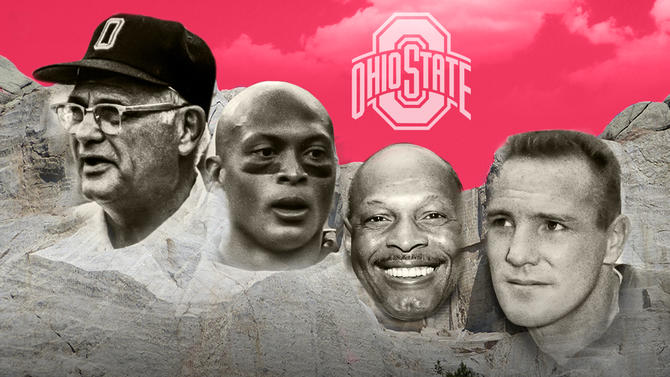
Woody Hayes, coach (1951-1978): Thanks to the internet, Hayes will be best known to millions for punching Clemson linebacker Charlie Bauman.
Yes, the cheap shot was terrible, heartless, childish and as accurate a portrayal of Wayne Woodrow Hayes as there is.
The man was a bully, profane, loud and hard on those around him. He also branded Ohio State. Not just the football program, but the school and probably the state.
"I will pound you and pound you until you quit," he once said.
Ohio State opponents felt that philosophy each game. From 1951-78, Woody won 205 games, 13 Big Ten titles and five national championships. He produced the only two-time Heisman winner Archie Griffin. Typically, Griffin was a bruising running back.
Hayes may be most famous for his 10-Year War against Michigan's Bo Schembechler. The two stubborn, brilliant coaches went head-to-head from 1969-78. Woody won out over his former Miami (Ohio) assistant 5-4-1.
That one tie (1973) was actually a win. Ohio State was selected to play in the Rose Bowl over Michigan that year by the Big Ten athletic directors.
Bo would never forget.
Hayes once said he wanted to die at the 50-yard line of Ohio Stadium. The end actually came quietly in 1987. Woody died in his sleep of a heart attack.
His legend will live forever at Ohio State.
Accolades: Five-time National Champion (1954, 1957, 1961, 1968, 1970), 13 Big Ten titles, Walter Camp Coach of the Year (1968), College Football Hall of Fame (1983), No. 40 jersey retired.
Howard "Hopalong" Cassady, Halfback (1952-1955): There may be some controversy among millennials here. They probably don't know Hopalong Cassady from David Cassidy. They might argue for more current hall of famers Orlando Pace or Chris Spielman.
But how do you deny a guy who scored three touchdowns in his first college game? How do you ignore a two-time All-American and Heisman winner who was part of a national championship?
You don't. Cassady was a Columbus native who Woody Hayes once said was "too quick" to hit the hole. In 1955, Cassady ran for 948 yards in winning the Heisman, becoming the Associated Press Male Athlete of the Year.
He spent 30 years as a coach in the Yankees system.
Accolades: 1955 Heisman Trophy winner, 1955 AP Male Athlete of the Year, Two-time Unanimous All-American, 1954 National Championship, 1979 College Football Hall of Fame
Eddie George, Halfback (1992-1995): Off the field, a quiet unassuming guy. On the field, a quick, elusive physical back.
George had all the physicality of Archie Griffin with the speed of Ezekiel Elliott. Did we mention durable? George still remains the Buckeyes' single-season rushing leader with 1,927 yards in 1995, which led to a Heisman Trophy.
Off the field, George is making them forget about football. Who knew he could play Billy Flynn in "Chicago" on Broadway?
George was the perfect fit for John Cooper's I-formation offense. In nine NFL seasons, he ran for more than 10,000 yards before becoming a song and dance man.
Accolades: 1995 Heisman Trophy Winner, Walter Camp Award, Maxwell Award, Doak Walker Award, No. 27 jersey retired, 2011 College Football Hall of Fame
Archie Griffin, halfback (1972-1975): It's hard to believe such a kind man could be so punishing. Actually, there couldn't be a better president of the Ohio State Alumni Association.
People flock to his welcoming personality, the same way tacklers fell off him. Griffin was Ohio State's best back at the height of Woody Hayes' power.
The first player ever to start in four Rose Bowls set the then-school record with 239 yards against North Carolina in the second game of the 1972 season.
Griffin's signature physical style produced back-to-back Heismans in 1974 and 1975. In an age when running backs ruled the world, Griffin accounted for 31 percent of Ohio State's yards in those two seasons (1,695 yards in 1974 and 1,450 yards in 1975).
We should also mention he's one of the most humble Heisman winners ever. And perhaps the only two-time winner forever.
Accolades: Two-time Heisman Trophy winner, Maxwell Award, 1986 College Football Hall of Fame, No. 45 jersey retired.
Just missed the cut: Orlando Pace (1993-1996), Keith Byars (1982-1985), Troy Smith (2003-2006).