Pac-12 falls behind SEC in money even with commissioner at $4 million in salary
Pac-12 commissioner Larry Scott makes a pretty penny out west

By
Jon Solomon
•
3 min read
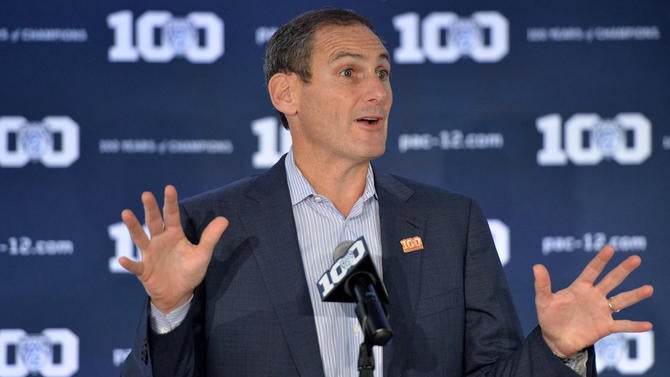
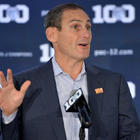
Pac-12 commissioner Larry Scott became college sports' first $4 million commissioner, even as his conference fell behind the SEC financially during 2014-15.
The Pac-12 distributed an average of $25.1 million to each school in 2014-15, about $7.6 million less than the SEC paid to its members, according to tax records released Wednesday to CBS Sports. The payout reflects more evidence of the financial gap the SEC and Big Ten have created with other Power Five schools.
Scott was credited with nearly $4.05 million in total compensation for 2014-15, about $600,000 more than a year earlier. That might have made him the highest-paid commissioner again, depending on what other conference tax returns show.
Mike Slive made $3.6 million in his final year as SEC commissioner. Big 12 commissioner Bob Bowlsby received $2.6 million last year and still owed $400,000 from a $500,000 loan provided by the Big 12 for his residence. Tax returns for the ACC and Big Ten have not been released yet.
In the Pac-12's latest tax return, Scott had a base salary of $2.55 million, received a $1.25 million bonus, and got $142,459 in other reportable compensation, $77,500 in retirement and deferred compensation, and $30,950 in nontaxable benefits. Scott continues to have an outstanding relocation loan of $1,861,842 from when he was hired.
Scott was the first $3 million commissioner several years ago. He was credited with $3.5 million, $3.3 million and $3.1 million during the previous three years. Scott is also executive chairman of Pac-12 Enterprises.
The Pac-12 generated a conference-record $439 million in revenue, up 17 percent from a year earlier. But the Pac-12 money got significantly jumped by the SEC, which generated $527.4 million revenue in the first year of the SEC Network and College Football Playoff, and the Pac-12 likely remained behind the Big Ten.
In 2013-14, the Pac-12's average payout ($21.2 million) was higher than the SEC ($20.9 million) and trailed the Big Ten ($27.6 million). One year later, the SEC provided far more money to its schools than the Pac-12, which still had a higher 2014-15 payout than the Big 12 ($23.3 million) when not factoring third-tier media rights for individual Big 12 schools.
Unlike the SEC and Big Ten channels, the Pac-12 owns 100 percent of its television networks, meaning higher costs and greater risks without shared ownership from a media outlet. The Pac-12 Networks has been unable to secure distribution with DirecTV and hasn't paid out as some expected.
In March, Washington State athletic director Bill Moos revealed in a letter to boosters that the school's revenue distribution from the Pac-12 Networks was $1.4 million, much less than the $5 or $6 million that was expected. The SEC and Big Ten channels, aided by larger and more rabid fan bases and a media rights partner, distribute much more money than the Pac-12 Networks.
The Pac-12 tax return listed the league with $116.6 million in total income from the Pac-12 Networks in 2014-15, up 8 percent from a year earlier. Pac-12 Properties, LLC, which controls intellectual property rights, licensing and sponsorship sales for the conference, produced $11.7 million (up 23 percent from a year earlier).
With additional television costs, the Pac-12 distributed 69 percent of its revenue back to members, up from 67 percent a year ago. The other Power Five conferences tend to be in the range of 80 to 95 percent.
The Pac-12's revenue sources include $298.6 million from television rights fees and $80.1 million from postseason bowls. The conference spent $435.1 million in total expenses to finish 2014-15 with a surplus of nearly $4 million. Net assets were listed at minus-$3.3 million, an improvement from minus-$7.2 million in 2013-14.
The Pac-12 spent $15 million on independent contractors, including $4.5 million on construction costs for its new San Francisco office and $2.5 million on legal fees with Proskauser Rose LLP. In addition to Scott, the tax return showed eight other current and past Pac-12 executives with more than $300,000 in total compensation from July 1, 2014 to June 30, 2015:
- Lydia Murphy Stephens, president of Pac-12 Networks: $1,247,223. She exceeded $1 million for the first time after making $975,000 for 2013-14.
- Ronald McQuate, chief financial officer: $461,790
- Arturo Marquez, senior vice president of affiliate sales: $597,918
- Neil Davis, executive vice president of sales: $568,493
- Brent Willman, senior vice president of finance: $514,526
- Danette Leighton, chief marketing officer: $501,654
- Jonathan Leess, executive vice president of operations: $478,798
- Kevin Weiberg, former deputy commissioner: $340,548. Weiberg stepped down at the end of the 2013-14 school year and made $646,396 a year ago.