SEC is playing with fire as West Division keeps dominating East
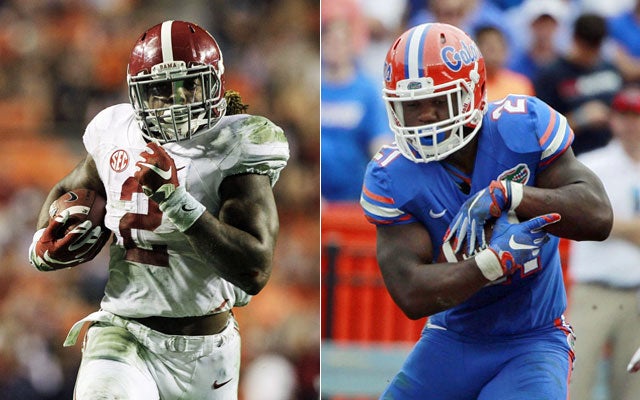
The SEC West has dominated its East counterparts since the departure of Urban Meyer from Florida. Can the Gators (or another East team) halt this momentum and save a conference slowly losing its competitiveness?

By
Jon Solomon
•
6 min read

When we last saw Alabama play Florida in the SEC Championship Game, everything was at stake. The SEC’s major powers produced back-to-back championship games in 2008 and 2009 that served as de facto national semifinals in the pre-College Football Playoff era. The winner advanced to the BCS Championship Game and the loser settled for the Sugar Bowl.
Everyone had to watch. The Alabama-Florida rematch in 2009 drew an 11.1 TV rating, which remains a record for an SEC Championship Game. Those seasons represented a very rare occurrence: Two teams with legendary coaches in their prime (Nick Saban and Urban Meyer) staging two straight winner-take-all conference championship games with national implications.
After Alabama demolished Florida in 2009, the pendulum within the conference swung dramatically from the East to the West ... and it has yet to bounce back. The result plays out this week.
While the Big Ten gets a CFP “quarterfinal” game between Iowa and Michigan State and the ACC and Pac-12 stage potentially compelling games, Alabama is an 18-point favorite over Florida. It’s the second-largest betting line in SEC Championship Game history, behind only 24-point favorite Florida defeating Arkansas 34-3 in 1995.
The seven-year imbalance between the East and West hasn't significantly hurt the SEC in the postseason. If Alabama wins Saturday as expected, the SEC will be in the BCS Championship Game or the CFP for the 10th consecutive year.
But one day the disparity could damage the SEC, particularly in a year when as a whole the entire conference is down, such as this year. If Arkansas had not converted a miracle 4th-and-25 lateral play against Ole Miss, the Rebels would have two losses and be in Atlanta this week facing the two-loss Gators, leaving the SEC in serious danger of getting shut out of the playoff.
Alabama is in the playoff if it wins. But there could be a day when a one-loss West champion may need a quality win against the East to state its last case to the playoff committee. Of course, it’s still possible (although unlikely) the Gators defeat the Tide on Saturday and knock the SEC out of the playoff with a stunning upset.
Off the field, the SEC remains wildly popular and very wealthy through television agreements, including CBS. Still, this is a rare season in which the three highest-rated college football games so far belong to the Big Ten -- all involving defending national champion Ohio State -- and not the SEC. When it’s Alabama vs. everyone else on the road to Atlanta, it’s harder to attract as many eyeballs.
The divide between divisions can be traced back to 2009. After Alabama dominated Florida, Meyer briefly resigned but then returned, only to then depart a year later for good. Meyer was gone so soon after his mini-dynasty ended. Saban continues to consistently win at Alabama. The East, which already includes some of the SEC’s weakest teams, has no alpha dog to chase like the West faces to keep up with Saban.
Alabama could become the first repeat SEC champion since Tennessee in 1997-98. Repeat championships are always an impressive feat, as it would be for Alabama. But consider the state of the East right now. The East has lost six straight times in the SEC Championship Game by an average of 23.3 points. At that rate, it’s only a matter of time before the West produces a repeat SEC champ.
Conference and division superiority tends to go in cycles in college football. The SEC divide, though, is lasting longer than usual. If Alabama wins Saturday, the West will have seven straight SEC titles and tie for the longest streak by any college football division in conference championship games. The Big 12 South won seven straight conference title games from 2004 to 2010 with Oklahoma and Texas by an average of 26.6 points.
Once upon a time, the East ruled the SEC, winning six straight titles with Florida and Tennessee from 1993-98. Yet even in those years, the East’s record against the West was only 57-56-2. Since 2009, the West is 81-35 vs. the East. This year, the West is 12-2 against the East.
To put it another way: When the SEC’s 20-year run of two, six-team divisions ended in 2011, the West had won 53 percent of the games against the East. That reflects relatively balanced divisions. Since 2009, the West has won 70 percent against the East. That’s a problem, even though there are now fewer games between the East and West.
Before the SEC added Missouri to join Texas A&M as new members for 2012, divisional alignment was a major sticking point. Some schools, including Auburn, were willing to shift Auburn to the East and put Missouri in the West for geographical purposes.
Alabama would only support Missouri in the SEC if the Tigers joined the East. The reasoning: Alabama wanted to keep its annual cross-divisional rivalry game against Tennessee instead of having to protect the Iron Bowl as an opposite-division game. Alabama was also concerned that Auburn could move to the East and grow its recruiting presence in talent-rich Florida and Georgia.
Missouri in the East allowed the SEC to keep its six traditional football powers divided equally -- Alabama, Auburn and LSU in the West; Florida, Georgia and Tennessee in the East. Those six have won every SEC championship since 1976. The decision also meant that four of the five worst teams based on all-time win percentage would be in the East.
For several years, the SEC debated how to schedule, deciding to keep eight games instead of going to nine. At one point, there was even an idea floated to schedule in part based on the previous year’s standings, the model used in the NFL. That didn’t gain much traction.
The SEC East has never looked as bad as it does in 2015. While the SEC West ranks as college football’s best division based on advanced statistics by Bill Connelly, the East is by far the worst among the Power Five conferences. According to Connelly's ratings, the SEC East is closer to both divisions in the American Athletic Conference and Mid-American Conference and one division each in the Mountain West and Conference USA than the SEC East is to the SEC West.
East champion Florida needed overtime to defeat Florida Atlantic, which finished 3-9. Georgia went to overtime to beat eight-win Georgia Southern. Kentucky barely beat Eastern Kentucky, a 6-5 Ohio Valley Conference team, in overtime. South Carolina lost to The Citadel, a nine-win FCS team, before a good showing in a loss to No. 1 Clemson. Vanderbilt lost to Conference USA East champion Western Kentucky and American West champion Houston. Two-time defending SEC East champion Missouri went 1-7 in the league and failed to score a touchdown in five of its 12 games.
Georgia, Missouri and South Carolina are all making critical coaching hires this offseason that will significantly shape the future of the East. Tennessee’s Butch Jones (10-14 SEC record) and Kentucky’s Mark Stoops (4-20 SEC record) are now the longest-tenured East coaches at three years.
Maybe Jim McElwain will rebuild Florida into a power after his surprisingly successful first season. Maybe Kirby Smart will lead the Bulldogs to a new level and better take advantage of the home crowd at the SEC Championship Game. Maybe the end of the Saban era, whenever that comes, will swing the balance back to the East.
For now though, Alabama-Florida is not your older brother’s Alabama-Florida. It’s looking like another trophy celebration for the West and the latest barometer for the East on how far it has to climb.
Follow and read more from Jon Solomon on Facebook and Twitter.