Seven things we learned after one month of college football: Don't sleep on Peppers
These are the trends to watch as the 2016 season enters its second month

By
Jon Solomon
•
6 min read

One month of the 2016 college football season is complete and trends have emerged. We all remember past September prediction that look silly in December. (Hello, September Heisman Trophy winner Geno Smith.)
Still, four weeks is enough time to take a look at happening so far and figure out how the 2016 season may play out. One factor to consider: Some of the more high-profile nonconference games occurred earlier in 2016 than past seasons, so that could impact statistics.
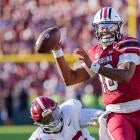
1. Louisville's offense is on a record pace: Bobby Petrino coaching Lamar Jackson is the offense he always wanted in the NFL with Michael Vick. Louisville is averaging 63.5 points, 682 total yards and 9.03 yards per play, all which are on pace to break Football Bowl Subdivision records. The records: Army averaged 56.0 points in 1944, Houston gained 624.9 yards per game in 1989, and Hawaii averaged 8.58 yards per play in 2006.
Jackson has accounted for 25 touchdowns. Michigan is the only team with more touchdowns than Louisville's quarterback in 2016. Jackson is on pace for 75 passing/rushing touchdowns in the regular season, which would shatter the FBS record of 55 set by Florida quarterback Tim Tebow in 2007.
Jackson and Louisville will come back to Earth at least some. So far, the highest-ranked scoring defense the Cardinals have played is 106th-ranked Syracuse. Top-five scoring defenses Clemson and Houston still remain. But no one won September more than Petrino and Jackson.
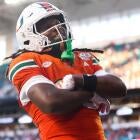
2. Jabrill Peppers had a special first month: While Jackson dominates the headlines, Michigan's do-everything star Jabrill Peppers enjoyed his own exceptional month. Peppers ranks second nationally in tackles for loss (2.4 per game) and third in punt returns (22.7 yards per return, one touchdown). Since the NCAA started tracking tackles for loss in 2000, no player has led the nation in tackles for loss and punt returns. Those are stats that typically don't belong to the same player.
The closest resemblance to Peppers' jack-of-all-trades start to 2016 may be LSU's Tyrann Mathieu in 2011. Mathieu finished fifth in punt returns and fourth in forced fumbles. A hybrid safety/linebacker, Peppers accumulates 8.3 tackles per game. He has made 48 percent of his tackles at or behind the line of scrimmage, according to CFB Film Room.
Oh, by the way: Peppers has two carries for 24 yards while being used some on offense as a decoy. Not many people are mentioning him in the way-too-early Heisman Trophy conversation. That may soon change.
3. Defenses may be catching up to running games: Don't misunderstand. Teams are still scoring. FBS scoring in September (31.9 points per game) was up less than 1 percent from last September. The FBS set a scoring record with 29.7 points in 2015 and it's on pace to do so again.
But check out some other September 2016 stats. The yards per play (5.9) stat was slightly down compared to September 2015 and yards per carry (4.58) declined 2 percent. Passing yards per attempt (7.56) are slightly up again for the second straight September after those numbers had been declining.
Yards per carry increased 14 percent over the past decade. That may not sound like much, but this stat increased just 1 percent from 1996-2006 and 4 percent from 1986-96. It dropped 2 percent from 1976-86. You have to go back to the 1960s-70s -- when the wishbone was at its peak -- to find a 10-year period with increased rushing yards like the past decade. So any decline, even one just one-third of the way through the season, is worth watching as run-pass options (RPOs) dominate college football.
4. Offenses can only go so fast: The plays per game stat is plateauing.There comes a point when offenses can only move so quickly. It looks like we're there. FBS teams averaged 72.2 plays per game in September, nearly identical from the first month of 2013 (71.9). Ever since plays per game spiked in 2012, they've hovered in the range of 71.5-72 per game.
Twenty-one teams are averaging 80 plays or more per game this season -- the exact same number of teams with 80+ plays in September 2013. California leads the country in 2016 with 92 plays per game, up 16 plays from 2015. Other big jumps this year: Missouri (up 19 plays per game), UCF (up 16), Texas (up 15), Ohio (up 14), Auburn (up 11) and Houston (up nine).
Tempo isn't everything, though. No. 7 Stanford and No. 10 Washington meet Friday in a Pac-12 game that resembles old-school, grind-it-out football. Stanford runs 58.7 plays per game (only Georgia State runs fewer in the FBS), and Washington has just 62.8 plays per game.
5. Quarterbacks are shining in the ACC, struggling in the SEC: We told you about the elite ACC quarterbacks this year, and it's playing out. Five of the top 16 players in quarterback rating by CFBStats.com are from the ACC: Jerod Evans (Virginia Tech), Mitch Trubisky (North Carolina), Jackson (Louisville), Ryan Finley (NC State) and Brad Kaaya (Miami). No other Power Five conference has more than two in the top 16. The MAC has three.
Even with the early-season struggles of Clemson's Deshaun Watson -- and Florida State's Deondre Francois not among the stat leaders -- the ACC is showing its depth. Still, the Big 12 leads the country in the NCAA pass efficiency rating (150.45), and the Pac-12 leads in completion percentage (65.1).
The SEC is last among the Power Five in pass efficiency rating (136.8) and completion percentage (58.9). Five SEC teams are 100th or worst in yards per throw (Mississippi State, Georgia, South Carolina, LSU and Vanderbilt). Six SEC teams are 90th or worse in completion percentage (Tennessee, LSU, Georgia, Vanderbilt, South Carolina, Texas A&M). SEC scoring in September 2016 was down 21 percent compared to September 2014.
6. Games are getting longer: The average game in September lasted 3 hours, 25 minutes, up from 3:20 for the first four weeks of 2015. The final average last year was 3:17.This year's games are on pace to be the longest since the NCAA began tracking the stat in 2008, when games took 14 fewer minutes to play.
More plays, scoring, replay reviews and commercial breaks can factor into longer games. Several long weather delays contributed to this September's increase. Many people are fine with longer games. Some wonder what kind of burden longer games might place on fans, players and TV networks with overlapping timeslots.
Before the season, an NCAA survey found 72 percent of coaches think the current game lengths are appropriate. Only 51 percent of conference commissioners agreed. There was no consensus among coaches, commissioners, officials and officiating coordinators about switching to a running clock after first downs. What if the clock didn't stop for a first down except in the last two minutes of the half? Ninety-two percent of the surveyed members support the idea while 71 percent of coaches oppose it.
7. The SEC is overturning more calls with collaborative replay: This is the first season the NCAA is letting conferences experiment with off-site replay officials helping on reviews. The SEC's results are fascinating: 43 percent of reviews in the opening month got overturned. From 2005-15, the SEC overturned 33 percent of on-field calls. The SEC's single-season overturn rate has never been higher than 38 percent.
Now, the increase doesn't automatically mean all of the calls are correct. Replay is still a judgment decision no matter who looks at a play. But having a conference's best-trained eyes weigh in on all of the games can only be a positive. Play stoppages in the SEC are up from 2.0 per game in 2015 to 2.4 this season. The SEC's average review length in Week 1 was 1 minute, 44 seconds -- considerably higher than 1:22 for all of 2015 -- but the duration dropped to as low as 1:17 in Week 3.
The SEC deserves credit for appropriately handling the crazy Auburn-LSU finish, which turned out to cost Les Miles his job. The officials stayed on the field and replay overturned a clear mistake that decided the game's outcome. Big 12 replay officials could learn a less from the SEC after not knowing the rules for the end of the Oklahoma State-Central Michigan game that cost the Cowboys a victory.
Collaborative replay is one trend I can almost guarantee will continue with more conferences in the future. Every other trend? That's why they still play the other two-thirds of the season.