
Underclassmen make difficult decisions on applying for NFL Draft
In many cases, college underclassmen pondering whether to declare for the NFL Draft are being sold a bill of goods.

By
Dennis Dodd
•
6 min read
History tells us that Thursday will breed a new generation of future insurance salesmen.
Along with some future NFL pros.
Thursday's NFL Draft declaration deadline for underclassmen continues to be part crap-shoot, part congratulations.
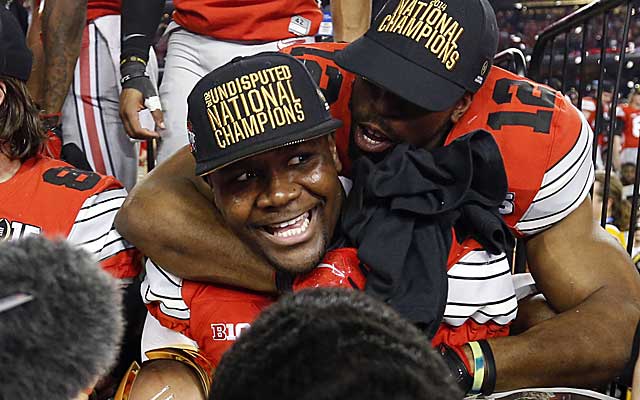
Do we need any better example than Cardale Jones? It's hard to discern what was more remarkable -- that Ohio State's redshirt sophomore third-string quarterback was considering entering the draft or that NFL teams were likely willing to take him.
Based on all of three career starts.
Jones announced Thursday he would return for his redshirt junior season.
"Cardale's brand right now has never been stronger," Urban Meyer told reporters Tuesday. "It might never be stronger again in his life."
Last May, a record 37 percent of the record 98 underclassmen went undrafted (36 total). For the fourth consecutive year a record number of underclassmen came out. That number accounted for approximately 10 percent of all the underclassmen who went undrafted in the 25 years since underclassmen were allowed into the draft.
For local State Farm offices, that meant a bigger talent pool. For the undrafted, crushed dreams.
As of Wednesday afternoon, the conga line to the draft had thinned. Only 75 underclassmen had declared. The number of draft evaluation requests had dropped 42 percent, according to NFL.com.
Part of that has to do with a new NFL limit of five players per school able to submit paperwork requesting an evaluation (exceptions are made in certain cases).
That doesn't mean it's easier to make the right decision.
In December, an agent called it "a completely broken system."
Start with a monumental decision by Jones. He's older than Johnny Manziel and actually four years out of high school. Jones attended a prep school for a year before redshirting at Ohio State.
Two sources close to the NFL process put his draft ceiling at fourth round.
"Developmental project," one source said. "Should go back and clean up all the details so OSU coaches can advocate his maturity and leadership."
Given the thin quarterback pool, NFLDraftScout.com's Rob Rang said Jones could be a top four quarterback -- possibly taken as high as the second round.
"The talent is undeniable," he said. "The need [for NFL quarterbacks] is undeniable."
The fact that Jones may not be ready matters less than the fact that a random NFL team would take him as is. Jones has a 2-month-old child (Hillary), a rocket arm and loads of potential to consider.
Perhaps most important entering the draft, Jones would have a head start to that second contract.
The now 4-year-old rookie salary cap makes the chase for that second deal more urgent. Rookie contracts are set at four years. First-round deals contain an option for a fifth year. Free agents sign three-year deals.
There is no limit to the second contract, so it's easy to understand an agent's rap: The sooner the better.
"That's what agents are telling them," Washington State coach Mike Leach said. "If you don't get your first contract, you're not going to get the second contract. I think, long story short, once people make up their mind one excuse is as good as the next."
If he waited a year, Jones would reach the NFL in 2016.
Figure in some seasoning, he might have to wait until his mid-20s to become a starter. All of it delays the journey to that second contract.
Leach recently called Gil Brandt trying to talk some sense into a defensive lineman considering coming out early. Leach wouldn't identify the player but the only Washington State underclassman on the list is defensive tackle Xavier Cooper.
"I couldn't get hold of him," Brandt said. "I don't know if he dodged my call or what. The guy is probably a sixth-round choice."
Brandt is the sage former pro personnel guy for the Dallas Cowboys and draft guru.
"No, they won't learn," he said when about the exodus of underclassmen.
"Let me tell you why: If I'm a [college] coach, there's only one of me and [multiple] players. If I spend an hour a week with each one of them, that's 40-plus hours. The agent has two or three players. He can spend three or four hours a week with them."
Oklahoma coach Bob Stoops and his peers have long said they have no problem with underclassmen leaving if family or financial circumstances dictate. It's the bad advice that frustrates them.
In the eyes of Oregon associate athletic director Jeff Hawkins, the definition of "runner" now includes those who pitch financial planning and injury/loss of draft value insurance.
"Quite honestly, there are too many creatures out there," Hawkins said. "Without naming a name, I had one guy who did [an insurance] policy. He told my player, 'You're going to be picked 26th in the first round.' How could he know that? That's why they're salesmen."
The process was streamlined in July when Nick Saban referenced previously unreported NFL Draft evaluation changes. Instead of five categories, underclassmen were categorized by NFL Draft evaluators in three categories: first round, second round or neither. That last category is an intimation from the league that the prospect should stay in school.
"The thing I was afraid of is, if they got the third grade that says 'stay in school' they were going to think, 'I'm a third rounder,'" said Hawkins, a dogged agent reformer.
"I don't think it's panned out that way."
A quarter of those undrafted (nine) last year were from the SEC. Hardest hit this year are Florida State (five underclassmen) and Florida (four). Southern California will have lost a combined eight underclassmen the past two drafts (three this year).
NFL.com reported that the number underclass draft evaluation requests dropped from 214 to 147.
Once again reported by NFL.com, the NFL Draft evaluation board hit on 74 percent of its first-round grades from 2012-14.
The industry freaked last season when underclassmen flooded the market. Almost 53 percent of those getting grades in the third round or lower didn't get drafted.
Twenty-six years ago, the NFL began accepting prospects at least three years out of high school.
The top choices don't have to worry. It hardly matters that Oregon's Marcus Mariota missed the deadline for filing NFL evaluation paperwork. He is considered by CBSSports.com to be the No. 1 prospect in the draft after declaring on Wednesday.
"You can't look at one year's worth of numbers and have a trend," said Jimmy Sexton, possibly the most powerful agent in college football. "The real problem is everybody has different interests in the game.
"The coaches want players to stay. A lot of agents want them to leave. It's really hard for these families to sift through and figure out what's good and what's not."
Hawkins is an aggressive player advocate. He has worked personally for years on the Oregon agent law that took effect Jan. 1, 2013. This addendum to the Standard Representation Agreement (SRA) makes clear what a prospect could negotiate.
• Bridge health insurance (NFL insurance doesn't kick until a player makes the team.)
• Training costs.
• A monthly stipend.
• Meals and housing.
Hawkins had envelopes ready for draft-eligible players immediately after Monday's championship game. In it were three copies of the addendum to be sent out to agents. The intention, he said, is for the player to say, "You made promises during the interview process. Let's put it in writing."
With his head spinning, Caradale Jones decided to delay that decision for another year.
>> Who's going to the draft? Full list of early entries