Why 2015 was the highest-scoring season in college football history
Who says defense wins championships? The 2015 season was the highest-scoring college football campaign on record. Here's why.

By
Dennis Dodd
•
7 min read

Who says defense wins championships?
While you were watching (from the stands), sleeping (during another late-night Pac-12 game) or actually crunching the numbers, the most notable college football record of the modern era was set. Again.
The national scoring average increased to a record 29.65 points per team in 2015, according to official numbers compiled by the NCAA for CBS Sports. This is the fifth time since 2000 the scoring record has been set, and it shatters the previous record of 29.5 points set in 2012.
More indicators the offensive revolution continues to thrive in college football.
It doesn’t seem to matter whether it’s a pro-style, spread or option scheme, offenses can’t be stopped. Not even Nick Saban -- with seven top five defenses since 2008 -- has escaped the storming of the gates. The two worst defensive performances (yards gained by an opponent) in school history have occurred under Saban.
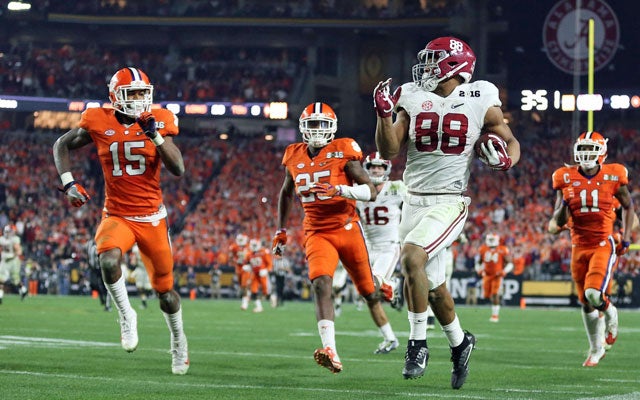
The highest-scoring national championship game in FBS history (Alabama 45, Clemson 40) should have been an indicator to this statistical milestone.
| Per team scoring since 2000 | ||
| Season | Points Per Team | |
| 2000 | 26.2* | |
| 2001 | 27.2* | |
| 2002 | 27.3* | |
| 2003 | 26.9 | |
| 2004 | 26.6 | |
| 2005 | 26.8 | |
| 2006 | 24.4 | |
| 2007 | 28.4* | |
| 2008 | 27.2 | |
| 2009 | 27.0 | |
| 2010 | 28.0 | |
| 2011 | 28.3 | |
| 2012 | 29.5* | |
| 2013 | 29.4 | |
| 2014 | 29.3 | |
| 2015 | 29.65*^ | |
| * National record ^ NCAA provided average to the hundredths place. |
||
Not surprisingly, that 2000-15 time period basically coincides with the rise of the spread offense as a series of games, innovations and schemes have been bred to torment defenses.
That previous scoring record in 2012 was not only broken but shattered. The three-tenths of a point increase per game is the biggest one-year increase in the record since 2001.
All-time highs were also set in yards per rush (4.51), total offense (411.56 yards), yards per pass (7.30) and yards per play (5.76). Average rushing yards (178.33) were the highest since 1980.
Not surprisingly, the Big 12 led the charge averaging 35.19 points per team in 2015. That was up almost three points per game from 2014. The Pac-12 led the country in 2014 (33.4 points) but slumped to 32.89 in 2015.
Biggest gainer: The American Athletic Conference with more than a 20 percent increase in scoring (to 30.07 in 2015). Biggest decline: The SEC was down more than three points per team (to 28.39 points).
For the second consecutive year, Baylor (No. 1 overall), TCU, Western Kentucky and Oregon finished in the top 10 in scoring. Stanford was the highest-scoring non-spread team at No. 18 averaging 37.8 points.
With the revolution in full effect and records falling annually, we thought we’d highlight five turning points in the rise of offensive football since 2000.
Texas-USC: At 9:25 p.m. PT on Jan. 4, 2006, Texas won its first national championship game in 35 years. In that sense, the revolution was televised. Quarterback Vince Young was a football LeBron James -- strong, talented, a born scorer. He won a game that featured more than 60 future NFL Draft choices with a brilliant touchdown scramble with 19 seconds remaining.
Before that point, it can be argued the spread had been a curiosity. When Mack Brown recruited to it, placing the 6-foot-5 Young in charge of his spread offense, it was a turning point. Dual-threat quarterbacks became more than trendy. They began to take over Texas high school football where their skills were refined. The Lone Star State began churning out quarterbacks like Boeing built planes -- in mass quantities. (Brown would follow up 2005 with Colt McCoy almost duplicating the championship in the same offense in 2009.)
The Longhorns’ 41-38 win over USC remains the best championship game. Young’s 467 yards in total offense remain a Rose Bowl and championship game record. “At that point in his career, he wasn't an athlete playing quarterback,” former Texas offensive coordinator Greg Davis said, “he was a freak.”
Celeb-coaches: The revolution took over mostly because a vanguard of four offensive coaches who changed the game since 2000. Mike Leach led at Texas Tech that year, a season after setting Oklahoma for a championship run. He put his offensive linemen in wide splits. Receivers were deployed almost sideline to sideline. No had ever isolated defensive weaknesses like The Pirate.
Linebackers couldn’t cover slot receivers. Spread yourself out too far on defense and a rush up the middle might go for a touchdown. Leach never deviated from his philosophy even when comfortably ahead. He might not have made many friends but he wrote the book. Literally. Passing records were set. Tech became a national program while Leach won 84 games and led the Red Raiders to 10 bowls in a decade. Amazingly, Leach may do the same thing at Washington State.
Urban Meyer wasn’t the first, but he was the most successful early on taking a raw-boned Alex Smith and turning him into a Heisman candidate. Meyer’s spread offense blossomed at Utah in 2004; the Utes won the Fiesta Bowl and his career took off. Three national championships followed.
Chip Kelly was an offensive coordinator at New Hampshire targeted by Oregon’s Mike Bellotti in 2009. A couple of years later, Kelly revolutionized Oregon, Nike and college football. His Blur offense became a template for the tempo pace that almost every team uses these days somewhere in its packages. Defenses are still catching up. His “Win The Day” catch phrase still adorns Autzen Stadium. Oregon’s multi-uniform swag will always be linked to Kelly.
Despite his failings at Michigan, Rich Rodriguez cannot be forgotten for taking West Virginia to the brink of a national championship in 2007. With quarterback Pat White, tailback Steve Slaton and punishing fullback Owen Schmitt, Rich Rod took the spread to the next level. West Virginia showed it was a possible to run the spread with a power running game as its base.
Auburn’s Gus Malzahn has displayed an amazing ability to adapt his zone read to his personnel. Tre Mason ran for 300 yards against Missouri a couple of years ago in the SEC title game. Gus also somehow made an effective passer of Nick Marshall. At times, Malzahn has been the best player-caller in the game. He diligently invested in his scheme as a high school coach then took it to highest-level of college football -- to dominate.
The five’s coaching “offspring” include Art Briles (Baylor), Tom Herman (Houston) and Kliff Kingsbury (Texas Tech). The next round of offensive innovators includes Scott Frost (Central Florida), Mike Norvell (Memphis), Seth Litrell (North Texas), Dino Babers (Syracuse) and Justin Fuente (Virginia Tech).
First one to 30: The numbers show that the average team now scores almost 30 points. How important is that? For one, defenses have to adjust accordingly if the number to beat is 30.
In 2014, almost 73 percent of games included at least one team scoring at least 30 points -- a 33 percent increase since 2006. That’s the highest percentage of the last 15 years. In fact, the five highest-percentage seasons in the category have come in consecutive years since 2011. (Thanks to SportsSource Analytics for the research.)
One-man teams: Quick, name the best defender of the last 15 years. You probably can’t -- at least not right away. There is little question what offensive players have had the biggest impact in the last one-and-a-half decades. Young, Johnny Manziel, Tim Tebow and Cam Newton were generational players who controlled the game as ultimate dual-threat quarterbacks.
Tebow was called a fullback who could throw, but he was so much more than that. From reintroducing the jump pass to his inspirational leadership, Tebow was part of two national championships at Florida.
Newton rehabbed his image and his game at Blinn Junior College then returned to the SEC at Auburn where he accounted for more than 4,200 yards and 50 touchdowns.
Johnny Football hijacked the game with his undersized swagger at Texas A&M. Coach Kevin Sumlin isn’t the only coach trying to re-imagine Manziel in recruiting. It may be that the punky QB was once in a generation. It sure doesn’t look like he’s going to take over the NFL anytime soon.
If you need any more validation of the revolution, three of the four players won the Heisman. Young finished second.
Defensive market adjustment: The revolution has had a cause-effect on the coaching market. Schools, particularly those in the SEC, are willing to pay top dollar for someone -- anyone -- to slow down these offenses. Here’s a look at desperation: Eight of the top 10 highest-paid assistants were defensive coordinators last season according to USA Today’s database. Will Muschamp, then of Auburn, was first on the list at $1.6 million.
Not surprisingly, Muschamp and Alabama defensive coordinator Kirby Smart (No. 3 on that list) flipped their talents into head coaching jobs in 2016. In that sense, we may be seeing a counter-revolution. After years of offensive-oriented coaches being hired, this offseason nearly half (13/28) of the new hires had defensive backgrounds.