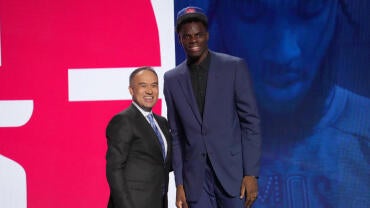
Nerlens Noel says opposing recruiters assumed Kentucky was paying him

By Matt Norlander | College Basketball Writer
Noel picking Kentucky on TV this past spring. (Getty Images)

Dirty recruiting and dirty recruiting tactics. They're two different things.

The former is benefits given to players in order to lure them to a school. The latter indicates a strategical approach based on bad-mouthing other coaches or programs. It happens. How often? Who's to say? But it's out there. Part of the game. It can't be prevented. For some, it works. For others, it backfires, as we'll see below.

(But as a quick aside, man, would I love to be a fly on the wall for some of these kids' in-home recruiting pitches. What's it like? Does each coach carry a certain level of awkwardness? You'd have to think the ones who make themselves the most comfortable are the ones with the leg up. At least sometimes.)

Anyway, SI.com has a piece up that details current high schoolers who have or -- in some cases, like five-star, top-five 2013 recruit Julius Randle -- haven't yet committed. The piece goes into how they do or don't make decisions, and why the negative courting can silently play a part in where they ultimately decide to go. The truly pathetic part is, even after these players orally commit to a school, other schools are still poking around and making sure the commitment is binding.

For instance, Brannen Greene, a top-40 player in 2013, has committed to Kansas. But some of his former chasers aren't necessarily abiding by the "former" part of that. Until he signs a letter of intent, he's considered open season.

Greene is bothered by that.

Greene can't understand why he's still being recruited with the same persistence and passion by college coaches as if he were still uncommitted.

"It's crazy," said Greene, who is ranked No. 22 in the Rivals150. "I'm always thinking in the back of my mind 'you do know I'm committed, right?' They want to know if I'm still open to their schools, but even though I say I'm not, they keep coming."

Added Greene's father, Jeffrey: "It used to shock me, but not anymore. After a while you get immune to it."

Greene's scenario isn't abnormal. It's not even a growing trend; it's one of many negative recruiting tactics college coaches use to try and lure recruits. Tactics that players and parents say get old really quick.

"I don't really like hearing about why I shouldn't go to certain schools too much," said Julius Randle, a rising senior forward at Prestonwood Christian (Plano, Texas). "It happens all the time, but, for me, I just don't like when coaches do that."

Greene said that before he committed to the Jayhawks he was "constantly" questioned by coaches recruiting him about why he was even considering Connecticut since coach Jim Calhoun, who turned 70 in May, "would never coach me because he's sick and going to retire."

That doesn't even include the possible badmouthing players can receive via Facebook or Twitter while deciding. For as much as one school's fans might pepper a player with plaudits, they could just as easily have factions bashing rival schools or others in the top three or five on a guy's list.

But those are fans. Many of them young and understandably stupid with Internet power. What about the coaches playing part to the negativity? You want to know why John Calipari is perceived to be the biggest cheating coach in the game? Because of what you're about to read.

This is how a lot of coaches think -- and it can backfire on them.

[Noel] recalled a conversation with a college coach during his recruitment process who urged him not to let money play a factor in luring him to Kentucky. Noel, a center, eventually picked the Wildcats.

"I was shocked that he would say something crazy like that," said Noel, the No. 2 player in the Rivals150 last season. "Of course I would never accept money and of course Kentucky never offered me money, but to hear that from him turned me off. I didn't hold it against him because I know coaches get jealous at times. I just look at it like they're really just insecure about themselves."

Good point. And how about a hypothetical? Let's say Noel's college pick came down to Kentucky and the school that employs the unidentified coach above. That one assumption by the coach cost that school a future lottery pick, perhaps the No. 1 overall pick in the 2013 draft.


I wonder how often negative recruiting works. It's a ratio we'll never really know, but I can't help but believe it's rarely a winning maneuver. Recruiting against a man's age and health? I get the low-hanging fruit, but it feels wrong. I don't think a lot of coaches do this, but it's undeniably out there and could be a big part of why the transfer culture has steadily become more accepted in the past decade.

You May Also Like
 

Biggest Stories

CBSSports Facebook Twitter
COMMENTS
Conversation powered by Livefyre

Latest

Most Popular