The unwavering tenacity of Patrick Reed and rebirth of American Ryder Cup supremacy
The United States' charge was led all week by Reed, now a Ryder Cup icon in his own right

By
Kyle Porter
•
8 min read

CHASKA, Minn. -- Patrick Reed was not the best golfer on the United States' Ryder Cup team. He was not even the best golfer on his own two-man team for the week. That was Jordan Spieth. Or at least, Spieth was the more accomplished of the two.
Reed was not the best driver on the U.S. team (by far). He was not the best putter. He did not solidify his spot on this team until August when he won The Barclays. He does not have a top 10 in a major championship. He was the only U.S. player who has not achieved that feat. Five of his American peers have major championships. Reed has never come close.
Reed is reviled in some PGA Tour circles, mostly by fans, for once referring to himself as one of the world's top five players. That's a barrier he has not come close to breaking. Even his opponent on Sunday, Rory McIlroy, has given him grief for that statement in the past.
And yet, Reed was the designated starter for captain Davis Love III, who paired him with Spieth to open foursomes play on Friday. Reed was also the designated closer on Sunday.
It had been eight years since the United States had taken that spire of a golden trophy back to the team room where the champagne and trash talk surely flows at levels us plebeians have never experienced. The Americans took it again this time around after beating the Europeans 17-11 and thrashing them in singles on Sunday 7.5-4.5.
It all started with Reed. Spieth called him "Captain America" on Saturday. Reed showed why on Sunday. He was the most ruthless of all these Americans players at Hazeltine. He was the "Reedemer."
Reed helped the U.S. overcome three straight heartbreaking Ryder Cup defeats this week. He helped it to a six-point victory, its largest in Ryder Cup play dating back to 1981. He helped it to its first sweep of a entire session (four matches) since 1975.
Reed went out first on Sunday, stared down Europe's reigning king, and cut him to the quick. He slayed the dragon early, and the rout was on for these Americans.
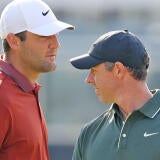
On paper, Rory McIlroy and Patrick Reed are not in the same stratosphere. Everyone knows this, McIlroy most of all. The only person at Hazeltine to whom that is a foreign concept is Patrick Reed. Their singles match, the first of 12 on Sunday, started slowly but soon blasted off like a Dustin Johnson drive. Reed drove the fifth and made eagle. After a birdie to match McIlroy at the sixth, he bowed and finger-wagged across the green while looking at the Ulsterman. McIlroy didn't see it, but the message had been sent.
They both birdied the seventh and eighth, and Reed wagged again. I've never seen anything like it. McIlroy taunting a lathered up red, white and blue contingent with guttural screams of, "I can't hear you!" Reed was an American version of Ian Poulter, portraying that character right in front of Poulter, who was following along. All any of us could do was cover our mouths and laugh. That's what Tiger Woods did, at least, so we figured that was the appropriate response.
Is this really happening?? Incredible. #RyderCup#GoUSAhttps://t.co/guA2h1BjGK
— Ryder Cup USA (@RyderCupUSA) October 2, 2016
Reed is a full-bodied American -- all of the good and all of the bad. He acts like the damn alpha in a twosome with someone who will probably be known one day as the greatest European of all time.
This is, in some ways, why America is disliked in certain parts of the globe. But this also is the literal history of America, a perpetual underdog who finally got his due. The one who finally climbed the mountain and pulled 11 other men with him.
McIlroy took Reed all the way to the final hole. It seemed both men were acutely aware of how much their showdown meant. The matches right behind them were tipping blue on the scoreboard as the late ones, which featured most of Europe's rookies, were heading red. Both knew that if Reed took a full point right off the bat, it was all over for the Europeans. McIlroy had to win for the Euros to have a shot. They were playing for more than a single point.
"It was important to see some red on the board," said Love when the day ended. "Just the excitement level of that match got guys going. We were standing on the first tee, or you're standing on the range or you're still in the team room, just to see him out there fired up and pumped up -- I hated to stand there on the first tee and only get to watch it on TV. I wished I had been out there for the whole thing."
Reed ended it on No. 18 with yet another birdie, his fifth of the day to go with that eagle. He started his trademark double fist pump (a move he showed off in the victory press conference following a few sips of champagne), and it was all over .
WHAT A PUTT!
— PGA.COM (@PGAcom) October 2, 2016
Patrick Reed makes birdie to defeat Rory McIlroy 1 up!#GoUSAhttps://t.co/TLAWTWDcbj
McIlroy flung his putter in disgust. He knew what Reed knew. The castle had been penetrated. The six-year reign had come to an end for Europe. The question now was only how decisive the win would be.
Justin Rose fell next after the Europeans nabbed a couple of points. He complained afterwards about the pin placement on Sunday.
"I thought the setup was incredibly weak," said Rose. "I thought it was very much a pro-am feel in terms of the pin placements. They were all middle of the green. I mean, the pin on No. 17 is ... a joke. It's a 9 iron into the middle of the green and you stiff it. So with a match on the line, you kind of feel like you want ... a player to step up a little bit more than they have to."
Rose played the course in 1 under par. He was beaten 1 Up by Rickie Fowler. He probably would have been beaten by any American. The other 10 were at least 2 under when their matches finished, too.
Phil Mickelson and Sergio Garcia halved their match next. They played a best-ball score of 58. Mickeslon made 10 birdies and scored only a half point. It didn't matter, though, because Europe's fantastic foursome of McIlroy, Garcia, Rose and Henrik Stenson could muster only 1.5 points. Masters champion Danny Willett fell next at the hands of Brooks Koepka. Then Andy Sullivan lost to Brandt Snedeker. Ryan Moore won his match on No. 18 with a par over Lee Westwood, and that was it.
It was as inconspicuously as a team could possibly win a Ryder Cup -- with the final captain's pick, the literal 12th man, beating one of their captain's picks with a two-putt par. It was fitting, though. The day hit its apex with Reed. This team hit its apex because of Reed. He was not the United States' captain, nor was he its best or its most experienced player. Not even close.
He was an American assassin who twice took down Europe's best overall team of Rose and Stenson. Then he did the deed on Sunday with McIlroy.
"Tried my best to get it done and put a point on the board for Europe early on," said McIlroy. "But Patrick played so well. I'd say maybe against anyone else I might have been a couple up going into the turn, but I was all-square and had a battle on my hands. It was tough at the end, it really was. I ran out of steam. It's been a long week. I didn't make any birdies on the back nine, which you can't do against a guy of that quality."
Love rode Reed to a 4-1-0 record this week and never looked back. Reed did not single-handedly win the Ryder Cup for the U.S., of course. For the first time since 1975, ever golfer contributed points. But he was the catalyst. He was the filter through which the rest of the team ran.
"I told Ian Poulter back in 2012 that he was built for the Ryder Cup," said Love on Saturday night. "I think Patrick Reed is built for the Ryder Cup, too. He's got that attitude."
After three straight Ryder Cups ended with questions for the U.S., this one concluded with statements. That Mickelson is as good at age 46 as he's ever been. That when Reed comes at the king, he never misses. That the Ryder Cup future of a beleaguered American side looks far different now than it did two years -- or even two months -- ago.
"The thing about this is that we need to build on this," said Mickelson. "Otherwise, it's all for naught. We created a very solid foundation this year. With the input that Davis Love had and each vice captain with Tom Lehman and Jim Furyk and Steve Stricker and Tiger Woods and Bubba Watson all brought integral parts to the success of this foundation, and it's important that we build on that."
Building is for later, though.
Sunday night, the Americans rest upon their new foundation after Reed rallied the troops into battle on an unforgettable day and weekend just outside of Minneapolis. Reed's match against McIlroy will reverberate for decades. This week will be spoken of reverentially by all subsequent U.S. Ryder Cup teams.
It was an indelible unfurling of an incredible future. At Gleneagles in 2014, Reed was a fun rookie who made some noise. This time around, he was the problem for which Europe had no answer.
The Americans will drink deeply from a four-pound, 17-inch-tall golden trophy well into Monday morning. For 10 of them, it will be for the first time.
Reed is here to make sure it's not the last.