
Zach Britton as a starter, Orioles? That's a bad idea for several reasons
Britton is currently working his way back from an Achilles injury

By
Mike Axisa
•
6 min read
To date, this has been a very quiet offseason for the Baltimore Orioles. The club made three Rule 5 Draft selections and handed out some minor-league contracts, and that's about it. They've been connected to a few free agent pitchers but have yet to land one.
In fact, the biggest news surrounding the Orioles has involved who they might subtract, not who they might add. Manny Machado's name has been involved in trade rumors for weeks, Zach Britton was said to be on the block as well before he blew out his Achilles during an offseason workout. Obviously the Britton trade talks are on hold now.
The top priority for the O's this offseason is adding rotation help. Their starting rotation right now is Kevin Gausman, Dylan Bundy, and three question marks. So perhaps it should not be a surprise then that, according to Roch Kubatko of MASN Sports, the Orioles approached Britton earlier this year to gauge his interest in returning to the rotation. From Kubatko:
I've been asked countless times about the possibility of the Orioles making Britton a starter again. He was approached with the idea earlier this year to gauge his interest, according to multiple sources, and he preferred to remain in the bullpen, where he made the All-Star team in 2016 and placed fourth in Cy Young voting in the American League.
There are people in the organization who continue to support the idea -- I was told a couple of officials like it "a lot" -- though the surgery tosses a giant wrench in the plan. Others wonder how he'd hold up physically and believe, the way he's wired, that closing is a better fit. It also suits his repertoire.
Britton, 30, came up through the minors as a starting pitcher and made 46 starts for the O's from 2011-13, including 28 during his rookie season in 2011. He moved to the bullpen full-time in 2014 because he was out of minor-league options -- the O's would have had to put Britton on waivers to send him to Triple-A -- and there was no room for him in the rotation. It wasn't long before he took over as closer.
There is some merit to the idea of putting Britton back in the rotation. Even in this age of heavy bullpen use, a quality starter is still generally more valuable than a quality reliever, and the Orioles have much a greater need in the rotation.
There are also several reasons why putting Britton back in the rotation is a very bad idea. Four reasons jump to mind.
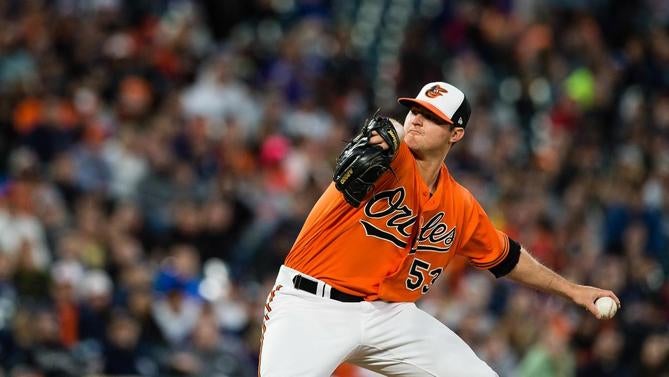
Britton is coming back from a major injury
It's not just the Achilles injury suffered earlier this month. A forearm issue sent Britton to the disabled list twice this past season, and forearm problems are a common precursor to an elbow injury, often Tommy John surgery. Asking Britton to rehab the Achilles, then go out and throw more total pitches and more total innings than he has at any point in the last four years is asking for trouble. He might not be up for starting physically. Forearm problems and a blown Achilles in a such a relatively short period of time make for a bad combination.
There's not much time to get him stretched out
The Achilles injury was serious enough to require surgery, and the current timetable has Britton on track to return sometime in June or July. He won't be back until midseason.
#orioles remain optimistic that Britton could be back by June. Even if July, they'll take it.
— Roch Kubatko (@masnRoch) December 21, 2017
Given his impending free agency, it makes sense for the Orioles to gauge trade interest in Britton at the July 31 trade deadline. And if they make him a starting pitcher, the O's will have to give Britton enough time on his minor-league rehab assignment to get stretched out to 75-plus pitches. That doesn't happen overnight. It could take a month, given his injuries.
For the Orioles to get the best possible return for Britton at the trade deadline, teams are going to have to see him pitch. He's so good that I'm sure several clubs would be willing to trade for him without seeing him pitch after the Achilles injury, but they won't pay full price. Taking all that extra time to stretch Britton out to start means less scouting time for interested teams prior to the trade deadline. Maximizing his trade value has to be a consideration.
Britton wasn't particularly good the last time he started
Obvious statement is obvious: Britton has been far more successful as a reliever in his career than as a starter. That is true for most pitchers, though with Britton, the difference is especially massive.
| IP | ERA | WHIP | K/9 | BB/9 | HR/9 | GB% | Opp. AVG/OBP/SLG | |
|---|---|---|---|---|---|---|---|---|
As SP | 250 | 4.86 | 1.52 | 5.9 | 4.0 | 0.8 | 54.9 | .274/.353/.407 |
As RP | 251 | 1.58 | 1.00 | 8.9 | 2.6 | 0.3 | 77.2 | .200/.263/.263 |
There is definitely something to be said for a struggled starter going to the bullpen, learning how to get outs in relief, then taking that experience and knowledge back into the rotation. Tons of top starters spent time in the bullpen early in their careers because they couldn't hack it in the rotation right away. New York Yankees ace Luis Severino is a good example.
That said, we can't just wave away Britton's performance as a starting pitcher and ignore it. Aside from the above-average ground ball rate, there's not much to get excited about. He didn't miss bats and he walked too many hitters. The upside here is what, potentially a good mid-rotation starter? That's valuable! But giving up a shutdown closer for that in this day and age doesn't make much sense.
Britton is a one-trick pony
Fortunately, it is a very good trick. Britton's mid-to-upper-90s sinker is historically great. Since batted ball data started being recorded in 2002, there have been 5,225 individual pitcher seasons with at least 50 innings pitched. Here are the four best ground-ball rates on record:
- Zach Britton, 2016 Orioles: 80.0 percent
- Zach Britton, 2015 Orioles: 79.1 percent
- Brad Ziegler, 2012 Diamondbacks: 75.5 percent
- Zach Britton, 2014 Orioles: 75.3 percent
Britton has three 50-inning seasons with a 70 percent ground ball rate. The rest of those 5,225 pitchers have seven. That's how good Britton's sinker is. And when you have a pitch that dominant, why not throw it over and over and over again? That's what Britton does.
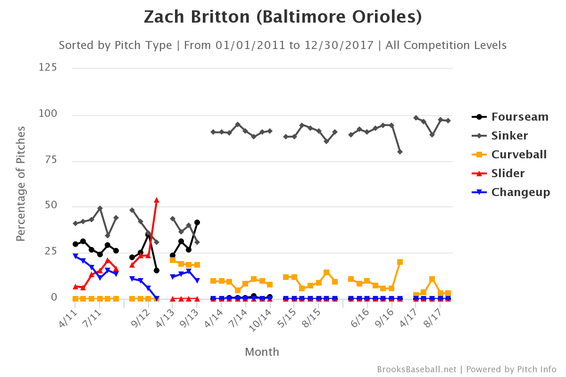
Since moving to the bullpen, Britton has thrown 91.9 percent sinkers. The other 8.1 percent is almost all curveballs. Britton did throw a changeup and a straight four-seam fastball back in the day, but like most pitchers, he focused on his two best pitches once he moved to the bullpen. Really, he focused on his best pitch. The sinker.
Having success as a starting pitcher while leaning on one pitch so heavily just doesn't happen, even when that one pitch is as good as Britton's sinker. He'd need something else to keep hitters off balance, and he'd need to throw that something else regularly. Also, check out the average velocity on Britton's trademark sinker over the years:
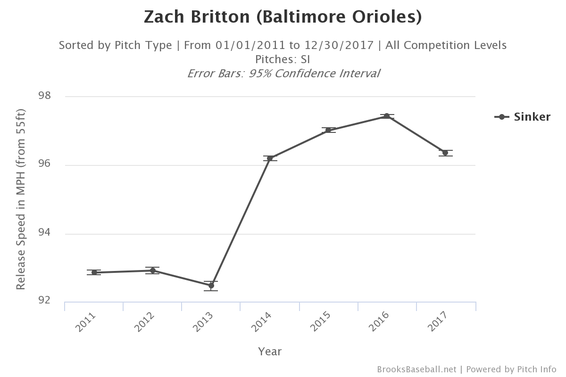
Britton added almost 4 mph -- 4 mph! -- to his sinker when he moved to the bullpen and starting airing it out in one-inning bursts. Britton's sinker at 96-98 mph is truly devastating. Britton's sinker at 92-94 mph is like most other sinkers. The velocity difference on the sinker combined with the fact his secondary stuff is more good than great is a pretty darn good reason to keep Britton in the bullpen, where he is most effective.
In most cases, I would be totally on board with seeing whether an ace reliever could have success as a starter, and that would be the case with Britton were he not due to become a free agent next offseason. The Orioles have to think about maximizing his value as a trade chip first, because chances are that is how Britton will be most useful to them in 2018. Add in the Achilles injury, his history as a starter, and the uptick in stuff he experienced following the move to the bullpen, and continuing to use him as a reliever is a no-brainer to me. Some guys are just made for the bullpen.