2016 NBA Draft: Best shooters available and the teams that need them
Does your team need help with shooting? Here's whom they can draft to fix that

By
Zach Harper
•
14 min read

Shooting has become a great equalizer and a premium skill in today's NBA. After the Golden State Warriors, Houston Rockets, Cleveland Cavaliers and Atlanta Hawks all made the conference finals in 2015, Charlotte Hornets coach Steve Clifford realized the 3-point shot was a key weapon his team couldn't ignore. So they started taking far more 3s in their offense, and attempted 844 more shots from beyond the arc in 2015-16 than the previous season. They also went from 30th in 3-point accuracy to eighth as they got back to the playoffs and nearly made it past Miami to the second round.
You need the 3-point shot, and getting it from a rookie scale contract is the most cost effective way of adding it to your roster. In no particular order, here are the 15 best shooters in the 2016 NBA Draft class and the 10 teams that have picks and need the shooting the most:
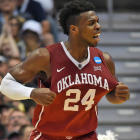
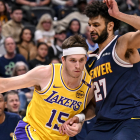
Buddy Hield, Oklahoma, SG, Top 10 projection: 45.7 percent 3FG, 62.3 percent eFG
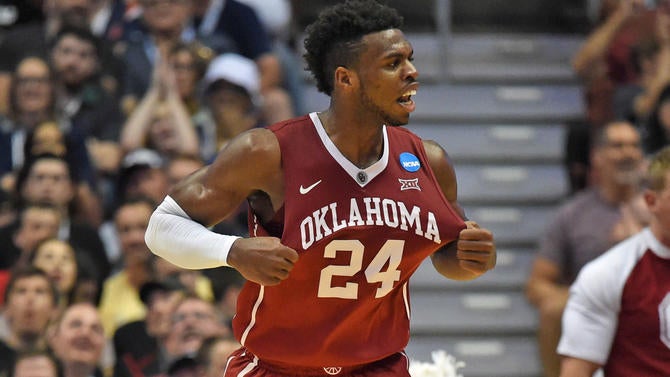
While this is in no particular order, Buddy Hield is currently the class of the shooters in 2016. His four-year career at Oklahoma saw him put up 894 3-point attempts at a clip of 39 percent. In his last year, everybody knew the ball was going to him, everybody knew he was going to shoot a 3-pointer (53.6 percent 3-point rate) and yet he still knocked down 45.7 percent of them. That's the kind of shooter he is. He's active off the ball, he has an effortless release from anywhere on the floor and the second you make a mistake covering him, he makes you pay.
He shot 54.8 percent of his unguarded catch-and-shoot attempts with a ridiculous effective field-goal percentage of 82.3 percent. On guarded C-and-S shots, it only dropped to 47.2 percent with an eFG of 70.4 percent. He may not be a star at the NBA level but he'll bury the opponent if they sag off of him.
Jamal Murray, Kentucky, PG/SG, Top 10 projection: 40.8 percent 3FG, 55.9 percent eFG
In terms of shooting, Jamal Murray may be the 19-year-old version of Hield. He's that good at such a young age. The Kentucky Wildcat from Canada was the second-best shooter coming off screens this season. He scored a ridiculous 150.6 points per 100 possessions when coming off a screen and taking a shot. He shot 56.6 percent from 3-point range on those possessions. His technique is beautiful even if his release point seems a bit low. There isn't any wasted motion from catch to release and he's deadly coming off a screen going left or right.
He might actually be better than Hield at setting up defenders to run into screens off the ball, and he doesn't turn 20 until February. He struggled shooting the 3-point shot in transition as a freshman (31.9 percent) but you'd assume he'll find that comfort.
Brandon Ingram, Duke, SF, Top 2 projection: 41.0 percent 3FG, 52.5 percent eFG
Even if Brandon Ingram wasn't a good outside shooter, his potential would still have him slotted to go No. 2 to the Los Angeles Lakers. However, it was his shooting ability that at least gave the Philadelphia 76ers a little bit of confusion before deciding they were taking Ben Simmons with the first pick no matter what. With a guy of Ingram's measurements (6-foot-9 in height, 7-foot-3 wingspan), a shooting stroke like his makes him all the more deadly. He has such a smooth release and you're going to need a crane in order to block his outside shot on a fly-by.
Oddly enough with him, he may subscribe to the NBA champion J.R. Smith school of thought regarding open jumpers being boring. He made 44.3 percent of his guarded catch-and-shoot attempts (64.9 percent eFG) and just 39.7 percent of his unguarded attempts (58.2 percent eFG). To think that his open jumper needs to catch up to the high production of his guarded jumpers shows just how comfortable he is with a hand in his face. The Kevin Durant 2.0 comparisons are a bit of hyperbole, but you can see a similarity with the outside shot, at least.
Kyle Wiltjer, Gonzaga, PF, 2nd round to undrafted: 42.5 percent 3FG, 57.7 percent eFG
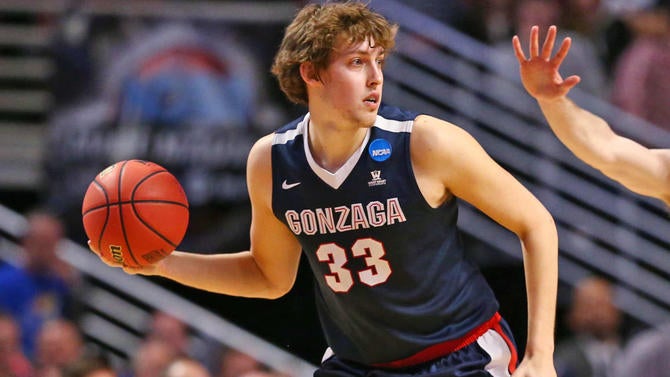
Whether Kyle Wiltjer was at Kentucky or Gonzaga, he was lethal from downtown. His career 3-point percentage over four years was 42.5 percent. He had one season under 43.2 percent. His percentage in two years at Gonzaga was a ridiculous 44.9 percent on over 350 attempts. Like Ingram, Wiltjer was better on catch-and-shoot attempts with a hand in his face (43.2 percent) than completely open (40.5 percent). He was a really good overall scorer in college, so you're not just getting a shooter, but it's hard to know if that will translate to the NBA.
The goal would be turning this lanky big man into a Channing Frye/Ryan Anderson type. That's the absolute best-case scenario for a guy who will probably go undrafted unless he agrees to be stashed overseas for a year or two. That could guarantee him a spot in the late second round. But if you can even get him to be a Steve Novak-type of player, you're going to have a weapon at the end of close games.
Furkan Korkmaz, Turkey, SF, Top 20 projection: 40.9 percent 3FG, 57.9 percent eFG
The Turkish wing is a bit of a mystery, as most international prospects tend to be, but the thing that doesn't seem to be in question is his shooting ability. While we don't have a large sample size to judge from when it comes to Furkan Korkmaz, what we've seen from his shooting stroke is undeniable. It's a little unconventional with him bringing the ball over his head, almost replicating a marriage between the shooting motions of Larry Bird and Michael Redd, but his release is consistent and his motion never has a hitch in it.
He made 44.2 percent of his guarded catch-and-shoot attempts and half of his unguarded attempts. The high release point and his height (6-foot-7) make it tough to block his shot, but he'll have to make sure he can keep his shooting motion consistent and quick against the size and athleticism of NBA defenders. He looks to be a legitimate threat from outside though.
Denzel Valentine, Michigan State, wing, 1st round projection: 44.4 percent 3FG, 57.9 percent eFG
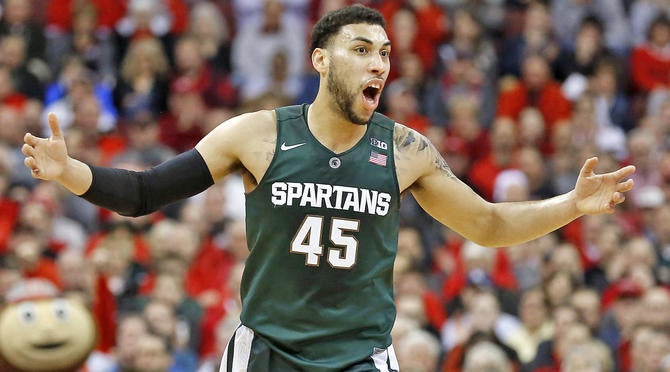
Four years at Michigan State, 650 3-point attempts, and Denzel Valentine improved every single year as a shooter. He went from 28.1 percent as a freshman to 37.7 percent as a sophomore to 41.6 percent as a junior to proving that above 40 percent mark was here to stay as a senior. Overall, he made 40.8 percent of his 3-point shots during his time as a Spartan. Knocked down 41.2 percent of guarded catch-and-shoot attempts and 55.3 percent of unguarded. He may not be a 40 percent-plus outside shooter from deep in the NBA but he'll be well above league average (usually 35-36 percent).
His draft stock has taken a hit over concerns about his knee, but he claims to be "asymptomatic" and not worried about how teams view him. If he had a clean bill of health, this deadeye shooter would be a guaranteed lottery pick and probably creeping into the top 10. The concern could make him a mid-to-late first-round steal and add a really good shooter and playmaker to a playoff team.
Demetrius Jackson, Notre Dame, PG, 1st round projection: 33.1 percent 3FG, 51.4 percent eFG
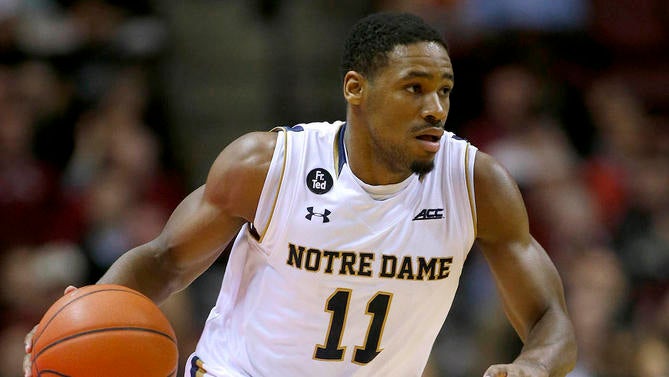
The first two years of Demetrius Jackson's career at Notre Dame, he shot 42.4 percent on 186 3-point attempts. This past season, he dropped dramatically to just 33.1 percent on 163 attempts. Believing in those first two years is the reason he's made this list of shooters. He was abysmal on guarded catch-and-shoot attempts (30.8 percent) this year as opposed to the 57.8 percent he put up a year ago playing alongside Jerian Grant. Maybe he just needs another dynamic guard to play next to in order to get that 3-point percentage back up. The confusion from this season beyond the arc is probably the reason he's not a lottery lock.
Malik Beasley, Florida State, SG, 1st round projection: 38.7 percent 3FG, 54.1 percent eFG
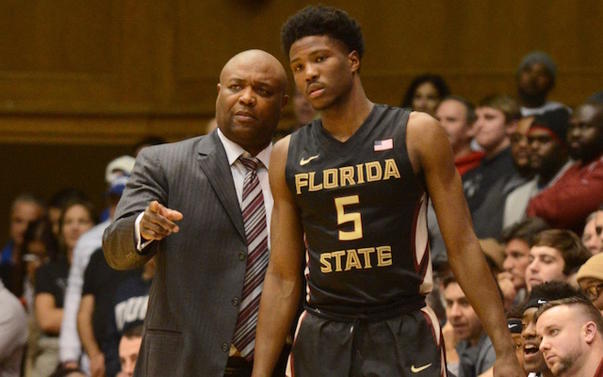
Malik Beasley's one year at Florida State was pretty successful, showing him as a really good floor-spacer. His 38.7 percent on over four attempts per game shows comfort with a high volume of attempts. He didn't shoot an overwhelming percentage on unguarded catch-and-shoot (39.6 percent) but his guarded attempts (38.5 percent) didn't drop off either. He shows great consistency there with his compact shooting motion and high arc. He did struggle more from the left side of the floor, making 33 percent from the left corner and 38 percent from the left wing. But he was 42 percent from the top, 40 percent from the right wing, and 42 percent from the right corner.
Malcolm Brogdon, Virginia, SG, 2nd round projection: 39.1 percent 3FG, 53.2 percent eFG
Malcolm Brogdon showed a bit of inconsistency from year-to-year with his 3-point shot, going from 32.4 to 37 to 34.4 to 39.1. However, his work from the corners this past season makes him a great second-round "gamble" at the shooting guard position. He made 53 percent from the left corner and 57 percent from the right corner. Considering how valued that shot has become in the NBA, he's a guy you can make the fourth guard/wing in your rotation.
Caris LeVert, Michigan, PG/SG, 2nd round projection: 44.6 percent 3FG, 63.6 percent eFG
Despite being a four-year player at Michigan, we're dealing with a smaller sample with Caris LeVert because he only played 33 games his final two seasons. Over his last three years at Michigan, he made 41.5 percent of his 3-point attempts. This season, the majority of those attempts came from the left wing (18 percent of all shots were left wing 3-point attempts) and he made 48 percent of those. As a 6-foot-7 combo guard, he adds a nice element of a shooter who can create off the bounce. Could be a second-round steal.
Jake Layman, Maryland, SF, 2nd round projection: 39.6 percent 3FG, 64 percent eFG
If Jake Layman can defend at the NBA level, his 3-point shooting will make him a definite rotation player. He was never over 40 percent in his four years at Maryland, but he did manage to get really close this past season. Over half of his shots were 3-point attempts, and he killed from both the left wing (46 percent) and the right corner (41 percent). He's another J.R. Smith candidate with 48.1 percent on guarded C-and-S attempts and 38.1 percent on unguarded attempts.
Michael Gbinije, Syracuse, SG/SF, 2nd round projection: 39.2 percent 3FG, 55.4 percent eFG
Last two years of his four-year college career showed incredible consistency. He took over 350 3-pointers combined in those two seasons. Each year, he knocked down 39.2 percent of those attempts. Surprisingly, he's not very good from the corners. 36 percent from the left and 17 percent from the right. But he hit 39 percent from the right wing on a high volume of shots and hit 50 percent from the top of the key.
Isaiah Cousins, Oklahoma, SG, 2nd round projection: 41.1 percent 3FG, 50.6 percent eFG
He was a great wingman to the hot shooting of Buddy Hield over the last couple years. Combining his sophomore, junior and senior seasons, Isaiah Cousins made 42.3 percent on nearly 400 3-point attempts. Almost everything came from above-the-break as a senior. He didn't take many corner 3-pointers and he wasn't good at them. But he was deadly from the top and the wings. If you can run him off the line, he struggles but you can do worse than him for a fourth guard.
Jarrod Uthoff, Iowa, SF/PF, 2nd round to undrafted: 38.2 percent 3FG, 51.5 percent eFG
He can get drafted if he's willing to be stashed overseas. Otherwise, he's probably a guy who will have to prove himself in the D-League for a couple of years. He can shoot though and he's absurdly accurate from the corners. Made 53 percent from the left corner and 60 percent from the right corner this past season. Majority of his 3-point makes came from the left wing (44 percent accuracy). He has good size to get his shot off but can he do anything else? That's what he has to prove.
Georges Niang, Iowa State, SF/PF, 2nd round projection: 39.2 percent 3FG, 60 percent eFG
Georges Niang looks to be a second-round steal for somebody. He doesn't have great length for a man his size, but he made 39.5 percent of his 3-pointers over his last two seasons at Iowa State. He's also great around the rim so if you get him away from the perimeter, he can still be a weapon. But Niang's height makes him a very solid stretch-4 option off the bench. The shot has been great for two years and you can put him in the D-League to develop a bit. Sure, he's 23 years old but he knows how to shoot.
Honorable Mention: Wade Baldwin (percentages are good but NBA people doubt his shooting stroke) and Sheldon McClellan (shot lights out this year but first three years weren't great)
The Teams That Need Shooting the Most
Los Angeles Lakers: 31.7 percent 3FG (30th), 46 percent eFG (30th)
Solution: They're taking Brandon Ingram at 2 and they should. Not only does he fill a need at the small forward position, but he can instantly begin lifting their horrendous 3-point percentage. Luke Walton will want to take some of the attack he learned with the Golden State Warriors and implement that with the Lakers. That means 3-point shooting and Ingram helps a lot.
Memphis Grizzlies: 33.1 percent 3FG (29th), 47.7 percent eFG (29th)
Solution: The Grizzlies pick at No. 17 and No. 57 in the draft. You're probably grabbing a player to stash with that second pick so maybe taking a chance on Kyle Wiltjer there makes sense. But at No. 17, you need a rotation wing who can contribute. They've struck out recently on Jamaal Franklin and haven't seen anything from Jordan Adams. Denzel Valentine or Malik Beasley make sense for depth. Furkan Korkmaz is a must if he falls there. Otherwise, they may take a chance on Demetrius Jackson as Mike Conley insurance if he leaves.
Boston Celtics: 33.5 percent 3FG (27th), 48.8 percent eFG (24th)
Solution: The nice thing about the Celtics in this draft is they have eight picks to use. Three in the first-round, five in the second. They don't have to address this need at No. 3. They can hope someone like Denzel Valentine falls to No. 16 or No. 23. If he's not there, they can grab Malik Beasley or Furkan Korkmaz. They can snag Georges Niang with one of their second-round picks. Lots of options for Danny Ainge to add shooting.
Denver Nuggets: 33.8 percent 3FG (26th), 48.9 percent eFG (23rd)
Solution: If Buddy Hield or Jamal Murray drop to No. 7, the Nuggets should take them even though they already have Gary Harris. Otherwise, they can be patient and snag either Furkan Korkmaz or Denzel Valentine with either the 15th or 19th pick. They also could package picks and try to trade for a veteran with a good outside shot.
Minnesota Timberwolves: 33.8 percent 3FG (25th), 49.8 percent eFG (18th)
Solution: Take Jamal Murray if he's still there at No. 5 and if he's not, take Buddy Hield. Either guy can step into Tom Thibodeau's rotation right away and be a floor-spacer off the bench. Thibodeau has emphasized 3-point shooting as a need for this team and wants to make sure to grab someone who can contribute to that if they keep the pick. These guys will have to learn defense in order to get consistent minutes but they have the teacher for that now.
Philadelphia 76ers: 33.9 percent 3FG (24th), 48.7 percent eFG (27th)
Solution: The Sixers won't be addressing their outside shooting need with Ben Simmons as the first pick, but they have picks 24 and 26 to handle that. They may also package their picks and try to move up into the Top 8 to grab someone like Kris Dunn, Jamal Murray, or Buddy Hield to add some much-needed shooting.
Dallas Mavericks: 34.4 percent 3FG (23rd), 50.2 percent eFG (14th)
Solution: Dallas is not usually a team you think of as needing to add shooting, but that's where they are right now. The Mavs don't have their first-round pick, but at 46 they can still add a solid shooter. Georges Niang should be an option to fill a need at wing if he falls to the middle of the second round. Adding Michael Brogdon to fellow Virginia Cavalier Justin Anderson might work as well.
Milwaukee Bucks: 34.5 percent 3FG (22nd), 49.9 percent eFG (17th)
Solution: The Bucks need a point guard badly and even though he was just an honorable mention, maybe they believe in Wade Baldwin's shooting percentages. If they don't go with a definite shooter at No. 2, they can grab a shooting wing in the second round with picks 36 or 38.
Detroit Pistons: 34.5 percent 3FG (21st), 49.1 percent eFG (22nd)
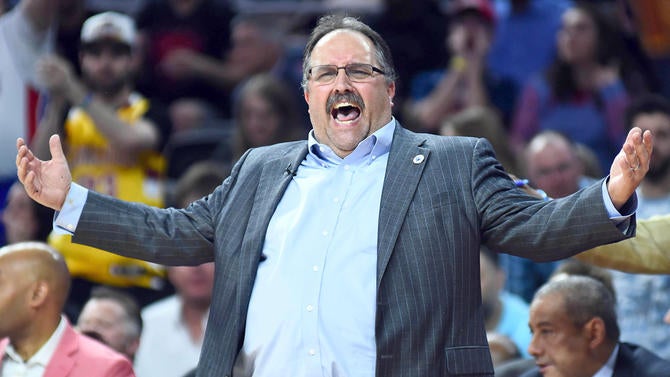
Solution: Stan Van Gundy needs shooters in his system and the Pistons struggled quite a bit with outside shooting this year. With picks at 18 and 49, they can add quality, versatile wings with both selections to bolster the rotation. Maybe SVG will keep Denzel Valentine in Michigan by going with him to compete with Kentavious Caldwell-Pope and Stanley Johnson for wing minutes.
Houston Rockets: 34.7 percent 3FG (19th), 51.6 percent eFG (6th)
Solution: Even though they shoot more 3-pointers than just about anybody, the Rockets don't shoot a great percentage. Their first-round pick doesn't belong to them but they have No. 37 and 43 to add cheap second-round talent. Any of the projected shooters in the second round work for them, but Georges Niang, Isaiah Cousins and Caris LeVert fit the profile of someone Daryl Morey would love to grab.