
Adam Silver interested in 3-round NBA Draft, raising D-League salaries
NBA commissioner Adam Silver says the league is exploring some cool ideas.

•
2 min read
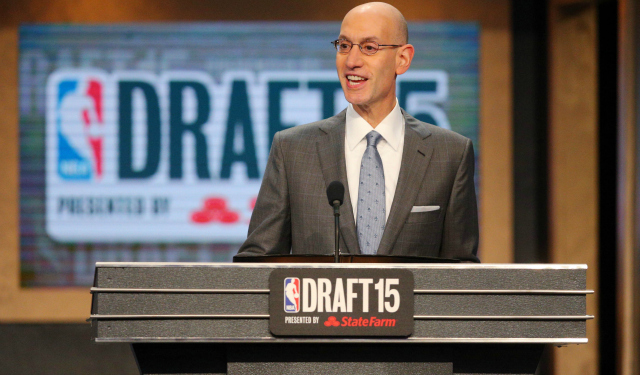
NBA commissioner Adam Silver has been making the podcast rounds in the last six days, First he appeared on Sports Illustrated's "Open Floor," then Yahoo Sports' "The Vertical Podcast with Woj," then FiveThirtyEight's "Hot Takedown" and, finally (we think), ESPN's "The Lowe Post." In his interview with Zach Lowe, he discussed the possibilities of raising D-League salaries, adding two "two-way" roster spots and making the NBA Draft three rounds instead of two:
You have for the most part D-League players, not those ones who have NBA contracts who are sent to the D-League but players who sign directly to the D-League, often making $18,000 or so a season. So they’re fairly low salaries by any standard. [...]
We've been talking about two-way contracts. So we’d keep NBA rosters at 15, but maybe in addition to your 15-man roster, you’d have two other slots called your 16 and 17th roster slot, but those would be two-way contracts. They would have different scale than NBA players, so where an NBA minimum is half a million dollars, the D-League contract for those two players could be $80,000 or it could be $100,000. Nobody’s gotten specific yet. [...]
Also once you had that direct relationship with an NBA team and it was their 16th or 17th roster spot, they would then have -- talk about incentive -- much greater incentive to train those players, to coach them under their system so that they would be ready to come right into their system on a moment’s notice and they wouldn’t risk losing those players to another team. Which is what you have now. [...]
This notion of adding additional rounds in the draft [is] very interesting to me because, first from a player standpoint, you’d have potentially another 30 guys or more who are drafted by NBA teams, but then again you’d have this much greater incentive for an NBA team to care about that player and want to develop them and bring them along to play at NBA standard.
The two ideas go hand-in-hand -- the guys who would be taken in the third round would be facing a choice between going overseas or to the D-League, anyway. Adding the two extra roster spots -- and, hey, why not make it three? -- with higher salaries gives them more reason to stay stateside.
As for Silver's point about incentive, let's take D-Leaguer Ronald Roberts as an example. Roberts played for the Toronto Raptors in summer league in Las Vegas, and they liked the athletic forward enough to invite him to their free-agent camp and, eventually, training camp. He might have made their roster if they hadn't unexpectedly signed forward Anthony Bennett when the former No. 1 overall pick became a free agent.
In order to keep him in their program, Toronto's D-League team, Raptors 905, made a trade for Roberts. He's played nine games for Raptors 905, averaging 17.6 points, 12.6 rebounds and 1.6 blocks. Roberts has been Raptors 905's best player, but his production might end up being bad for Toronto.
Since Roberts is not on the 15-man NBA roster, any of the 29 other teams can call him up. Essentially, the Raptors could wind up investing months of work developing Roberts just so he can go help a competitor. This does not make much sense, and it is why the idea of two-way contracts is being discussed.