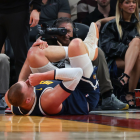
Even when Dwight Howard plays well, the Hawks can't beat the Wizards with him
Atlanta is facing elimination, but there's a big adjustment it can make

•
4 min read

Dwight Howard played only two of his 28 minutes in the fourth quarter of the Atlanta Hawks' 103-99 loss to the Washington Wizards on Wednesday. If Atlanta is going to come back from its 3-2 deficit and advance to the second round, he might need to play an even smaller role.
Heading into an elimination game, the Hawks should look at how the Boston Celtics and Toronto Raptors changed the complexion of their first-round series. As mentioned here -- and analyzed in detail by The Ringer's Jonathan Tjarks -- the Celtics replaced big man Amir Johnson with swingman Gerald Green in the starting lineup and the Raptors replaced center Jonas Valanciunas with guard Norman Powell. The adjustments made them quicker, more versatile and helped them space the floor. Atlanta tried to do this down the stretch, but it was too late.
In Howard's brief stint in the final frame, he turned the ball over, committed a foul and was subbed out for center Mike Muscala, who is faster getting up and down the court and isn't afraid to launch the occasional 3-point shot. Down by seven points with 3:20 left, Atlanta replaced Muscala with guard Kent Bazemore, fully embracing smallball as it tried to steal the game. This was bold considering that Howard makes more than $23 million per season, but coach Mike Budenholzer knew that the Hawks had put some distance between them and the Wizards early in the fourth quarter of Game 4 by going without a traditional center.
"Every game is a little bit different, and at times offensively it felt like we were kind of struggling to score," Budenholzer said. "Maybe spread 'em out, go a little bit smaller, get Paul [Millsap] in some space and let him attack and try and get to the free throw line. But no doubt Dwight can have an impact on the boards and have an impact on what Gortat does or doesn't do. Those are always the tough decisions that you gotta make."
Here's what happened on the very first play when Atlanta went small:
Look at how much room Dennis Schroder has to drive because the floor is spaced. Schroder was easily Atlanta's best player, scoring 29 points on 10-for-18 shooting and dishing 11 assists. Much of that was because he went 5-for-6 from deep, though, and he could have had an easier time getting in the paint if Howard wasn't in there clogging it up.
That basket was part of Atlanta cutting Washington's lead to just two points. If forward Taurean Prince had converted this seemingly easy layup, then perhaps the end result would have been different:
The Wizards had to scramble all over the place there, and they still surrendered a layup and left Tim Hardaway Jr. open on the perimeter. This is the kind of thing the pre-Howard Hawks did to teams all the time.
So, why not try to space the floor as much as you can for most of the game? Why not have Schroder run pick-and-rolls with Millsap, surrounded by shooters? Why not try to get Millsap going against the bigger, but slower, Marcin Gortat? These are all excellent reasons to go small, but the best reason is actually on the other end on the floor.
Howard is past his prime but still an excellent defender. He should make the All-Defensive team because of how he transformed this Atlanta team in terms of half-court defense and rebounding. The Hawks signed him because they wanted to stop being bullied on the glass and thought he could anchor their defense. He has delivered in that regard, and he has done a good job of disrupting the John Wall-Gortat pick-and-roll in this series.
The problem is that he's just too slow. Washington's best attribute is that it scored 1.189 points per possession in transition in the regular season, per Synergy Sports, which trails only the Utah Jazz (who almost never run) and the mighty Golden State Warriors. This isn't particularly hard to figure out -- Wall is quicker than everybody else in the league, and Bradley Beal and Otto Porter are ideal players to run with him as they're both athletic enough to take lanes to the rim and finish, and are also terrific shooters always looking to flare out to the 3-point line in space.
This has been a serious issue for the Hawks. As Haralabos Voulgaris pointed out, that was the case particularly when Howard was on the court on Wednesday:
Dwight moving like the Tin Man in transition. Wiz have scored 1.63 points per play that started with a D Reb with DH12 on the floor today
— Haralabos Voulgaris (@haralabob) April 27, 2017
According to Voulgaris, that number went down to 1.13 points per possession without Howard. That is a significant difference, especially in a series as tight as this.
It would be incredibly reductive to frame this as "Howard was -4 in the game, and Atlanta lost by four points." The biggest factor in this game was probably the free throw differential -- the Hawks went 14 for 21, while the Wizards went 22-for-27, with Porter going 9 for 10 by himself. Atlanta will be looking to make adjustments going into Game 6, though, and one of them should be reducing Howard's minutes if he can't get back in transition. It will probably hurt the Hawks' half-court defense, but if the alternative is letting Wall push the ball and punish them in the open floor, then that's a risk they have to take.