Few players will impact West playoff race more than Jazz's Rudy Gobert
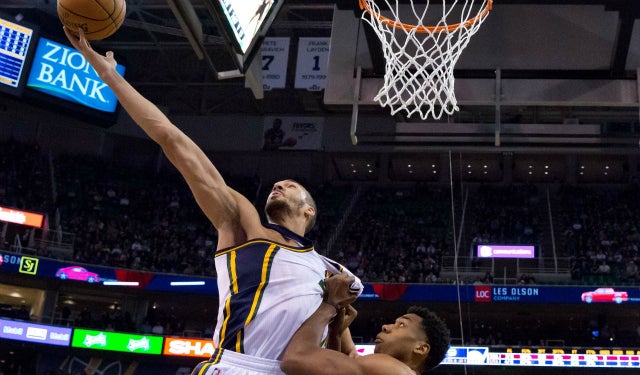
Rudy Gobert is the league's best rim protector and his return to the lineup gives the Jazz big time playoff aspirations.

By
Zach Harper
•
6 min read

SALT LAKE CITY -- The final 29 games of the 2014-15 season were a bit bewildering when you watched the Utah Jazz. After the All-Star break, the Jazz were the best defense in the NBA. It's not just that they were the best defense; they were putting up historic defensive numbers by allowing just 94.8 points per 100 possessions. You know that ridiculous San Antonio Spurs defense this year? They're allowing 93.6 points per 100. The great Golden State Warriors defense last year? It allowed 98.2 per 100.
That helps put into perspective just how good the Jazz were at the end of last season when they traded Enes Kanter and handed over the keys to the defense to Rudy Gobert. The 7-foot-2 Frenchman with the 7'9" wingspan was more than capable of thwarting opponents from scoring at the rim or even trying. His presence allowed others to defend better within the system, and the Jazz took advantage of a more favorable schedule to show themselves and everybody else their ideal way of executing on the court.
Fast-forward to this season and the Jazz have shown flashes of this defense and overall execution, but they've been battling too many injuries to find consistency. Derrick Favors has missed 13 straight games. Alec Burks is out for maybe a month and a half with a broken ankle. Dante Exum will miss all season with a torn ACL. And for 34 days and 18 games, Gobert was out with a strained MCL.
Without Gobert in the middle, the Jazz defense fell apart. During the first month of the season with Gobert, Utah ranked 11th in the NBA at 99.8 points per 100 possessions allowed. In the stretch where Gobert missed 18 games, the Jazz were 23rd in the NBA in defense allowing 107 points per 100 possessions. Since the league's best rim protector returned back to the lineup 10 days ago, the Jazz are back to a defensive rating of 98.1, which is sixth in the league during that time.
"You don’t want to become too reliant on him doing your job," Jazz coach Quin Snyder said about Gobert and the presence he provides. "I think with him out, it became even more obvious and evident to the other players how tight and how focused and how disciplined they needed to be."
The entire season for the Jazz has been a learning experience. The injuries have tested them and thanks to a down year in the Western Conference depth, they've maintained the 8-seed despite having an 18-22 record. In the absence of Favors and Gobert, guys like Trey Lyles and Jeff Withey have stepped up to find roles in the frontcourt. It's helped build up some depth for the Jazz, but they're still not able to be what they want to be without their starting frontcourt.
“I think we’re doing great," Gobert said nearly at the halfway point of the season. "We had a lot of injuries that slowed us down a bit. We kept pushing and we kept fighting. I’m proud of the guys. I’m proud of the coaches. We know Favors is going to be back pretty soon. It’s time to make the push and keep getting better. Make a strong push for the playoffs.”
Favors was playing like a potential All-Star before his back spasms took him off the court. But Gobert's charge to the defense ignites them in ways the rest of the league can't really replicate. Of the players in the NBA defending at least seven shots at the rim every game, Gobert is the only player allowing lower than 40 percent (38.6 percent). It's this level of protection that allows other players on the Jazz to have more confidence in their own defense.
“He’s a dominant protector," Jazz point guard Trey Burke said about Gobert. "A guy protecting the rim all the time. His ability to rebound and block shots, his presence alone out there, he’s in the way. If a guy gets beat or someone beats us in transition, he’s able to save that play.
“You can be a little more aggressive when you have that presence behind you like that. His desire to want to block shots, to want to help his teammates out, that gives us confidence for guys up in the backcourt pressuring the ball. If one of our guys beat us, he’s there to clean it up.”
Snyder tries to remind his players that with Gobert out there you can defend a bit differently. When your man drives against you, pull your hands back and make sure not to bail them out with a call. If you keep your hands back then Gobert is probably blocking the shot and if your hands are on the player, that means two free throws instead. On offense, you can lob the ball higher because the pterodactyl-like reach of Gobert can get to it. At the same time, don't throw him many bounce passes in the paint because you'll hit him in the leg instead of the hands.
It sounds simplistic, but there is an adjustment to remembering how you can play with Gobert on the court. The Jazz are much better on both ends of the floor with Gobert playing. The defense is obviously better, clocking in at 4.5 fewer points per 100 possessions with him. The offense is nearly seven points per 100 better and the Jazz are roughly six percent more accurate in the restricted area with Gobert out there.
Everything is connected with Gobert. The defense sucks into the paint more often with Gobert rolling to the basket on offense, which allows for better looks on the perimeter. Gobert is a skilled passer for a big man, which is one of the reasons the Jazz are so confident with him making decisions on the perimeter. Hand-offs that become screens and finding cutters become a regular process with Gobert in the offense.
"I feel like my teammates had confidence in me," Gobert says after an 18-point, 18-rebound performance against the Lakers. "The more I touch the ball, the better I feel. There are some periods I don’t touch the ball and I kind of get rusty. I touch it and I may try to rush and not feel good with the ball. When we play with flow and I touch the ball, it’s great.”
All things lead back to this Jazz team developing together and trying to make their play at the end of last season become their calling card at all times. That calling card will always be defense, as long as Gobert and Favors are in the lineup.
"Our habits, we did something very, very well for two months at the end of last year," Snyder said. "That just doesn’t become who you are unless you continue to do it. Then I think at the beginning of this year I think we played very good defense the first week or two. And then when Rudy went out, one we played some very good offensive teams but we got exposed a little bit. That process, we’re going through that process again. In some respects it’s similar to last year. Not the same but there are some common threads.”
When they find that commonality again, the confidence in what they can do and some help in the health department should not only keep them in the playoff race but also put them in a position to challenge for a higher seed than just the last position. They're only a game ahead of the Sacramento Kings for the 8-seed but they're also only 2.5 games behind the Houston Rockets for the 7-seed. Defense and Gobert's presence are what will fuel them toward challenging the rest of the West as they make a bigger playoff push.
Does Gobert feel they can make it?
“Of course," he says confidently. "Definitely. To me, we’re the best defense in the league. We’ve just got to be disciplined every game.”
It's a lot easier to be disciplined like that every game with the league's best rim protector having everybody's back.