Five questions about a Utah Jazz team you'd be foolish to jump ship on
They haven't lived up to the hype, yet, but there are a lot of good things starting to happen

•
6 min read

The Utah Jazz entered the season with as much buzz as any non-superteam, at least among the Internet crowd now known as NBA hipsters. Full of young players and possibility, it was easy to imagine the Jazz emerging as one of the league's best stories. They missed out of the playoffs last year mostly because of poor health, after all, and their moves in the summer drew nothing but praise.
Now that we've had a look at them, let's take stock of where they are and where they're going. Five questions:
Are they living up to the hype?
Not exactly. Utah is 6-4 so far, and it isn't attracting a ton of national attention. The Jazz's start hasn't been as impressive as the Los Angeles Clippers' dominance or the surprising early season success of the Atlanta Hawks and Charlotte Hornets.
That is not to say that they've been disappointing. They've split their two games against the San Antonio Spurs, and their other three losses were on the road against the Portland Trail Blazers, Clippers and Hornets. Against the Blazers, they were without swingman Gordon Hayward and big man Derrick Favors. Utah has won the games it is supposed to win, and it could rattle off more victories now with games against the Miami Heat, Memphis Grizzlies, Chicago Bulls, Houston Rockets and a home-and-home against the Denver Nuggets in the next week and a half.
The Jazz are sixth in the league in defensive rating and 15th in offensive rating. Hayward, who is averaging career highs of 24.3 points and 7.3 rebounds to go with 4.3 assists after missing the first six games of the year with a broken finger, is not even concerned about the latter.
"We have a lot of weapons and a lot of guys that can score points," Hayward said. "I don't think we'll have any problem scoring. I think we're going to have to make sure that we're good defensively. That's going to be our calling card. That's who we gotta be."
Who is their go-to guy?
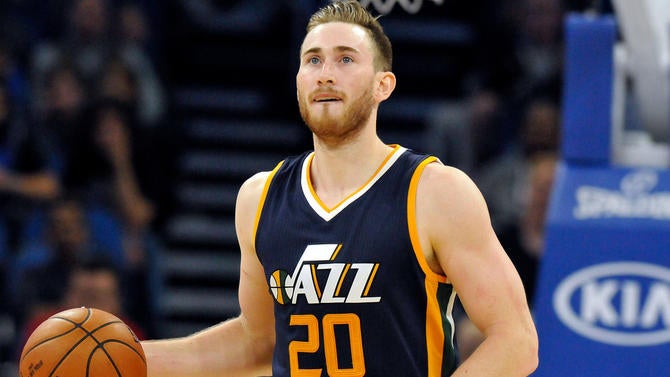
Against the New York Knicks a week ago, forward Rodney Hood initiated much of Utah's fourth-quarter offense, and he hit two big 3-pointers that put the game out of reach. Hood had a similar impact down the stretch on Friday against the Orlando Magic, scoring 11 of his 13 points in the final frame.
Hood is a patient, smooth pick-and-roll player who has a polished midrange game and is making 42.4 percent of his 3-pointers. It makes sense that coach Quin Snyder would want the ball in his hands in crucial situations. It would be a stretch, however, to call him their No. 1 option. Hayward leads the team in usage rate by a significant margin, and the true strength of the offense is that there are multiple options.
Favors is quietly one of the best two-way big men in the game, and he could be putting up monster numbers if the Jazz just ran pick-and-rolls with him at center on every possession. That's not how they play, though, and it's best to think of Utah as a younger version of the beloved 2014-15 Atlanta Hawks team that won 60 games and had four players make the All-Star team.
Snyder was an assistant coach under Mike Budenholzer the year before that magical season. Ideally, this group will be able to do what those Hawks did: make people realize that this isn't about building a team without a star. Rather, it's about developing multiple stars: Hayward, Hood, Favors and center Rudy Gobert. Oh, and guard George Hill has performed like a star this season, too.
Is Hill really a perfect fit?
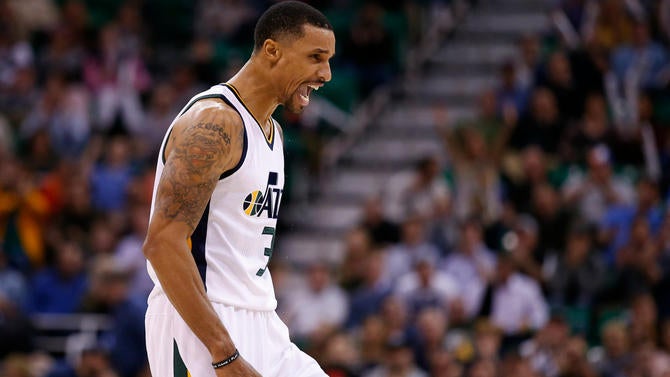
Yes, and that's why Utah tried to get him for years. He might be the best defensive point guard in the league, and while he is an effective floor general, he doesn't need the ball in his hands all the time. The Jazz like to use Hayward and Hood -- and now Joe Johnson -- as playmakers on the wing, so Hill's ability to make spot-up 3s is crucial. He's also strong enough to switch onto shooting guards and small forwards when necessary.
Hill has missed the last three games with a sprained right thumb, but just before that he won Western Conference Player of the Week. In seven games, he's averaged 20.4 points, 5.0 assists, 2.9 rebounds and just 1.1 turnovers in 33.9 minutes, shooting an absurd 54.1 percent and 43.2 percent from 3-point range.
"He's been unbelievably tough both offensively and defensively," Hayward said. "He's long and active on the ball. And on the offense, it seems like he's always going at his pace. He's controlling the game for us and he definitely won the game for us in a couple of games early on."
Hayward said he was "ecstatic" when Utah acquired Hill. Had this move happened a year earlier, it almost surely would have made the playoffs. Last season, the Jazz relied on Raul Neto, Trey Burke and Shelvin Mack to run the point. In the league where almost every team has a terrific point guard, Utah was at a huge disadvantage. No more.
What is their identity?
It starts with what Hayward said: the Jazz need to be elite defensively. They have shown that they can be, too -- in 2014-15, they had the best defensive rating in the NBA after trading Enes Kanter and committing to the frontline of Favors and Gobert. That is why they extended Gobert, the league's premier rim protector, on a four-year deal worth more than $100 million.
Beyond the defense, though, Utah should be known as the most versatile team in the NBA. In Hayward's first game back, Snyder closed the game with Hill, Hayward, Hood, Johnson and Favors on the court -- four ballhandlers and a center that can switch onto smaller players.
"Anytime you add a player of his caliber, everybody gets to do what they're good at a little easier," Snyder said. "So there's a trickle-down effect. I think he gives guys confidence, other guys on our team. It allows us to play small, with more size and more force 'cause he's a big guy, obviously, at the 3. When you play Joe Johnson and Rodney and Gordon, 2, 3 and 4, that's a decent sized team even though it's a small team."
Those three have only played 22 minutes together, but in that time Utah has outscored its opponents by 21.2 points per 100 possessions. Over the course of the season, that trio with Hill and a big man could emerge as the Jazz's version of the Death Lineup, but Snyder has a bunch of other options, too. If he doesn't want to use Johnson at power forward in a particular matchup, then second-year forward Trey Lyles and veteran forward Boris Diaw can defend multiple positions and stretch the floor.
With Favors and Gobert playing significant minutes together and dominating the defensive glass, Utah can look like an old-school team. That perception is helped by the fact that the Jazz are the slowest team in the league. They also pass more than any other team on a per-possession basis, though, and they have embraced the two most important tenets of the modern game: shooting and shape-shifting. They can beat you a bunch of different ways.
Any more reasons for optimism?
Yes! Diaw has played in only three games and didn't make much of an impact in any of them. Guard Alec Burks is out indefinitely after another ankle surgery. These are above-average rotation players, so we still haven't seen Utah at full strength. The Jazz also expect to see significant improvement from 21-year-old guard Dante Exum, who missed all of last season because of a torn ACL. He's been pretty passive on offense, but, like his team, he has all sorts of upside.