If Spurs are going to cover this much space, Rockets have to counter with pace
San Antonio's multiple-effort rotations are forcing Houston into too many shots it doesn't want to take

By
Matt Moore
•
9 min read

HOUSTON-- There are a lot of shots that Mike D'Antoni wants in his offense.
This isn't one of them.
A mid-range floater from Patrick Beverley on the baseline after running the clock down to the last five seconds. That was life for the Rockets in Game 3 vs. San Antonio, ending with a 103-92 Spurs win.
The Rockets were averaging 6.4 runners in the playoffs heading into Friday night. They averaged just three per game in the regular season. They were 4-of-13 on floaters in Game 3. They took 21 shots in non-Morey-ball zones (basically, any shot from outside the rim area to short of the 3-point line ) Friday night.
After the game, D'Antoni suggested that sometimes players are just going to take shots they're comfortable with, and if it's late in the clock, you have to trust them. But these shots are the antithesis of what works for the Rockets. Houston had the second-best offensive efficiency in the league this season, and no one has been able to dictate the terms of engagement on them defensively until the Spurs. So how is this happening?
LAYERS AND A TOWER
"They're running off the 3," Eric Gordon said after Game 3. "Anytime we're in the pick and roll, yeah we might pass the ball, but we have to make another effort to get someone else a good, open look."
Let's look at another floater, this time from Gordon. First, pay attention to how the Spurs guard Harden. Don't just watch the two guys directly defending him on the strong side, LaMarcus Aldridge and Danny Green. Watch Kawhi Leonard and Patty Mills.
First, Kawhi is lurking on the other side. Harden's had a world of trouble vs. the Spurs' reaches on his drives this series. Whether they're fouling him or not, they've disrupted his handle. If you do that and he's facing a weak big, he can still recover and score. But the Spurs' bigs are maintaining space and giving him extra trouble. So here he goes away from the middle, and you can see he has what appears to be a lane to the rim.
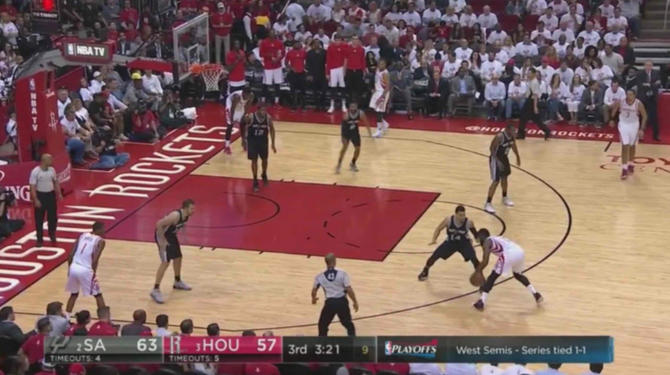
But the Spurs handle this again. In Game 1, the Rockets shredded the Spurs with pick-and-roll lobs. The Spurs effectively decided after that game, "No more of that." So they've started helping off more aggressively. As you can see below, once Harden gets in the lane and Aldridge has to push up, Mills comes down to guard against the lob on Capela:
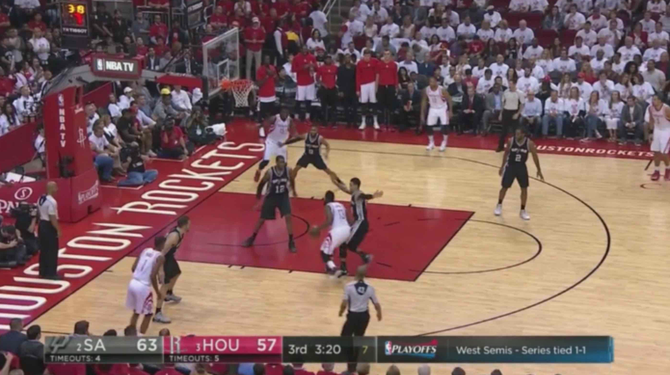
So now Eric Gordon is open on the weak side. But when Harden throws the pass, Mills is already recovering, and is fast enough to get there so that when Gordon lands from catching the pass, Mills is already there. Gordon has to drive, the shot clock's running down, and the floater is the result:
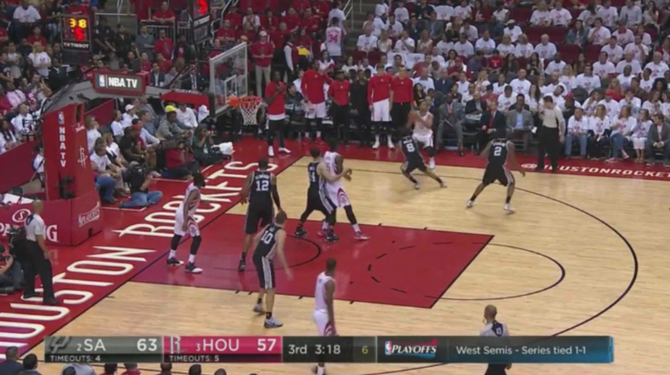
That's been the model.
- Force Harden to help with Green or Leonard as the primary defender
- Bring a big up, a true big like Aldridge or Pau Gasol, to contest
- Help aggressively on the big's man to prevent the lob or finish on the back side
- Recover on the weak-side 3-pointer.
That last bit is the interesting talking point here. The Rockets shot 39 3-pointers in Game 3. There are very few things old-school basketball minds and new-age advanced analytics experts agree on, but the idea that 3-point volume is more important than 3-point percentage is one of them. In other words, make or miss, the more threes you get up the better. So limiting those attempts is the key.
But the Spurs seem to have accepted after Game 1 that the Rockets are going to get up a ton of 3s. That's just what they're going to do. So at some point, the Spurs have decided to take away the action at the rim, close out hard on shooters, and live with the gamble on half-court, contested 3-pointers.
"We know that they're going to shoot 3s," Mills said Saturday. "That's what they do, so we can't take them all away. We hope to limit them, and contest them where we can, when we can."
"It's a challenge," Spurs coach Gregg Popovich said Saturday of the 3-point threat from Houston. "They have great shooters, good athletes, good scheme. Just like anyone else, we just try and do our best to get out to those shooters. But James does a great job about making you think about what you can do to him, how much you can help off other people. It's enough to drive you crazy."
This is a gamble, to be clear. When the defense collapses like this, there are going to be kick-out opportunities:
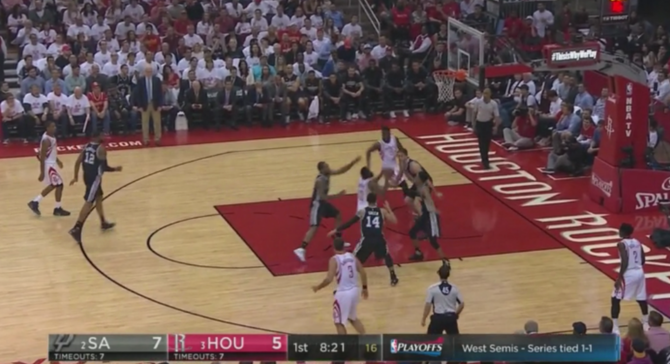
But the Spurs are A) disrupting Harden's attack very strongly, and B) they're forcing him into angles where he can't always find open shooters. Even when he did find those passing angle in Game 3, the Rockets didn't make them. In the last two games, Ryan Anderson and Eric Gordon have seven combined 3-point attempts off Harden passes, per NBA.com. Trevor Ariza has 11. The Spurs are targeting specific personnel (basically, make Ariza and Pat Beverley beat them, not Gordon and Anderson) and the Rockets haven't figured out how to counter that.
The biggest thing in the past two games for Houston has been this: Houston is getting the shots in the half-court that they want. But they don't want shots in the half-court at all.
PACE AND DISPLACE
Game 1: 37 Rockets fast-break points
Game 2: 13 Rockets fast-break points
Game 3: Nine Rockets fast break points
This is a problem.
Obviously, the Spurs have designed their scheme to stop this. The biggest thing has been offensively, they're scoring, which they did little of in Game 1. This was the big talking point going into Game 2 for the Spurs, and has been the talking point since. Their best defense is their offense. They are scoring, making the Rockets take the ball out, and that gives the Spurs time to set their defense. And trying to score on the Spurs' set defense is diving into the maw of a giant carnivorous whale. You don't get into shootouts with San Antonio where both teams are scoring, you get into a diminishing-returns match, where the more they score, the worse you do, which saps your energy on the defensive end, which allows them to score more efficiently and that's how they drain the life from your basketball soul.
Here's part of it, though.
The Rockets are allowing San Antonio to dictate terms if Houston doesn't succeed initially. What does that mean? It means that Houston isn't running off of made Spurs buckets.
I went back through all of Houston's possessions in Game 3 and tracked when they made their "initial action." This is a vague and subjective term, so you're going to have bear with me. It means the first real effort to drive, or the first screen set, or the first pass made to begin a set. I wanted to see how much time was on the shot clock when that happened. I didn't count shortened-clock possessions off deflections or a handful of other possessions.
First quarter: 19 seconds left on the shot clock, Rockets won the quarter by two.
Second quarter: 17.7 seconds left on the clock, Spurs won by six.
Third quarter: 15.9 seconds left on the clock, Spurs won by two
Fourth quarter: I only tracked the first 11 possessions, which is where the game got away from Houston, where they averaged initial action at 16.9 before trying to speed things up down double digits in the last four minutes.
The important thing is that third quarter stretch. The Rockets closed within a point in that quarter, only for Harden to unleash a series of possessions where he began the action with under 14 seconds left on the clock. It doesn't give you enough time to make multiple drive-and-kick plays to get the Spurs' defense scrambling. One action and done is never going to get it done vs. the Spurs' defense.
Harden is going to have to take the ball out off of makes; the Rockets aren't good enough to get enough stops vs. the Spurs to win that battle, even if they have an off night.
"That's one of the reasons...," Harden began to say about pushing off makes on Saturday, before changing course. "We have to get stops. They played at their pace yesterday. We have to do a better job rebounding."
When the Rockets did try and push off makes, it was Harden trying to push the ball ahead to shooters. The one mismatch that the Rockets have is Trevor Ariza being guarded by LaMarcus Aldridge, who did a terrific job stepping out to contest and prevent the quick 3-pointer while also hanging with Ariza on the drive.
This is a conundrum with Ariza. He's a 34-percent 3-point shooter this year, which means if he does launch, the Spurs will live with it. But more importantly, Ariza can't drive or create off the dribble. He had one great dunk in Game 3, but overall, you get actions that just wind up eating clock.
Here's another Ariza push after a make, which winds up taking off a lot of time... and it results in, to circle back, one of those floaters:
Ariza has to be on the floor often to guard Kawhi Leonard; he's done a tremendous job on an impossible cover in this series. But the Rockets also need another playmaker up the floor to push the edge and get transition buckets besides Harden, and neither Gordon nor Beverley have been able to do that to huge effect.
The Rockets challenged the Spurs in Game 1 and said "you're going to have to be perfect with your two-big lineups to contain us." The Spurs have risen to that challenge. So now the Rockets' only real adjustment is to go even smaller, with Ryan Anderson at the 5 for stretches, sacrificing any chance on the boards, to try and get ahead of them... but they haven't shown an ability to get out in transition if they're not getting the rebound. It's a catch-22.
AND YET ...
This isn't to say the Rockets are cooked. The Spurs had no chance to win Game 1. The Rockets had plenty of chances to win Game 2 and Game 3. They missed open shots, and while that's always going to be the case in a loss, with Houston, they're just as liable to have a game like that as they are to burn the nets to cinder and ash in Game 4. If they knock down those threes at just a 38 percent clip vs. the 31 percent rate they did in Game 3, they'll win if Game 4 is played the same way.
They have things they can do better, ways they can play better, that's why the talk on Saturday was about "championship spirit" from Mike D'Antoni and "swagger" from James Harden. But there are tactical things that have to improve, or they have to have better execution. It's an either/or situation, not both, for Houston. That's how much firepower they have.
One more note on the execution issue. You saw a lot of plays like this in Game 3:
Notice that pass. The pass being just a little bit off prevents the catch-and-shoot 3-pointer. Houston was all sorts of off on those, and while some of it is assuredly the Spurs' defense, some of it is just passes that went awry. This is why coaches will talk about execution over game plan. It's these little things that can be the difference in a series.
Houston has a lot of ways to even the series in Game 4. But this is the Spurs, and they will be putting every ounce of pressure on the Rockets to bend, bend, bend, and finally break, securing San Antonio a path to the conference finals if the Rockets don't respond.