INFOGRAPHICS: NBA Draft trades are on the rise overall but not within the lottery
The data reveals lottery teams have been more hesitant to make deals in the one-and-done era

•
5 min read

Once again, we're running our annual NBA Draft Trends series. Every Wednesday leading up to the NBA Draft will feature a piece on both the college and/or professional angle of the draft to highlight patterns (and dispel some myths). We started with an unprecedented turn of events in this year's lottery, then followed that up with a deeper look at the history of the No. 2 pick. Last week, we broke down a lot of the myths surrounding international players taken in the first round. Today, an examination of trade patterns over the past 25 years.
It's draft season, yes, but it's also trade season. We're now 15 days away from this year's draft, and the one guarantee for June 23: We're going to see so many trades. Some have already been put in place due to previous trades. Other trades will be agreed upon in the days, even hours leading up to the draft. Heck, even minutes before certain picks are made. These decisions, these agreements to swap picks, can have long-lasting positive effects on a franchise.
They can also amount to absolutely nothing.
They're certainly a major part of draft mythmaking and the science of selection. So all this swapping hasn't stopped teams from switching positions in an attempt to out-think their competitors. Right now, one of the big speculation talking points is whether the Los Angeles Lakers will trade out of the No. 2 spot. While it seems foolish when there's a good 1-2 of Ben Simmons and Brandon Ingram at at the top of the draft, reality is it's not a terrible idea to trade down, if you look at the history of the pick. But if the Lakers are going to trade that pick -- hey, let's take it three steps further and include other teams in the top five: -- Boston, Phoenix and Minnesota -- they're going to buck recent convention.
It hasn't been trendy to trade out of the top five over the past seven drafts. This after it was commonplace for much of the previous 2 1/2 decades before that. On the whole, here's what's become of the NBA Draft trade scene in the past 25 years. Three-hundred-and-eighty-five of the 1,455 players who've been drafted since 1991 have had their rights traded on draft day.
Overall, the pattern of trading picks has gone up in the past decade -- while trading within the top five, or even the lottery, isn't as potent as it was in the 1980s and 1990s.
Here are the total lottery pick trades by year over the past 25 years.
Why do teams trade if they're in the top five? Here are 15 reasons why. These are the 15 best players/careers among guys who were top-five picks that got moved on draft day. For clarity, I only selected players who went to teams that traded for them, then lasted at least four seasons with that team and also had significant statistical contributions.
1993: Chris Webber: Orlando to Golden State at No. 1; Penny Hardaway: Golden State to Orlando at No. 3
1995: Antonio McDyess: LA Clippers to Denver at No. 2
1996: Stephon Marbury: Milwaukee to Minnesota at No. 4; Ray Allen: Minnesota to Milwaukee at No. 5
1997: Keith Van Horn: Philadelphia to New Jersey at No. 2
1998: Antawn Jamison: Toronto to Golden State at No. 4; Vince Carter: Golden State to Toronto at No. 5
1999: Steve Francis: Vancouver to Houston at No. 2
2001: Tyson Chandler: LA Clippers to Chicago at No. 2; Pau Gasol: Atlanta to Memphis at No. 3
2004: Devin Harris: Washington to Dallas at No. 5
2006: LaMarcus Aldridge: Chicago to Portland at No. 2
2008: O.J. Mayo: Minnesota to Memphis at No. 3; Kevin Love: Memphis to Minnesota at No. 5
We haven't had movement in the top five in a while, though. Will the streak be broken this year? The Celtics have options at No. 3, for sure. Here's the takeaway: as the overall talent crop in college basketball has been perceived to be less impressive in the one-and-done era, the impulse to trade into the top five has disappeared.
You could also look at it and say: Teams are less willing to trade down, figuring that drafts aren't as deep as they once were.
But you can get great value outside of the top five, even outside of the lottery. But it's not easy. In fact, many GMs could say it's a lot of luck. First off, you have to have the player slide to you. Then, he has to actually work out in your system. But with some regularity, really good (sometimes Hall of Fame-level) players are acquired via trade. Here are names of notable guys whose rights were traded on draft day:
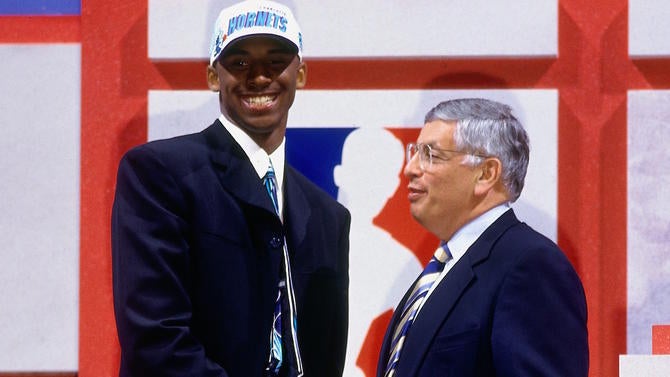
- Kobe Bryant (Charlotte to Los Angeles at No. 13, 1996)
- Dirk Nowitzki (Milwaukee to Dallas at No. 9, 1998); Bonzi Wells (Detroit to Portland at No. 11, 1998)
- Richard Jefferson (Houston to New Jersey at No. 13, 2001)
- Luis Scola (San Antonio to Houston, No. 55, 2002)
- Kendrick Perkins (Memphis to Boston at No. 27, 2003); Leandro Barbosa (San Antonio to Phoenix at No. 28, 2003); Kyle Korver (New Jersey to Philly at No. 51, 2003)
- Luol Deng (Phoenix to Chicago at No. 7, 2004); Jameer Nelson (Denver to Orlando at No. 20, 2004); Anderson Verajao (Orland0 to Cleveland at No. 31, 2004)
- Nate Robinson (Phoenix to New York at No. 21, 2005)
- Brandon Roy (Minnesota to Portland at No. 6, 2006); Rudy Gay (Houston to Memphis at No. 8, 2006); Rajon Rondo (Phoenix to Boston at No. 21, 2006)
- Marc Gasol (Los Angeles Clippers to Memphis at No. 48, 2007)
- Roy Hibbert (Toronto to Indiana at No. 17, 2008); Nicolas Batum (Houston to Portland at No. 25, 2008)
- Ty Lawson (Minnesota to Denver at No. 18, 2009)
- Eric Bledsoe (Oklahoma City to Los Angeles Clippers at No. 18, 2010)
- Bismack Biyombo (Sacramento to Charlotte at No. 7, 2011); Kawhi Leonard (Indiana to San Antonio at No. 15, 2011)
- Andre Roberson (Minnesota to Golden State, then Golden State to Oklahoma City at No. 26, 2013)
Plenty of really nice players there who became cogs of those teams after being drafted by them. Some went on to have even better careers in different spots, but all of them started well with the franchise that traded to get them. Then there is the hilarious instances where rights go through the meat grinder. Take a look at these two players, Sergei Lishouk and Georgios Printezis. Screengrabs via RealGM.com.


Two players with a combined -- yep, you guessed it -- zero games of NBA experience. Trading for international prospects is another matter entirely, though.
Trades are tricky, and made even tougher when dealing with unproven commodities like draft picks. They can often benefit both teams. But it often takes years of hindsight to know for sure. Owners and general managers have long been liberal with moving up, moving down, treating the draft like an never-ending experiment. No evidence exists that trading on draft day leads to unequivocal success vs. traditional drafting in allotted spots. Sometimes teams land the right guy, but often, no. Just as it goes with the draft. The percentage of players that stick is small. There is no science to trading. It's about fit, money and, as always, the future.