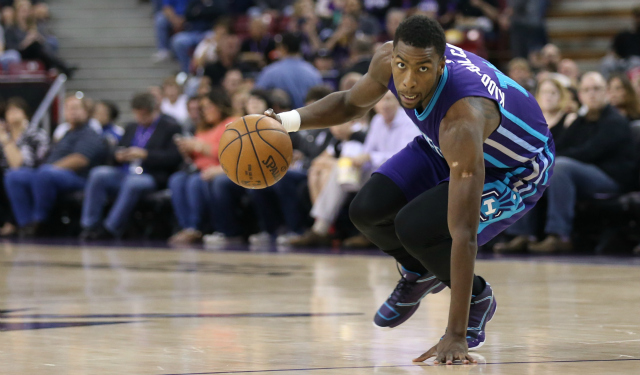
Michael Kidd-Gilchrist's return to Hornets couldn't come soon enough
Getting a healthy body back who happens to be one of the best defenders in the NBA is something this battered Hornets team needs badly.

By
Zach Harper
•
6 min read

SALT LAKE CITY -- In most seasons in the Eastern Conference, just being around .500 would guarantee you a great shot at making the playoffs and soaking up some valuable postseason experience. Steve Clifford's first season coaching Charlotte was a success, posting a 43-39 record for the 7-seed while an Atlanta team six games below .500 rounded out the East playoff picture. Last season, the Charlotte Hornets managed just 33 wins and missed the playoffs by only five games.
Right now, they find themselves 22-24 after a blowout loss to the Utah Jazz. The schedule and injuries have ravaged this team. The Hornets were penciled to play 17 games in 31 days in January, including 12 on the road. Nicolas Batum (toe), Jeremy Lamb (toe), Cody Zeller (shoulder), Al Jefferson (knee) have all missed key games or significant time, and Jeremy Lin turned his ankle in Utah and didn't return.
The Hornets' rotations are hanging on by a thread and all of this is happening to Charlotte in a year in which the East is flush with eight winning teams. Clifford's team needs an injection of energy.
The good news is the Hornets' injury situation may be getting monumentally better very soon. Michael Kidd-Gilchrist, a defensive stalwart and former No. 2 pick in the draft, has missed this entire season after shoulder surgery. And many people weren't sure that he'd even play this season after surgery to repair a dislocated shoulder back in early October.
“He’s close to playing," Clifford said. "I think he’s ready to play. The big thing now is just being safe with his shoulder. The doctors want to make sure we give him the proper maximum time that we’re as sure as we can be that he won’t go out and hurt it again. He’s worked hard. He’s done a lot of contact. He’s been practicing for a while. He’s certainly close to being ready to go.”
Kidd-Gilchrist is one of the best defensive players in the league. Not just one of the best defensive wings; one of the best defenders, period. When he was on the floor for the Hornets last season, they were nearly eight points per 100 possessions better defensively and 10.8 points better overall. There can be a lot of noise in this stat, but players shot just 0.3 percent worse than they normally would when defended by MKG. When you dig deeper, you see that the majority of their success came in the first quarter against Kidd-Gilchrist.
He just wears you down as a defender, adjusts to what you and your team are doing, and then locks in the rest of the game. First quarter, opponents shot 2.7 percent better against him. That drops to 0.6 percent better than normal in the second quarter. By the third quarter, opponents are shooting 2.8 percent worse against MKG and that drops down to 3.1 percent worse in the fourth quarter.
The thing about his defense is you don't see it with traditional stats. He doesn't get steals. He doesn't block shots. He had 68 combined steals and blocks in 55 games last season. That's not a lot. His coach isn't worried about him not forcing those turnovers and getting steals.
"You want to gamble?" Clifford asks rhetorically. "You better get it. Stealing the ball in this league is one of the most overrated things. You look at Golden State is the difference but except for them, this is my 16th year, normally most years the teams that gamble and try to steal the ball are the worst defensive teams. [Golden State has] changed that because they’re so tied together and they’re all so big but usually forcing turnovers is not a recipe for playing good defense.”
We know the Hornets' defense will improve with the return of MKG. Once his conditioning is back to normal, his ability to help, recover and help end possessions with rebounding (Hornets are still second in the NBA in defensive rebounding percentage and 14th in defensive rating). But what happens to this new high-powered offense when Kidd-Gilchrist returns? The reconstruction of his shot and what it could mean to the Hornets has been a topic of discussion ever since he was drafted.
The Hornets dedicated themselves to shooting more 3s as Clifford saw the impact 3-point shooting can have on contending teams. They currently ranked third in 3-point rate (percentage of shots that come from behind the arc) and 17th in 3-point percentage. A more open floor with more ball movement has helped them jump from 28th in offense last year to 14th in offense this year, despite the injuries. But MKG has never been a 3-point shooter. He's taken just 18 3-point attempts in 195 career games, made three of them, and didn't take any last season.
Clifford expects that to change some and by the end of the season, we could see Kidd-Gilchrist getting to the corners to take 3-point shots.
"He hasn’t [been a 3-point shooter]," Clifford admitted, "but I believe -- and I don’t think it’ll be right away -- I think you’ll see him shooting corner 3s this year, by the end of the year. He’s worked really hard with Bruce Kreutzer, our shooting coach. I was watching him this morning and even at the end of last year, he shot a good percentage from 19 to 20 feet. He had worked so hard. I think that he’ll do that."
After shooting 30.9 percent from 16-23 feet his first two seasons, Kidd-Gilchrist did improve his percentage at that distance to 37.1 percent. He now features a jumper with better form, less of a hitch and a smoother release. It's been years of working on it with Mark Price previously and now Kreutzer. If he can be a near-40 percent shooter from those midrange spots, taking that to the corners for 3s isn't too big of an adjustment.
Clifford isn't expecting Kidd-Gilchrist to change his game or who he is as a player. In fact, he doesn't want him to do that because he doesn't believe that's extremely beneficial in adding value because it's so rare that players do it successfully. He believes the biggest way guys can change their value on the court is by adding long-range shooting, but it can't come at the price of forgetting who you are.
“How you play is how you play," Clifford explained. "The biggest mistake that people make is it doesn’t matter what player you have, they’re not going to change the basic nature of how they approach the game. If you’re a driver, you’re going to be a driver. That’s your strength.
"The other part of that is a maturity in the way they play. Knowing what your game is. If you’re a driver and you can add shooting, don’t lose what your great strength is that you’ve probably done since junior high. You’re a driver. That’s Gilchrist for us. Mike is still going to get to the basket. His shooting is improving tremendously. I’ll tell you we had a long talk yesterday. He’s going to be a great defender, an individual defender, an energy guy, and a guy that brings value to our team with his intelligence. Then when he makes shots, he puts himself in another place. But his game should never be based on anything but value."
The Hornets plan to meld what Kidd-Gilchrist can do with what the team is doing. It sounds simple but they don't want it to happen by him changing as a player. If he feels comfortable stretching his offense to the corners then they're all for it. Overall, they want his defense. They want his energy. It helps that an unexpected healthy body returning to the rotation will happen to be such a brilliant defensive player. He'll make plays on that end of the floor. He'll make plays on offense at the rim.
And Charlotte will hope it's enough to fight for a playoff spot that typically wouldn't require such a battle.