Reggie Jackson getting used to his dream job starring for the Pistons
Detroit guard Reggie Jackson spent three and a half years as a backup. Now he's the man in Detroit, and he's handling the transition well.

•
11 min read

Twenty-three days after joining the Detroit Pistons, Reggie Jackson’s teammates called him out. Against the Utah Jazz, Jackson had 10 points, zero assists and five turnovers and was benched down the stretch for a rookie. For the first time in his career, Jackson found out what it feels like to lose 10 games in a row. On the team plane, veterans Caron Butler, Jodie Meeks and Greg Monroe moved the rookie, Spencer Dinwiddie, from his usual seat at their table and asked Jackson to sit down.
"It was like, 'What is it that you want?" Jackson said. "Basically, 'You’ve talked a big game, you got the opportunity and this is your chance. Like, this is your team, you got the keys, go out and be you.'"
They told Jackson that, from then on, everything would operate through him. They clicked earlier in the season when Brandon Jennings, pre-Achilles injury, played with an attacking mentality. Jackson "struggled trying to be somebody else, be this ideal point guard," he said, and "didn’t want to step on any toes." That wasn't working.
When Jackson arrived in Detroit, he was ecstatic about the opportunity. He loved coach Stan Van Gundy’s system, couldn’t wait to play with Andre Drummond and remembered Kentavious Caldwell-Pope scoring 30 points against the Thunder as a rookie. He wanted to prove himself. After three and a half seasons playing alongside Kevin Durant and Russell Westbrook, he needed to get used to being the man.
"Even every game I tried to be aggressive in OKC, there was times, of course, I would defer to Russ and KD," Jackson said. "We all were. Two talented players who get it done night in and night out, and very proven in this league, that’s what happens. I got over here and I’m thinking Greg needs his touches, you’re going to keep Andre happy and everybody else. I want to find the shooters shots, but I’m not really understanding how I’m going to get that done."
In his first game since that sit-down with his teammates, Jackson had 23 points and a career-high 20 assists, a victory over the Memphis Grizzlies. In the final 16 games before hitting free agency, he averaged 19.9 points, 10.9 assists and 4.9 rebounds. Then he re-signed in Detroit for five years and $80 million in July, a contract that was controversial at the time but not so much anymore. He’s continued to put up All-Star numbers in his first season as a full-time starter.
Jackson scored a career-high 40 points against Portland Trail Blazers in November, including 26 in a fourth-quarter comeback. Earlier this month he had 34 points and 16 assists in a victory over the Phoenix Suns, becoming the first Piston to have a 30-15 game since Isiah Thomas in 1988. Down the stretch against the Los Angeles Clippers on Monday, fans at the Palace of Auburn Hills chanted his name. He’s had his share of off-nights, too, but understands that he’s going to be expected to bring his best consistently now. That is exactly what he worked for.
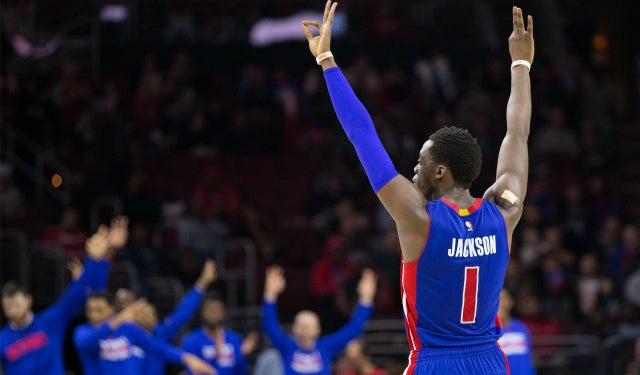
Three summers ago, Jackson showed up for a 7 a.m. workout with his new shooting coach, Mike Penberthy. He was 22 years old and "almost like a ghost,"” Penberthy said, recalling the difficulty of getting Jackson to communicate with him. Penberthy usually has his clients shoot 500 to 700 shots in an hour, and after the first 40 or so, Jackson was obviously straining and tired. After the first 100, Penberthy had to check on him.
"I was like, 'Are you OK?'" Penberthy said. "And he's like, 'Yeah I'm good.' And I’m like, 'Dude, you're sweating really hard.' He’s like, 'Nah, I'm good.' I was like, 'You want some water?' And he's like, 'No, I'm good.' I'm like, 'Reggie, what's going on? You gotta tell me. We have to work together here. I'm trying to help you. You've seen Freddy Roach and Manny Pacquiao? This is how it works. I'm working with you here, you’ve gotta give me some conversation here.'"
Finally, Jackson admitted his shoulder was tight. "He wanted to just grind, grind, grind through it," Penberthy said, adding that he had to convince Jackson that shooting was supposed to be easy, not painful. Penberthy couldn’t get a read on him at first -- Jackson was so quiet that you couldn’t tell whether or not he’d be there the next week. He kept showing up at 7 a.m., though, and then he wanted to do two-a-days.
Penberthy soon discovered Jackson was “by far the most disciplined player I’ve ever coached.” The two of them had a lot of work to do, and Jackson was initially trying to tuck his elbow in the way you’re taught in grade school. The result was a stiff, difficult shot for someone with arms as long as his, and Penberthy didn’t want to see that. Doing things by the book wouldn’t get them anywhere.
“He didn’t try to make my shot anybody else’s,” Jackson said. “I don’t think he tried to put me in this box or this construct. He always just preached to me, if I have an athletic body build, then why would you not use it to your advantage on your shot? He just worked with me on figuring out my shot and being very smooth and consistent with in it. But it’s very relaxed. I didn’t feel like I was trying to shoot in a telephone booth.”
This past offseason, Jackson missed the playoffs for the first time, so he was in the gym with Penberthy in May. The focus was on shooting effortlessly from range, and stopping his right knee from collapsing. If he could keep a stronger base on his shot at the end of a vigorous workout, it would be easier to do the same late in games where he’s playing 30-plus minutes. He had to make 10 in a row from a spot to move on to the next one. That first day, when he was exhausted, that number was three.
When Penberthy watches Jackson this season, he sees a different kind of confidence. On his makes, Jackson used to shake his head as if to say, “Finally!” -- he has always been a perfectionist, so it has been a challenge to move on from misses. “Now he makes a swish, he just goes back down the court,” Penberthy said, and it’s usually the same response regardless of the result. It took thousands of shots to get there.
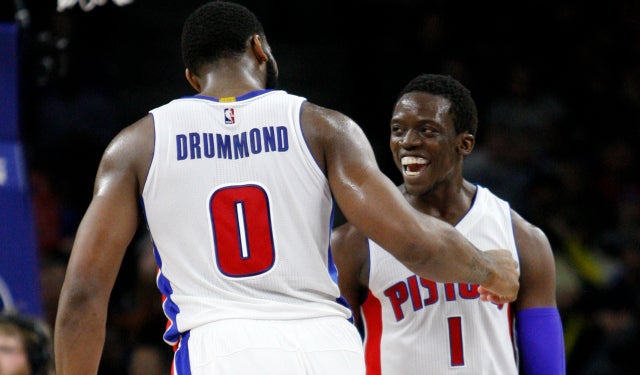
The first night Jackson spent in Detroit, he wasn’t cleared to play but teamed up with his new pick-and-roll partner anyway. After cheering on the Pistons in a win over the Bulls, Jackson and Andre Drummond had a shooting contest against owner Tom Gores and Jackson’s brother, Travis. They talked trash and joked around at the Palace of Auburn Hills until 4 a.m.
Two days later, Jackson and Drummond stayed at the Palace until 4 a.m. again after a win over the Washington Wizards. Jackson said he didn’t know how he’d be received in Detroit, but Drummond “knows how to lure people in, make you feel wanted.” Immediately, he knew he had someone in his corner.
Jackson stayed in a hotel for a while, then he moved into a place across the street from Drummond. He perhaps could have saved his money and just moved in.
“We had dinners after games,” Jackson said. “It became that. Then it became we played video games, trash talk a little bit about who’s winning here, who’s winning there. Just hanging out all the time. I forgot I had an apartment of my own, I had my own condo -- I just basically was at Dre’s all the time. We had practice together and then we would go play the game together, eat together, just hang out. We’d be up all night, end up just talking the game, trying to figure out what we have to do to get better and to try to figure out how to be a dominant force in this league.”
Together, Jackson and Drummond are able to be their best selves. It’s not complicated: Drummond sets the screens, Jackson makes the plays, shooters space the floor. Penberthy, once a Los Angeles Lakers guard, compared it to when he played with Shaquille O’Neal and “every ball screen I was in with him was like the Red Sea was parting.” It is demanding, though, for Drummond to repeatedly dive to the basket and Jackson to repeatedly put pressure on the defense. It helps that they want to play hard for each other.
“Man, he’s playing out of this world,” Jackson said. “It’s silly to watch. It’s like a kid playing a video game. He never ceases to amaze us. He continues to find 20 rebounds nightly and 20 points to go along with it. He’s playing special. He’s doing better defending the rim for us and defending the paint. He’s been more active in pick-and-roll coverages. He’s talking. He’s getting better with his wind. He’s just playing at a whole ‘nother level. He definitely, I think, has to be in consideration for best big in the league. And in my eyes, he’s been every bit of that to start this season.”
Drummond, 22, is indeed one of the best centers in basketball, and Jackson has done his part to make that happen. His smoother 3-point shot off the dribble means teams can’t go under Drummond’s massive screens. His proficiency with lob passes means teams can’t risk giving Drummond room as he rolls. Jackson can make teams pay with floaters whether he makes or misses them -- when he attracts attention, Drummond gets offensive rebounds and scores.
If there’s a way to stop the two of them, the league hasn’t figured it out. The architect of the team is betting that won’t happen.
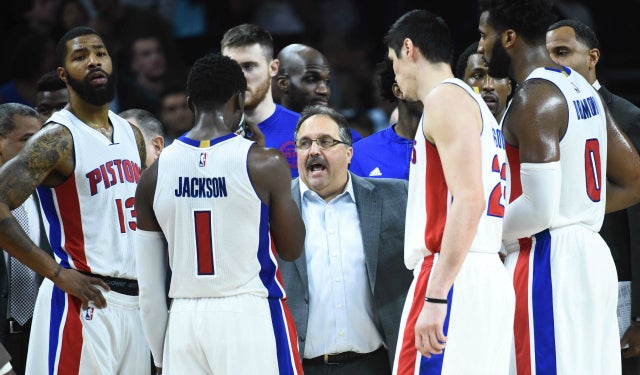
After a game against the Bulls last season, Stan Van Gundy pulled Jackson aside and told him how hard it is to be a star in the NBA. Jackson had the ball in his hands every night, and the team relied on him to execute the game plan. In November, after a loss to the Los Angeles Lakers at the end of a six-game road trip, Van Gundy told reporters that Jackson had been awful, was worn down and his decision making was terrible. Some players don’t like their criticism served directly or publicly, but Jackson appreciates Van Gundy’s approach.
“He has tapped into something that I wasn’t sure I had,” Jackson said. “He continues to challenge me to be better than sometimes even I think I can be. So he’s always pushing me to another level and making sure there’s no excuses, just get it done. And I think one of the things I like most about him is he holds everybody accountable.”
Van Gundy’s four-out system is predicated on Jackson making the offense go. In the Pistons’ 15 wins, he’s averaging 23.4 points, 6.9 assists and 2.7 turnovers, shooting 49.4 percent and 48.3 percent from 3-point range. In their 12 losses, those numbers drop: 15.9 points, 5.5 assists, 3.7 turnovers, 35.8 percent, 22.8 percent from 3-point range. His usage is higher than Durant’s, and he’s getting comfortable with all this responsibility.
“You are looking for young men that are driven and hungry and have high expectations for themselves and the role that they can envision,” Detroit general manager Jeff Bower said. “It’s really important, though, that that blends and matches with the team that they’re on and the environment that they’re in. We have a situation here where our opportunities and needs probably met what Reggie was looking for, and he understood that and has taken advantage of it.”
Two years ago, almost to the day, Jackson told reporters that he wasn’t complaining about his sixth-man role, but eventually wanted to be a starter -- when he woke up at 5 a.m. every morning to train in high school, he told himself he wanted to be the greatest. Last year at this time, he was still a reserve, trying to help a banged-up Thunder team try to make a playoff run while his future was up in the air. Now Jackson is a better player in a bigger role, with a coach that believes in him and a capable co-star. When he met up with Penberthy in November, the two laughed about how far he'd come. For the Pistons, though, what's most important is that this is only the beginning.
“You still are talking to the same hungry individual that’s trying to figure it out and always trying to be the best player in the league at all times and trying to elevate his team to a level to win championship,” Jackson said. “Still the same me. Just a new situation.”