
Tim Duncan set the standard that seems so impossible to replicate
Every team is supposed to copy Spurs culture, but you're really asking people to copy Tim Duncan

By
Zach Harper
•
4 min read

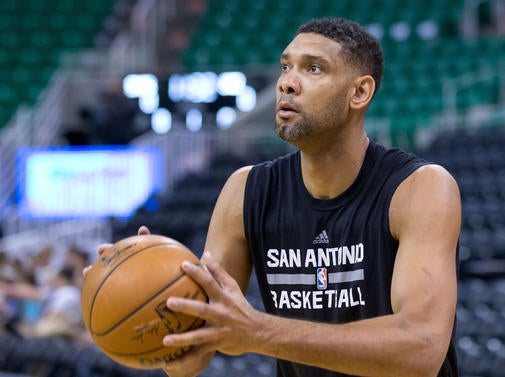
It was April 5 and the San Antonio Spurs were enjoying another incredible season. They were on their way to a franchise-best 67 wins, which would end up feeling empty when they couldn't solve the Oklahoma City Thunder in the second round of the playoffs. The Spurs were in Salt Lake City to take on the Utah Jazz and an hour-and-a-half before the game, Tim Duncan ambled out to his team's end of the court to go through the routine.
Black "San Antonio Spurs" warm-up shirt. Gray game shorts. Adidas laced up leading to his knee-high black and gray socks. The socks providing a brief layer between his kneecaps and his customized Punisher knee braces. The robotic routine began with a warming of his hands before he started going through all of the mid-range jumpers, bank shots, rip-through moves, and hook shots that have terrorized opposing arenas for 19 years. There wasn't much fanfare from those in attendance. A few workers and security guards turned to appreciate the legend before them for a few minutes, but eventually they moved on to focus on something more captivating or a conversation that muted his presence.
This was a perfect encapsulation of Duncan's career. The work would be done without the focus being on him. Everything was precise and no wasted movement was given. Do the work and do it well, no matter what the playing situation was going to be. Duncan would score just three points in 23 minutes that night. He didn't make a single shot in a victory. But that didn't change his approach to the game. He approached it like any other night in a dominant NBA career the likes we haven't really seen since Bill Russell.
Russell's 11 rings in 13 seasons couldn't be attained but five rings in 19 years is a pretty impressive success rate for Duncan and the Spurs. And in a similar way Russell was able to command the culture of a team behind a brilliant, forward-thinking architect and coach, Duncan put winning above ego. He put winning above everything and his existence meant the Spurs would win far more games than they could ever lose. San Antonio won 71 percent of their games in the Duncan era, not just because they had good players and a great star, but because the team culture that was established by their team-builder was embraced by their superstar.
When a team is rebuilding, so many suggestions revolve around replicating what the Spurs have. What Gregg Popovich, R.C. Buford, and Peter Holt have established in San Antonio is truly beautiful in terms of adopting a true team sense, but none of it happens without Duncan agreeing to fit in -- agreeing to sacrifice fame, branding, and personal accolades for the greater good of cultivating a team culture that would help lead him to wins.
When we say a team should adopt what the Spurs have done, what we're really urging is for the star player of that team to adopt Duncan's selflessness in the name of the fire burning inside of him to win. That's why the first thing the Spurs mention about Duncan's career in their retirement announcement was about the team victories and the team success instead of the accolades and individual excellence he was able to accumulate over his career. His résumé is as impressive as anybody's over the last three decades.
Three players in NBA history have scored 26,000 points, grabbed 15,000 rebounds, and dished out 4,000 assists in their careers. Kareem-Abdul Jabbar. Wilt Chamberlain. Tim Duncan. That is some kind of company to put yourself with through countless jab steps, drop-steps, and instances of being just a half second better than your competition over and over again.
The only emotion he ever truly showed on the court was disbelief that a foul had been called against him -- flashing a bug-eyed, incredulous look at officials. He showed as much emotion off the court accepting the Larry O'Brien trophy as he did having his kids with him at playoff press conferences. All the while, ego continued to be set aside in the name of victories. The inferno inside him to win could be seen in his eyes, raging as much in Year 17 to win a title against the Miami Heat as it did in Year 2 to get his first ring over the New York Knicks.
And this is what we ask of today's stars and tomorrow's hardwood heroes. Be the guy who only cares about winning. Be the star who sacrifices for the team culture. Be the one who sets the next example for generations of players that going quietly into the night doesn't mean you don't destroy everything in your path.
You win titles. You become the standard. You embody the team culture everybody pretends to want to create through sacrifice of the individual. That is still Tim Duncan until someone else does. So few have done it before him. So few will do it after him. But all will claim it's important to them. Whether it was his rookie year or his flirtation with two decades in the NBA, Duncan put in the work to be historic. Quietly. Robotic. Historic.
No matter what.