Eric DeCosta and how events unfolded in the Ravens' NFL Draft war room
Eric DeCosta, Baltimore's GM-in-waiting who has been with the club almost since its inception, gives a behind-the-scenes account of the NFL Draft and how the Ravens used their bounty of picks with numerous holes to fill.

•
11 min read

Like many of the NFL's top evaluators, a good portion of Eric DeCosta's thoughts are consumed by the NFL Draft. From mid-summer through early spring, not a day goes by that he isn't mulling over some element of the annual entry-level selection process -- to the point that the event almost begins to feel like an extension of his being.
And for DeCosta, the assistant general manager of the suddenly retooling Baltimore Ravens, coming off a disappointing season and ending up with a bounty of 11 picks and with numerous holes to plug, this particular draft was assuming an acute import.
The Ravens missed the playoffs last season after nearly knocking the Patriots out of the postseason in 2014 (when New England went on to win the Super Bowl). For the first time since coach John Harbaugh took over in 2008, they played regular-season games in which they were already eliminated from the postseason, and their 5-11 record was their worst since 2007.
Never a team to go too wild in free agency, this had long set up as a paramount draft for them -- one the Ravens entered with a particular focus on their four fourth-round picks -- and it would no doubt take a mental and physical toll on the men entrusted with shepherding it.
Even knowing all of that, however, it was jarring to listen to DeCosta document the draft process, and the emotions that swirl within him in its aftermath. I spoke at length with the well-respected personnel man during my latest podcast (www.bmoshow.com), exploring not only the behind-the-scenes machinations going on at the top of the draft Thursday night with trade offers floating around and tackle Laremy Tunsil plummeting as the result of a social media sabotage campaign, but what the aftermath of the process is like for men like DeCosta who have so much invested in each pick.
"The reality is, you carry this draft around with you for like nine months," said DeCosta, who has rebuffed numerous GM overtures from other clubs to remain Baltimore's GM-in-waiting.
"It's like having a baby and going through all of the different stages of the year -- in the fall scouting, the all-star games, the combine, the personal workouts, and then the draft. And when it's over it like hits you in the face and it's basically, ‘What am I going to do with the next couple of months.' And, ‘How am I going to stay busy?' And there's a sense of depression that you feel, and everything keeps building and building and building and building, and then boom, in the span of three days it's over."
There is an overall fatigue from the pressure of the process, and it was only on Wednesday that DeCosta said things began to return to the norm. By then he has processed all that transpired and could have transpired -- including a potential trade to move up to the fourth overall to selection corner Jalen Ramsey, the eventual selection of tackle Ronnie Stanley over Tunsil (who was removed from Baltimore's board when the video emerged) and a busy third day punctuated by the selection of Navy quarterback Keenan Reynolds, who the Ravens coveted as a player and a person.
DeCosta had replayed picks and scenarios in his mind and was starting to disconnect from the three-day selection binge and transition back to more mundane weeks ahead at the office.
"You're exhausted the first couple of days," DeCosta said, "and today is probably the first day that I feel normal. You go through all of the angst and excitement and then all of a sudden, it sounds crazy, but there is an empty feeling, and now I'm looking forward to the weekend and my first chance to see these guys on the field together for the first time and then we start up again soon and the hunt goes on."
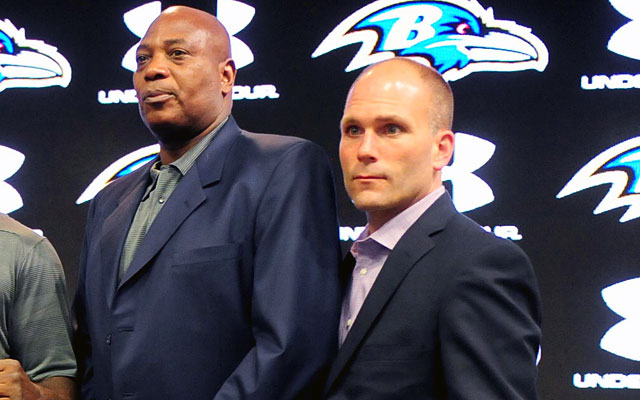
On Saturday night DeCosta, who has been with the Ravens almost since their inception and worked his way up the scouting ranks, headed from the team facility to his home in time to grab dinner and catch up with his immediate family, as well as his father and nephew who were visiting.
"Basically, I just watched a little bit of the [post-draft] coverage and went to sleep."
On Sunday he was lethargic and returning to the office on Monday was anti-climatic as well.
"Sunday, I was exhausted," DeCosta said. "The whole day I really didn't feel like myself. I woke up, had some coffee, I was still tired most of the day. I came into the office on Monday and did some administrative things, but again I still really didn't feel like myself. ... And honestly, today was the first day I felt like, 'Hey, I got my fastball back again.' "
Of course, it was for good reason.
The Ravens were among the most active teams in the draft, pulling off several trades, nearly making some others, and taking in a haul of picks. They are not accustomed to picking this high -- being one of the NFL's most successful teams since 2000 -- and this was a particularly quirky year to hold the sixth pick.
A near-trade with Dallas at No. 4
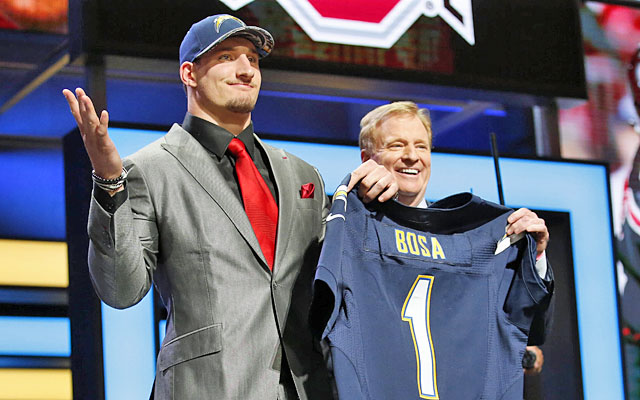
At various times in the weeks leading to the draft, DeCosta was convinced the Chargers were leaning toward Stanley, or Tunsil, or Joey Bosa, or DeForest Buckner.
"It was virtually impossible to pick what those guys were going to do," he said.
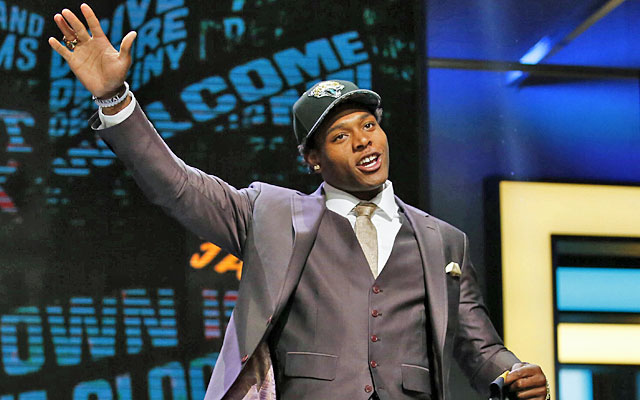
But by the middle of the day, he was hearing the same reverberations I was -- the Chargers had actually locked in on Bosa and had been for quite some time. Baltimore operated on that assumption, meaning Dallas was going to take Ezekiel Elliott or Ramsey with the fourth pick, and knowing Jacksonville would pounce on Ramsey with the fifth pick if he was still there (DeCosta has a strong relationship with Jaguars general manager Dave Caldwell and had a good read on what type of player they would select there).
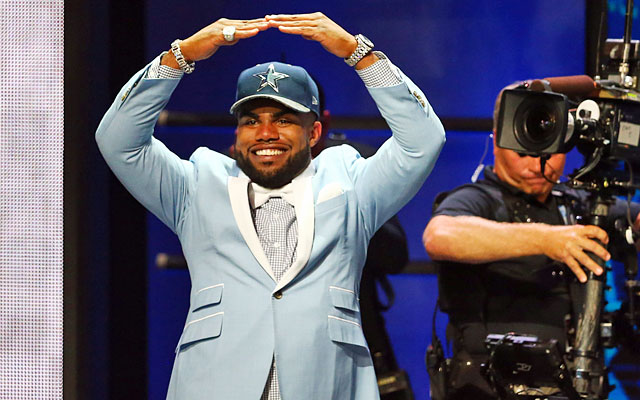
Sure enough, Bosa went third and Baltimore was engaged in talks with the Cowboys for the fourth pick. At one point sources said the sides seemed to be in agreement on a deal that would include Baltimore sending a third- or fourth-round pick to Dallas to move up, but those league sources said Jerry Jones balked because of an erroneous report Baltimore was looking at Elliott.
DeCosta did not want to go into specifics on the offers, but made it clear the Ravens had given the Cowboys assurances they were only moving up for Ramsey.
"I think clearly they knew we weren't taking Elliott," DeCosta said. "Those discussions had taken place. I don't know why, but in the end we just had differing values on what we thought that trade was worth. We just couldn't get it done. There is a great history between [Ravens general manager] Ozzie [Newsome] and Jerry Jones and Stephen Jones, and those guys have a lot of mutual respect for each other, and we did inquire about moving up."
Steering clear of Tunsil's unpredictable freefall
Meantime, Tunsil, once viewed by many as a player who would never get past the Ravens, was in a freefall. Baltimore's recent history with the Ray Rice videotape removed Tunsil from consideration, but it was nonetheless a story that was impossible to escape as draft rooms around the league were buzzing because of the video.
"That was a curveball," DeCosta said. "I think that was a curveball for anybody picking in the top 15, 20 in the draft, because it was hard to predict how that was going to affect everybody who was picking. It was a virtual certainty that he was going to be a top six or seven pick in the draft, and then when the Tunsil thing broke it was like, 'All bets are off.' "
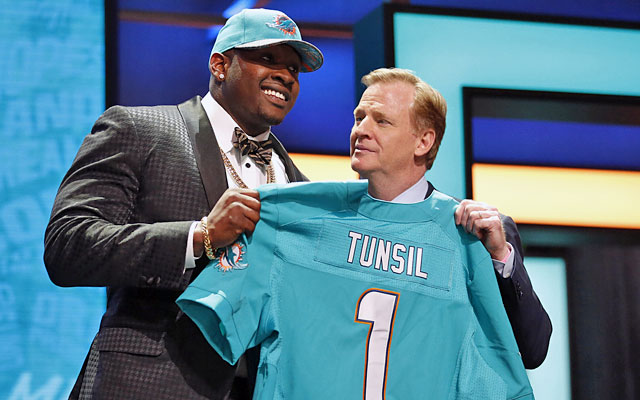
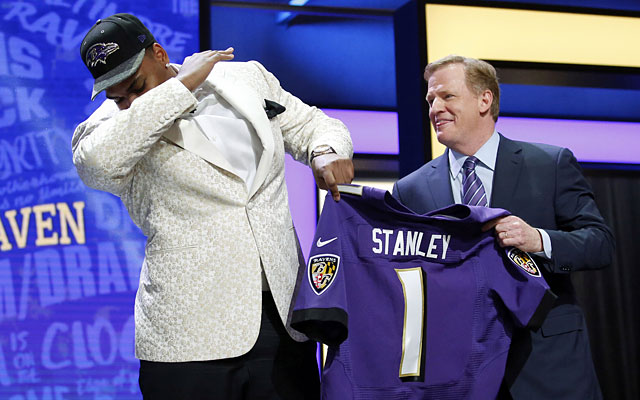
Tunsil was off Baltimore's board, so the sixth pick was going to come down to Stanley or Buckner, and for the Ravens it did not require much deliberation. Stanley had the higher rating, left tackle had become a significant position of need with Eugene Monroe aging and oft-injured and already previously on the trade block, sources said, and Stanley was the pick.
"Ramsey was a player we definitely liked, and after he was selected by Jacksonville, for us the decision was pretty easy," DeCosta said.
"Stanley was the highest-rated guy on our board. Left tackle, we're an organization that has a history of drafting a left tackle high, and that was a transformational decision for us back in '96 [Hall of Famer Jonathan Ogden], and I believe you win up front and I believe if you're going to draft high in the draft you should focus on foundation-type positions -- quarterback, left tackle, cornerback, things like that. Players that really can play for a long, long time in critical positions that every team needs to be successful, and Ronnie Stanley really fit the bill."
Trading down and gambling on Day 2
Baltimore had an active second day as well, twice trading down in the second round and making a calculated gamble that coveted outside linebacker and pass rusher Kamalei Correa would still be there when they selected. Correa would be a great scheme fit who is badly needed with Terrell Suggs and Elvis Dumervil nearing the end of their respective careers.
He was, and in the meantime, the Ravens added to their fourth-round haul, a strategy that was hatched in April 2015, when they sent center Gino Gradkowski to Denver.
The Ravens knew losing free agents like Pernell McPhee and Torrey Smith would land them quality compensatory picks in 2016 -- likely fourth-rounders -- and they picked up a 2016 fourth in the Gradkowski swap. They would of course be getting their own pick in that round as well.
Watching so many quality defensive linemen tumble out of the first round -- a position they already were young and deep with -- gave Newsome and DeCosta confidence to keep moving back to target other positions, and it worked with aplomb.
Baltimore was uncomfortable with linebacker Myles Jack's medicals as an early second-round pick, and dropped back two spots with the Jaguars for them to take Jack (Baltimore netted a fifth-round pick).
Then Miami offered a fourth-round pick for Baltimore to move back four more spots so the Dolphins could take corner Xavien Howard. The Ravens preferred other corners at later stages in the draft.
"That was a huge win for us," DeCosta said of that trade, as Baltimore took Correa with the 42nd overall pick and added another potential edge presence in Bronson Kaufusi in the third round.
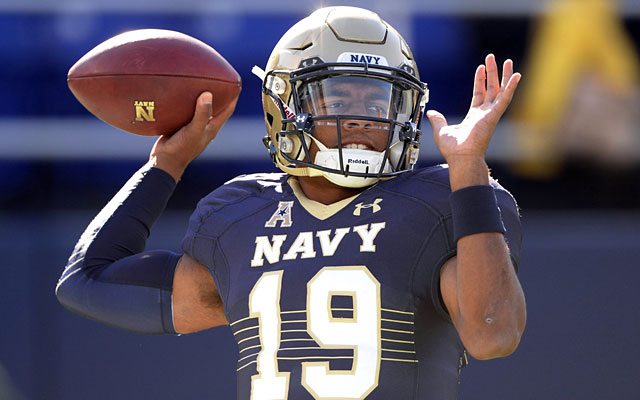
DeCosta found himself awoken in the middle of the night heading into Saturday, the final day of the draft, fixated on finding a way to land Reynolds. They view him as a potential versatile weapon on offense and immediate upgrade in the return game.
He had a chat with Harbaugh in the weight room that morning, and Harbaugh reached out to former Eagles/Redskins return ace Brian Mitchell, who Harbaugh worked with as the special teams coach in Philly and who was working with Reynolds on his return technique.
Mitchell gave rave reviews and, in the meantime, the Ravens were dictating much of the fourth round with so many picks.
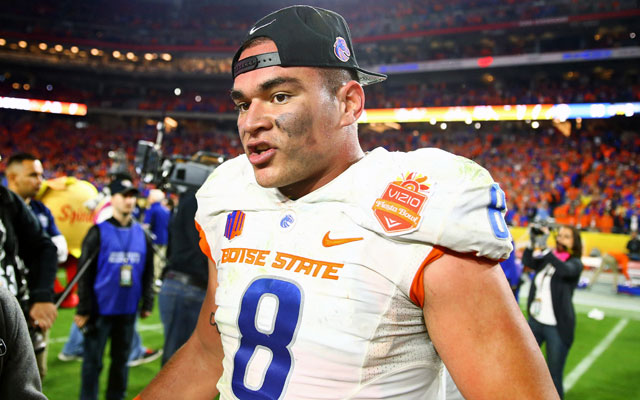
They ended up using those picks on corner Tavon Young, receiver Chris Moore, tackle Alex Lewis, defensive tackle Willie Henry, and running back Kenneth Dixon.
They view Young as an immediate slot guy. They hope Moore can replace Steve Smith's vertical presence with last year's top pick, Breshad Perriman, still trying to come back from injury. Lewis could push for a spot at guard while serving as a swing tackle. Some evaluators I trust believe Dixon could be the second-best back in the entire draft.
Of the eight players the Ravens had earmarked for potential picks in that round, DeCosta said they came away with five of them "at critical positions for us we think can come in right away and be really good."
Landing Reynolds was important ... and emotional
And, with teams like the Patriots, Giants and Redskins also eyeing Reynolds, the Ravens invested their first pick in the sixth round on him. Although the team is unsure that he will be cleared to play for them in 2016 -- the Naval Academy has been willing to alter the service responsibilities of some high-profile graduates lately -- they are certainly hopeful that he could be on the field even as soon as this weekend's rookie camp.
"I'm confident, and I think the recent precedent is in our favor that Keenan will be able to play this year," DeCosta said. "But again, that's not my decision to make and I'm not really involved in that decision making. We'll have the answers shortly, I imagine. We're excited about Keenan. It was an emotional decision for us. We all value what that kid has done ... for our local community and the sacrifices he's made for our country."
If the Ravens end up hitting on their historical percentage of picks, especially given the quantity of selections in this draft, they won't be down much longer.
The Ravens have not had consecutive losing seasons since 1996-98 -- their first three seasons in Baltimore -- and they can't possibly endure the kind of barrage of injuries to top talent they did a year ago. This haul might have fortified them for the future, and it won't be all that long before DeCosta and his peers around the league have turned their considerable attention to the spring of 2017 and another crop of players to obsess over again.