Packers-Cowboys key matchup: Can the Dallas line outmuscle Green Bay's front?
Dallas knows all too well what can happen if you can't pressure Aaron Rodgers enough to bother him

By
Jared Dubin
•
7 min read

Way back in October, we ran a story on this site about an upcoming matchup between the NFL's No. 1 rushing offense and the No. 1 rushing defense, which at the time was the No. 1 run defense in modern NFL history through a team's first four games of the year. We explored how each team had come to its No. 1 ranking at that point in the season, searching for reasons that one or the other may be able to win the matchup that Sunday.
Here we are 13 weeks later, and now it's time to take a look at the same two units again -- with an eye on what's changed since the Dallas Cowboys beat the Green Bay Packers, 30-16, in Week 6, as well as what's the same.
- Who: Green Bay Packers (10-6) at Dallas Cowboys (13-3)
- When: Sunday, Jan. 15, 4:40 p.m. EST (FOX)
- Where: AT&T Stadium, Arlington, Texas
- Latest line: The Cowboys are 4.5-point favorites, according to SportsLine
Let's start with that Green Bay run defense. Heading into their Week 6 game against the Cowboys, the Packers had allowed only 42.8 rushing yards per game, the fewest through four games since the AFL/NFL merger. Teams averaged just 2.0 yards per carry against Green Bay through their first four games of the season, also an NFL record through four games. They were stuffing an average of 32 percent of opponents' rushing attempts at or behind the line of scrimmage, per Football Outsiders, something only two other teams had done over the last 10 seasons. Their Adjusted Line Yards allowed figured of 2.16 per carry would have been the best in the history of the site (they have tracking going back to 1989).
In other words, the Packer defense wasn't just winning the battle up front; they were dominating it like we've never seen before. And then the Cowboys rolled into Green Bay and smacked them in the mouth.
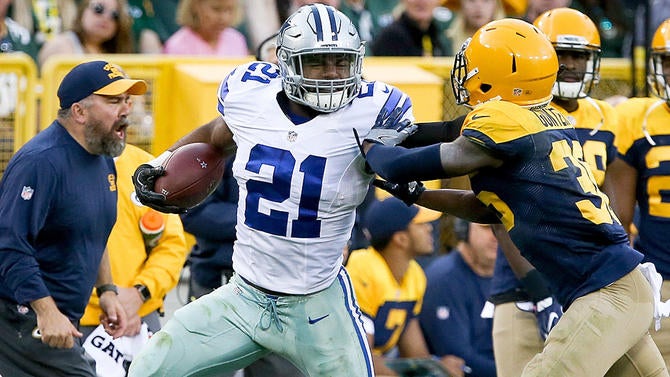
Ezekiel Elliott racked up 157 yards on the ground on his 28 carries, an average of 5.6 a pop. The Cowboys as a team took their 33 carries for 191 yards, an average of 5.8 per carry. (Yes, the Cowboys ran for more yards in Week 6 alone than the Packers had allowed over their first four games combined.) Green Bay opponent's had been averaging only 0.31 yards per carry before contact, far lower than the NFL average of 1.56 per carry to that point in the season. The Dallas offensive line cleared the way such that Elliott averaged a full 2 yards per carry before contact in Week 6. The Green Bay defense hadn't allowed a single 20-plus yard run all season through four games; Elliott had two in that game and Lucky Whitehead added another on a jet sweep.
Since that point, the Packers' run defense has been merely mortal.
| GAMES | RUSH | YDS | YPC | YPG |
| FIRST FOUR | 86 | 171 | 2.0 | 42.8 |
| LAST 12 | 290 | 1,344 | 4.6 | 112.0 |
After checking in first in the league by far in both rushing yards allowed per carry and per game over the first four weeks, the Packers played to figures over the final 12 games of the year that would rank just 29th (per carry) and 21st (per game) over the course of the full season. They also stopped only 17 percent of opponent's runs at or behind the line of scrimmage over their final 12 games, a figure that would rank tied for 21st in the NFL. Their Adjusted Line Yards allowed number of 3.95 per carry over the final 12 games would rank only 18th, a far cry from where they were during that dominant opening stretch.
All of these downturns, of course, are a big problem against what is still the most dominant rushing attack in the NFL. The Cowboys finished the season second in the league in rushing yards per game and third in yards per carry, as well as second in rushing touchdowns. They checked in fifth in Adjusted Line Yards and the percentage of runs stuffed at or behind the line of scrimmage, and they were third in conversion rate on third or fourth and short. All of those figures were negatively affected by their 21-carry, 69-yard performance in Week 17 that saw Elliott sit the entire game, along with two starting offensive linemen (Tyron Smith and Ronald Leary).
Elliott is still the primary rushing threat for the Cowboys, and he may well be the most dangerous runner in the league. Despite sitting out the regular season finale, Elliott led the NFL in rushing yards by 318 over the next closest player. Considering he averaged 108.7 yards per game, he essentially compiled a three-game lead over second-place Jordan Howard. It wasn't just about volume with Elliott, either, as he also averaged 5.1 yards per carry, making him one of only six backs with 100-plus carries and an average of over 5 yards a pop. He tied for the NFL-lead with seven games of 100-plus rushing yards and 22 runs of 15 yards or more.
The thing that makes Elliott so dangerous is that he's not purely a power runner or purely a speed runner. He's a power back with breakaway speed nearly unmatched by any other runner. He's the rare running back with the ability to plow over opposing defenders at full-speed and then zoom away from anyone else that might be chasing him. And if he actually gets a clean lane to scoot through, well, he's just gone. And that's a problem for defenses, because he may well get more clean lanes to run through than any running back in football. (That's what working behind the NFL's best offensive line will do for you.)
ZEKE TO THE HOUSE!
— NFL (@NFL) October 9, 2016
SEE YA 👋 #DallasCowboyshttps://t.co/0RhtwNuQd0
ZEKE with the go-ahead TD!!!
— NFL (@NFL) November 14, 2016
Only 9 seconds remain.
Wowowowowowowow. #DALvsPIThttps://t.co/69sn9wdn3H
Even if you think you're about to get your hands on him, sometimes he just breaks out the old high school hurdling skills and jumps straight over the top.
Goin 🆙@EzekielElliott completely hurdles the defender! 😱 #CHIvsDAL
— NFL (@NFL) September 26, 2016
https://t.co/5KTIN2A9b0
#ZekeLeap#DallasCowboyspic.twitter.com/fnIk0Z2v1F
— NFL (@NFL) October 16, 2016
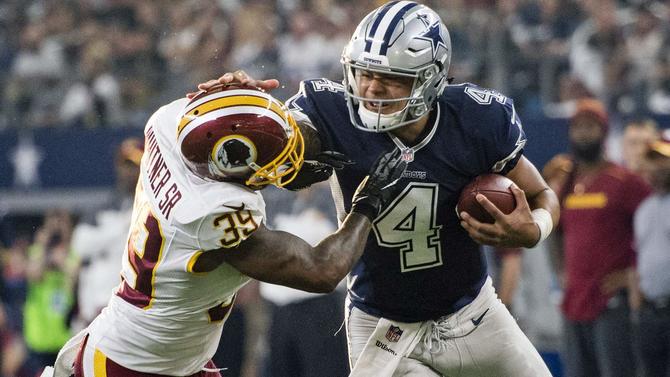
Elliott, of course, is not even the Cowboys' only high-level rushing threat. Dak Prescott didn't have quite as many designed carries as your typical "running" quarterback, but the ones he did get, he made defenses pay for. Prescott actually only had 12 designed runs on the season, per Pro Football Focus, but those runs totaled 69 yards -- an average of 5.8 per carry. The Cowboys mostly used his designed runs on read-option plays close to the end zone, where Prescott would only pull the ball out and take off with it himself if he was sure he could get the first down or a touchdown without subjecting himself to a big hit. That's why he had three touchdowns on his 12 designed rushing attempts. (One of his two QB sneaks also went for a touchdown.)
It's incredible likely that we'll see more of the read-options style runs whens the Cowboys get to the red zone this Sunday, and it wouldn't be a surprise if we see a greater amount of them elsewhere on the field as well. The Packers have historically struggled to stop those types of plays under defensive coordinator Dom Capers (who can forget Colin Kaepernick torching them for 181 yards on the ground back in 2013?), whose defense will surely be selling out to stop Elliott on nearly every play. All it takes is Prescott zooming around the edge for a first down or two early in the game to put the fear of his rushing threat into the defense for the rest of the day, which can slow them up just enough for Elliott to continue gashing them.
Being able to do so is of paramount importance for the Cowboys, who very badly need to keep the red-hot Aaron Rodgers off the field for as long as possible. The Dallas defense exceeded expectations this season and did an excellent job against Rodgers early in the year, but the Rodgers we've seen over the last seven weeks is a far greater threat than the one that took the field in Lambeau that day.
The Cowboys know better than anyone what can happen if you can't pressure Rodgers enough to bother him -- that's how they lost to the Packers in the divisional round in 2014. DeMarco Murray ran for 123 yards that day and the Cowboys actually won the time of possession battle, but they didn't win it by enough as they let Rodgers orchestrate a comeback from eight points down in the second half. Dallas' pass rush come on stronger down the stretch of the year but is still not a strength. Their secondary played far better than expected but can still be taken advantage of.
Their best defense on Sunday will be, as it has been throughout the year, a good offense. If they can control the clock and give Rodgers as few opportunities as possible to put points on the board, the Cowboys will stand a much better chance of hosting the NFC title game next week.