Redskins GM will be happy to 'overpay' Kirk Cousins 'if he's good'
Redskins GM Scot McCloughan would be happy to sign Kirk Cousins to a long-term deal. But he wants to see him replicate his success first.

•
4 min read

After earning an average salary of $643,172 through the first four years of his career, Kirk Cousins is scheduled to earn nearly $20 million in 2016 under the franchise tag, which probably has Cousins feeling something like this:
The person handing Cousins that pay raise, Redskins general manager Scot McCloughan, is also the same person who decided not to hand Cousins a lucrative long-term contract this offseason. Instead, McCloughan will wait to see if Cousins can follow up his promising first full season as a starter with another productive outing in 2016.
During a lengthy interview with Bleacher Report's Jason Cole, McCloughan revealed that he'll be more than happy to "overpay" for Cousins -- if he ends up being, you know, an actual good quarterback.
B/R: You also had very little choice. If you don't franchise him, other teams bid. At the same time, it's hard to pay a quarterback the market rate after only one full season. If you give Cousins $55 or $60 million guaranteed, you get criticized even more.
SM: I told Kirk when he came in -- and his wife must have hugged me for 10 minutes because he just went from making $600,000 to $19.9 million -- I told him, "You take care of me and this organization, we're going to take care of you. I promise. And we're going to build this roster to where you can be average and still be good. I promise you."
B/R: The way to look at it is that if everything goes according to plan, you're going to have to overpay. But it also means you have a quarterback.
SM: Correct, and I'm OK with that (laughs). Let me overpay him if he's good. If you have a productive guy, it helps everything, and it proves out. You look around this league and see the teams that are in the playoffs every year and look who the quarterbacks are. Look at the ones who win. It proves out. Don't get me wrong, the O-line is huge. The running game is huge, which we had in Seattle. But when it's all said and done and the quarterback can get the guys rallied around him, you have a chance. You're going to play good defense. That's easy to fix. You just draft good football players. They can be a small guy, a big guy, as long as they can find the ball. The special teams are going to be good because we're going to build through the draft, so the younger guys will be big in that. But that quarterback, I'm telling you ...
My favorite part of that exchange: When McCloughan told Cousins that he can be average and the Redskins will still be good. That's actually an interesting comment coming from McCloughan, because by combining it with some of his other comments from the interview, we can begin to understand what kind of season McCloughan might characterize as a "good" season -- the kind of season that'll help Cousins acquire a long-term deal.
The question immediately before the sequence above was also about Cousins. In his response, McCloughan defended his use of the franchise tag. And he defended it by almost exclusively referring to wins.
"We did the franchise tag, and I know everybody made fun of me, and that's fine. But you know what? The guy won the division," McCloughan said. "They won nine games. They won four games the year before and turned around and won nine, and he plays all 17 with the playoffs, and we went on the road at the end of the season having to win, and we beat Philly and Dallas, both at their places. You know, the NFC East, I don't care if they're good teams or bad teams, you still don't win on the road. We didn't early in the season, but he kept going and going, and the players rallied around him."
So, clearly, McCloughan values wins, which makes sense given his job is to build a consistent winning football team in Washington. But a win-loss record isn't necessarily an indicator of how well a quarterback played. I'm not saying Cousins didn't play well -- by quarterback metrics like passer rating (101.6) he certainly performed well -- but it's interesting to consider what would've happened if the Redskins hadn't made the playoffs after a nine-win season. Rather, it's interesting to consider what might happen if the Redskins fail to qualify for the postseason again, which is a real possibility considering Tony Romo should be healthy for the Cowboys and the NFC East might not be the cake-walk that it was in 2015.
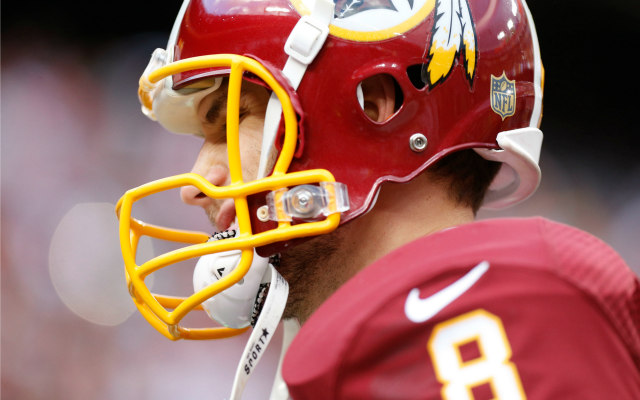
If Cousins regresses drastically and the team misses the playoffs, the solution seems simple: Let Cousins walk if he won't accept a modest deal. But what happens if the team misses the playoffs and Cousins still shines? What if the Redskins make the playoffs in spite of a subpar Cousins?
Look, it's entirely possible McCloughan values stats other than a quarterback's win-loss record and simply didn't mention it during this particular interview. It's also entirely possible the Redskins will repeat as division champs and Cousins will turn into a legitimate franchise passer and this discussion will be rendered completely useless.
But hopefully, for Washington's sake, the organization doesn't overvalue quarterback wins. Because what McCloughan said earlier is right: If he builds a great roster, then that great roster should be able to mask the flaws of an average quarterback. That great roster should be able to win with any average quarterback.
And if that's the case, then McCloughan shouldn't feel the need to hand an average quarterback a long-term deal with millions of dollars attached. He shouldn't feel the need to overpay on the sole basis of wins and losses.