
Johnny Gaudreau shows why more teams are betting on skill over size
Undersized players like Calgary Flames rookie Johnny Gaudreau can excel in today's NHL, and that is a huge change from 10 years ago. And that is better for everybody.

By
Adam Gretz
•
4 min read

The success of the Los Angeles Kings in recent years, a team mostly made up of hockey giants, has sparked a league-wide obsession with "heavy" hockey. Watch any game they -- or any other team with great size -- plays, and you will hear it nonstop for two-and-a-half hours as it has become one of the most popular buzzwords in the league.
A heavy lineup. A heavy style of play. Playing heavy.
Heavy. Heavy. Heavy.
But what's funny about this, as well as the way obstruction has worked its way back into the game and power plays (and goals) continue to dwindle, is that size suddenly doesn't carry as much importance as you might be led to believe. The game is more open to smaller, more undersized players than it has been in more than a decade. Teams are more willing to play -- and play in a meaningful way -- players that would have previously been overlooked or passed over because they weren't big enough and strong enough to hang in the "bigger is better" style the NHL became in the dark days of the league in the early-to-mid-2000s.
This is one of the reasons that the game today, even though the goal scoring numbers are similar to what they were in the late '90s and early 2000s, is a better overall product.
There really is room for more skillful players to get an opportunity to not only play, but to also stick in the NHL. Slowly but surely, teams are starting to give them that chance.
So far this season there have already been 38 players who are both under 6-feet and 180 pounds, and the majority of those players have been regular contributors to their teams. Some have been among the league's top players. This may not seem like a lot, but it is a significant increase over what we saw in the NHL 10 or 15 years ago. (It also matches up with the recent study by Benjamin Wendorf at Hockey-Graphs that found players overall have been becoming shorter and leaner for several years now.)
Just look at how the number of those players -- as well as the number of them who are semi-regular players -- has increased since 1997, and especially since the mid-2000s when players with that type of build were nearly extinct.
There was no place for them in the NHL, mainly because the NHL's general managers wanted a bunch of refrigerators that could muck up the middle of the ice.
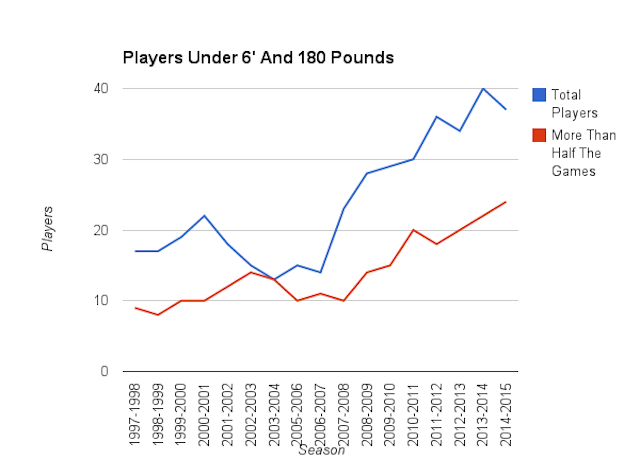
That still represents a pretty small percentage of the NHL population as a whole, but it's still a sign of progress from a talent evaluation standpoint that teams are more willing to give a player who might be "undersized" an opportunity.
Two of the teams benefitting from this the most are Tampa Bay (as a collective group) and Calgary (with one notable individual).
The Lightning especially, with five forwards on the roster right now who either fall within the above range or are just missing it by an inch or a couple of pounds.
J.T. Brown is 5-10, 170.
Nikita Kucherov is 5-11, 171, same for Vladislav Namestnikov.
Ondrej Palat is 5-11, 174, and Tyler Johnson, one of the league's top scorers, stands 5-9, 182.
Palat, Johnson and Kucherov are especially interesting because they have spent most of the season playing together on the same line and outscoring their opponents 42-20. They're not just a great line. They dominate.
Could you imagine a trio of players that averaged about 5-10 and 176 pounds controlling the pace of play like that 10 years ago? Of course not, mainly because they probably would have never had an opportunity to do so. It wouldn't have happened. And even today they had to overcome some long odds. Johnson went undrafted, mainly because of his size, even though he was one of the best players in the Western Hockey League in his draft year. Palat lasted until the seventh round (No. 208 overall) in the 2011 draft.
Meanwhile, out in Calgary, the smallest player of them all is quickly becoming one of the NHL's most exciting. That is where 21-year-old rookie Johnny Gaudreau, coming in at 5-9 and 150 pounds, is playing a top role for an overachieving Flames team and making a serious charge at the NHL's Calder Trophy as rookie of the year, recording 50 points in his first 66 games. And he is usually doing so in an impressive way, like when he records a natural hat trick to erase a 3-0 deficit in Los Angeles.
And even when he doesn't score he is still impressive going up against bigger, stronger players one-on-one.
At some point over the years, as the way the game has been analyzed has divided into different groups of people (numbers vs. eye test) there has become a massive disconnect in hockey as to what matters and what isn't as important, and it's never as black-and-white as either group wants to make it.
Physical play and size are important. But it's not everything. Size for the sake of having size without having skill to back it up is meaningless. A lack of size shouldn't hold a player back if he is skilled enough to make it and contribute.
Sure, if all things between two players of different sizes are equal (skill, talent, skating, production, similar personalities for "in the room") then by all means, take the guy with the better size.
But all things are rarely equal. And if there is one thing NHL teams seem to be more willing to do now than they were in recent years (even if not enough), it's overlooking the "too small" aspect of a player and focussing on the skill. And those teams have been rewarded with guys like Tyler Johnson, Mats Zuccarello, Johnny Gaudreau and many, many more.
And that is better for everybody.