NHL trade chains: What has Jaromir Jagr been traded for in his career?
Jaromir Jagr was traded for the fourth time in his career on Thursday afternoon. The previous three trades have not resulted in much of a return for the team that has traded one of the NHL's greatest all-time players.

By
Adam Gretz
•
4 min read
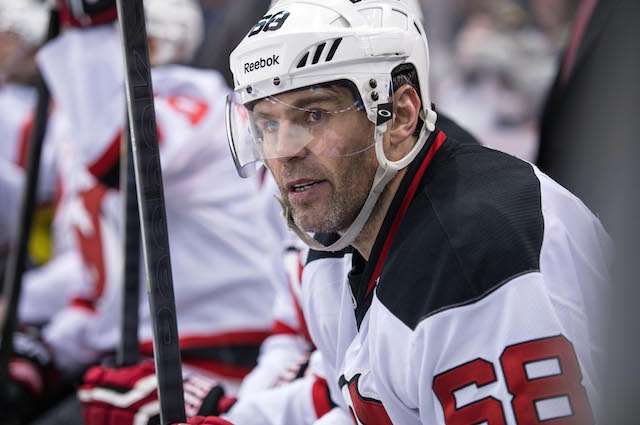
Jaromir Jagr was traded for the fourth time in his career on Thursday afternoon when the New Jersey Devils sent him to the Florida Panthers for two draft picks.
At this point we still have no idea what those picks will produce for the Devils and it will take several years before we even come close to finding out.
When you consider that he has had arguably the second most productive player in the history of the league (had he not missed so much time due to lockouts and a three-year stop in Russia, he would have made a serious run at Wayne Gretzky's all-time goal scoring crown) it would be reasonable to assume that the previous trades involving Jagr would have been blockbusters that featured major pieces going in the other direction.
They have been anything but that.
Let's take a brief look back at the three previous trades involving Jagr and what the teams that traded have to show for him today. If they even have anything to show for him.
These are NHL trade chains.
July 11, 2001: Pittsburgh trades Jaromir Jagr
After spending 11 years with the Penguins, winning two Stanley Cups, five scoring titles and an MVP award, Jagr was ready to move on. He wanted out of Pittsburgh and the Penguins couldn't afford to pay him and still put a team around him on the ice. So the fact he was traded following the 2000-01 season was not a surprise. It was expected. Everybody knew it was going to happen. What was a surprise was the fact he was traded to the Washington Capitals, one of the Penguins' biggest rivals and a team that Jagr had helped torment year after year in the playoffs over the previous decade.
So what did the Penguins get out of it?

Nothing. A whole bunch of nothing. Well, that's not entirely accurate. There was a lot of financial relief (including the $2.3 million salary that defenseman Frantisek Kucera had at the time) and that cash turned out to be pretty important.
In fairness, Craig Patrick did get a fair amount of money ($4.9 million) out of that Jagr deal. Helped buy the land CEC sits on.
— Seth Rorabaugh (@emptynetters) February 26, 2015
So there is that.
The players, though, were a massive disappointment.
Beech, Sivek and Lupaschuk were all selected by the Capitals in the 1999 draft and were three of the first 34 players taken that year. In theory, they should have been decent prospects. But as history shows us the 1999 draft was not a particularly strong one (outside of the Sedin twins at Nos. 2 and 3 and a couple of late round steals -- Henrik Zetterberg, Martin Havlat, Radim Vrbata). At his press conference to announce the trade, then-Penguins general manager Craig Patrick infamously compared Beech to a "Ron Francis-type player" which did nothing but set everybody up for disappointment.
As the trade chain shows, this was a giant dud for the Penguins.
But how did it work for Washington?
January 23, 2004: Washington trades Jaromir Jagr
Jagr's two-and-a-half seasons in Washington were almost as disappointing as the return Pittsburgh ended up getting for him in the initial trade. The Capitals made the playoffs once, never won a playoff series, and Jagr's production was a fraction of what it was in Pittsburgh. He was still productive, but nowhere near the dominant force he had been over the previous decade.
That is when this unbelievable series of events started to take place.

And that is it. That is what the Washington Capitals had to show for their time with Jaromir Jagr.
Carter, after coming over in the trade from the New York Rangers, played 19 games with the Capitals before being traded in the offseason for Jared Aulin who never played a game in the NHL for the Capitals.
Following the 2004-05 lockout, Jagr returned in his first full season with the Rangers and was a monster, scoring 54 goals and recording 123 points. He followed that up with a 96-point effort the following year and a 71-point season in 2007-08 before leaving for the KHL for three years.
He would return with the Philadelphia Flyers in 2011-12 for one season before signing a one-year deal with the Dallas Stars the following offseason.
Which leads us to this:
April 2, 2013: The Dallas Stars trade Jaromir Jagr

The jury is still very much out on this one for Dallas. Payne is still playing in the Ontario Hockey League and really isn't putting up numbers that jump off the page and make you scream "PROSPECT!" Dickinson is also still playing in the OHL and is averaging more than a point-per-game the past two seasons. He is the one that will make-or-break this deal for the Stars.
Jagr would go play the remainder of the season for the Bruins as they reached the Stanley Cup Final, and even though Jagr did not score a single goal in the playoffs he was still a dominant force with the puck and a constant playmaker.
After the season he signed with the New Jersey Devils where he played until Thursday when he was traded for a second-round draft pick in 2015 and a conditional third-round draft pick in 2016.
In total there are 11 players -- whether they were traded directly for him or the result of trades that followed the initial trade -- on the Jagr trade chains shown above. Those players combined to score 234 goals in their entire NHL careers, both before and after they were traded for Jagr (and 202 of those goals belonged to Carter).
Jagr, as of Thursday, has scored 716. And counting.
More NHL Trade Chains: What the Bruins have to show for a decade of trading star players