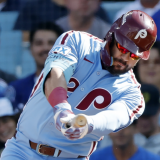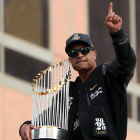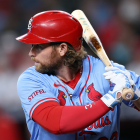
Baseball Hall of Fame ballot: Fielder, Howard, Morneau and Teixeira were great, but not worthy of Cooperstown
These first basemen -- all on the ballot for the first time -- made their mark on a generation of baseball

By
Matt Snyder
•
4 min read
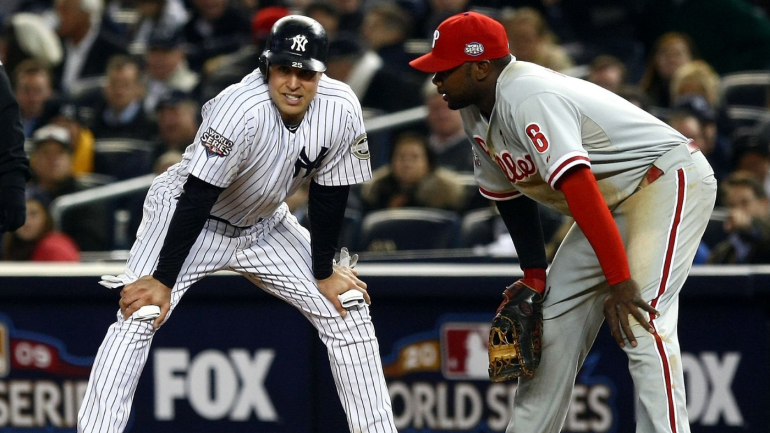
Buried beneath a lot of the polarizing -- or for some, downright annoying -- discussion this Baseball Hall of Fame season are four first-time eligible first basemen who aren't likely to gain a ton of fanfare for enshrinement. But they also deserve a tip of our cap. A good way to do that is to run the group of four -- Prince Fielder, Ryan Howard, Justin Morneau and Mark Teixeira -- down one-by-one.
Let's get to it.
Prince Fielder
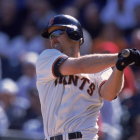
When a young core headed up by Fielder and later Ryan Braun arrived, the Brewers hadn't had a winning season since 1992 and hadn't made the playoffs since 1982. From 2007-11, the Brewers had three winning seasons, a wild-card berth, a division title and a trip to the NLCS. Fielder was the middle-order anchor of the turn-around.
Fielder was once a model of durability, too, playing in 157, 158, 159, 162, 161, 162, 162 and 162 games, respectively, in his first eight full seasons. In his elite-level, six-year prime (five years with the Brewers and 2012 with the Tigers), he hit .289/.401/.549 (151 OPS+) with 1,007 hits while averaging 38 homers and 112 RBI per season. He had three top-four MVP finishes in there.
Unfortunately, a neck injury ruined Fielder's run. He needed surgery on it after 42 games in 2014. He bounced back with a full 2015 and made his sixth All-Star team, but then after 89 games in 2016 -- during which he was clearly compromised -- he was forced into retirement due to the neck injury.
Perhaps more than the players above, the injury really hurt Fielder's Hall chances. He was only 32 years old. He had 1,645 hits, 319 home runs and 1,028 RBI and that's including two significantly impacted seasons.
Regardless, let's give another round of props for an excellent, even if not Hall of Fame, career.
Ryan Howard
An injury might have conspired against Howard. Remember the final play of the 2011 NLDS in which the Cardinals upset the Phillies? Howard tore his Achilles. To that point in his career, Howard had a Rookie of the Year, an MVP, three All-Star appearances, a Silver Slugger, four top-five MVP finishes and six top-10 finishes.
From 2005-11, Howard hit .275/.368/.560 (139 OPS+) with 1,032 hits, 184 doubles, 284 homers and 859 RBI. In the final five seasons of his career, after the Achilles injury, surgery and recovery, he hit .226/.292/.427 (95 OPS+). Again, decline years happen to everyone but it was pretty drastic following a major injury. There's no way to know how his career would have unfolded without that injury.
Howard ended with a .258 average, 125 OPS+, 1,475 hits, 277 doubles, 382 homers and 1,194 RBI. He led the majors in homers twice and RBI three times. Even with the hardware, including his World Series ring and being a central part of the Phillies core that also won five straight division titles and two pennants, this isn't a Hall of Famer. Great career, though.
Justin Morneau
Was Morneau on his way to becoming a Hall of Famer before a concussion? In July of 2010, he suffered a career-altering blow to the head via knee on a slide. At the time, Morneau was 29 and had made four straight All-Star teams after winning an MVP. He also had an MVP runner-up in there, not to mention actually winning the Home Run Derby where Josh Hamilton stole the show early on at Yankee Stadium (and the sponsor called him "Jason" Morneau when handing him the trophy -- which only matters here because it was funny).
From 2006-10, Morneau hit .298/.372/.528 (138 OPS+) with 162-game averages of 182 hits, 40 doubles, 32 homers, 123 RBI and 97 runs. This was in the midst of the Twins being a relatively regular playoff team. Along with Joe Mauer and Johan Santana, Morneau was the core of the foundation.
The rest of his career, he hit .275/.331/.433 (106 OPS+) with 162-game averages of 165 hits, 36 doubles, 18 homers, 83 RBI and 65 runs.
Every player goes through a decline phase, but it really seems like the concussion ruined Morneau's career, to a certain extent.
In the end, he had 1,603 hits, 349 doubles, 247 homers, 985 RBI with a .281/.348/.481 line. With those four All-Star Games, the MVP and two Silver Sluggers, it's a very formidable career, but it isn't a Hall of Fame career.
Mark Teixeira
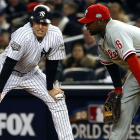
And then there's Mr. Teixeira, who didn't have the killer offensive upside of Fielder nor the hardware of Morneau or Howard. He did finish second in MVP voting once, but the main reasons he has the best chance of this group to remain on the ballot are that he avoided the career-altering injury and he was a more complete all-around player.
Teixeira was pretty clearly the best defender of this group, taking home five Gold Gloves in addition to his three Silver Sluggers. He was one of the best players on a World Series champion, too, as Howard was.
Teixeira ended with the best case here in counting stats, again, due to longevity. He sits with 1,862 hits, 408 doubles, 409 homers, 1,298 RBI and 1,099 runs. Students of the Hall of Fame know that those numbers for a first baseman are pedestrian, some even a bit lacking. Among first basemen in history he's 61st in hits, 40th in doubles, 19th in homers, 30th in RBI and 43rd in runs. There are currently 22 Hall of Fame first basemen.
JAWS helps Teixeira a bit, but he's still 31st, sitting a pretty sizable tick below the average Hall of Fame first baseman. Some recent players in his ballpark in JAWS are non-Hall guys like Jason Giambi, Will Clark, Fred McGriff, Carlos Delgado and Don Mattingly. While Teixeira gets closer than any of these four we've discussed right here, he's still comfortably out of the Hall of Fame, for me.
And that's OK. These four had careers worth celebrating, even if they weren't the elite of the elite to the point being considered Baseball Immortal. Very, very few ever are. That's the point of the Hall of Fame.