
Cubs' Jed Hoyer says Yu Darvish trade was not financially motivated, expects 'competitive team' in 2021
Jed Hoyer added the Cubs are going through a 'small reset'

By
Mike Axisa
•
3 min read
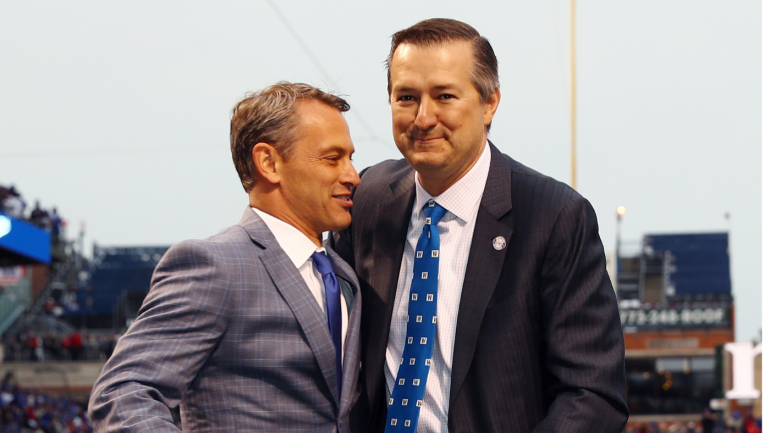
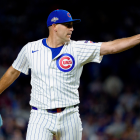
On Tuesday, the Chicago Cubs completed a blockbuster trade that sure does resemble a salary dump. The Cubs sent Yu Darvish, the reigning NL Cy Young runner-up, and personal catcher Victor Caratini to the Padres for four rookie ball prospects and actual big leaguer Zach Davies. The four prospects have 77 combined games of pro experience, all by the same player.
Chicago shed $59 million owed to Darvish the next three years and, with all due respect to Davies, they received nothing that will move the needle in a meaningful way in the short-term. The four prospects are well-regarded, though they are years away from the big leagues, and they all just lost a crucial year of development time to the canceled minor-league season.
Despite that, president of baseball operations Jed Hoyer on Wednesday told reporters, including Scot Gregor of the Daily Herald, the trade was not financially motivated. He called the team's current state a "small reset," similar to the 2016 Yankees and 2020 Red Sox, according to 670 The Score's Chris Emma. Hoyer cited the Phillies and Tigers as teams that held on to players too long.
"I think we're going to have a really competitive team next year," Hoyer added, according to Emma. "... But do we need to make some moves with the future in mind after six years of every single move being directed on the present? Yes."
Truth be told, the Cubs might be good enough to win the NL Central even without Darvish. The won the division this past season and every other team in the division is cutting back. The Reds non-tendered Archie Bradley and salary dumped Raisel Iglesias, the Pirates traded Josh Bell, the Cardinals declined Kolten Wong's option, and the Brewers parted with Ryan Braun and Corey Knebel.
The rotation is thin behind Davies and Kyle Hendricks, though the Cubs can still build their lineup around Javier Baez, Kris Bryant, Willson Contreras, Ian Happ, and Anthony Rizzo. That said, there's no guarantee the Cubs won't continue tearing down their roster in the coming weeks. Bryant and Contreras are known to be on the trade block.
"There are contractual realities to this core group," Hoyer told Emma. "The fact that we haven't been able to get these guys to sign extensions that we thought were the right value ... I think we'd be foolish not to keep that in mind as we go forward."
Baez, Bryant, and Rizzo will all become free agents next offseason. Contreras is two years away from free agency, Happ three. It's difficult to see the Darvish trade (and the Kyle Schwarber non-tender) as anything other than the beginning of the end for this core. The Cubs aren't loading up and trying to make one last run with these guys. They're breaking them up.
Earlier this offseason Cubs chairman Tom Ricketts called the team's pandemic-related financial losses "biblical," though there is no reason to believe anything any owner says about finances. They've been lying about how much money they make for decades. The Padres have several big contracts on the books (Eric Hosmer, Manny Machado, Wil Myers, etc.), yet they still took on Darvish.
"We will spend again," Hoyer told Gordon Wittenmyer of NBC Sports Chicago. "We will be back in that market again (when we have) the bones (of a contender) necessary to do that."
Again, the Cubs won the NL Central this past season. In 2020. They already had the "bones" of a division winner, and rather than reinforce the roster around Baez and Bryant and Darvish, they're breaking them up. If they're not willing to spend to supplement this roster in a very winnable division, when will they?
The Cubs and Hoyer can spin things however they want. The Darvish trade was very clearly about dumping salary. No team that truly believes it will be a "really competitive team next year" makes a trade like that for baseball reasons.