2016 MLB Trade Deadline: The best options at each position who could be traded
This is what happens when you put together a team of players who might get traded before the deadline

•
9 min read

With the August 1 trade deadline less than four weeks away, this is as good of a time as any to start defining the market. There are numerous ways to do that, but we've settled on an old-timey, pure basebally approach: constructing a team -- or most of one -- using players who seem to have a great chance at being traded before the deadline passes.
Here are the two legally obligated caveats:
- This is more art than science
- Reminder: this is more art than science
Now, onto the team.
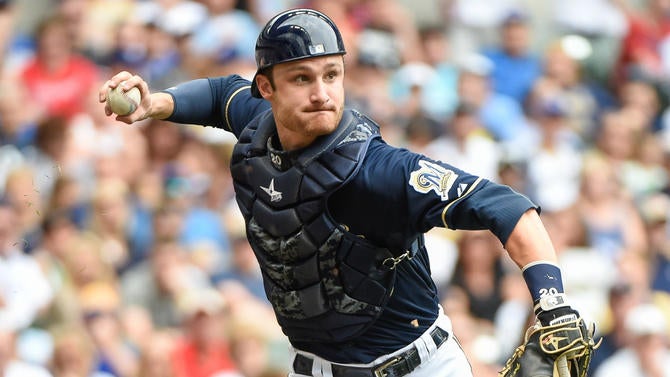


Jonathan Lucroy
View Profile
ATL • C • #14
Contract$2M remaining in 2016; $5.25M club option in 2017
Lucroy has done all he can do to put an injury-ravaged 2015 behind him. He's hitting for average, walking, and even hitting for more power than usual. Behind the plate, he remains a skilled receiver whose caught-stealing rates continue to outshine his raw arm strength. Throw in the insanely cheap club option the acquiring team would hold over Lucroy's services for next season, and it's fair to write that he's one of the bigger bargains in baseball. Of course, the flip side to that statement is that the Brewers may not get a good enough offer to move him before the winter. Whatever the case, Lucroy is the closest thing on the market to an impact-level backstop.


Yeah, the first-base market figures to be barren. Morrison's miserable April (.290 OPS) continues to weigh down his overall numbers, as he's hit .276/.362/.443 with eight home runs since May 1. No one outside of St. Petersburg is going to confuse Morrison with a middle-of-the-order threat, however, he's a solid enough platoon bat who ought to come cheap. Besides, trading Morrison would allow the Rays to give a long look to former first-round pick Richie Shaffer, who has been in Durham so long that he's probably tried every food truck in town. Twice.


Jed Lowrie
View Profile
ATH • 2B • #8
Contract$3.75M remaining in 2016; $6.5M in 2017; $6M club option in 2018
The A's have to be open to trading anyone at anytime, but they might have more reason than usual to move Lowrie. Judging by his catch-all offensive metrics, he seems to be having his typical, league-average season at the plate. A deeper dive reveals that isn't the case. Lowrie's power numbers are way down, to the point where he's a glorified singles hitter -- and he hasn't made up for it by walking more. A team buying in on Lowrie is doing so with the belief either that his pop will return or that his higher-than-norm batting average is here to stay. Otherwise, he's a 32-year-old with a below-average glove and a long injury history. Buyer beware -- even if the second-base market offers few alternatives.
Yunel Escobar
3B
Contract$3.5M remaining in 2016; $7M club option in 2017
Escobar is the player most likely to change teams in the coming weeks -- in part because he's always changing teams. Dating back to November 2012, Escobar has been dealt five times, including twice before he even suited up for his new club. Those moves have been spurred by his personality more than his play, since he remains an above-average hitter who could hit .300 for the second season in a row. Escobar does have his on-the-field negatives: he doesn't offer the power typically associated with third base, and his big arm doesn't make up for his other defensive issues. Still, he should bring more offense (and better fashion sense) to any team who acquires him -- for as long as they can stand him, anyway.


The inverse of Lowrie -- or close to it. Cozart entered last season with a career 76 OPS+ and .122 ISO; he's since managed a 108 OPS+ and .200 ISO in more than 500 plate appearances -- improvements he credits to focusing on hitting the inside of the ball. Considering he's a well-above-average defender, that's a huge difference -- like, the difference between being an all-star-level talent and being on the starter-reserve bubble. The paucity of legitimate two-way shortstops means some team will probably take a shot to see if Cozart's emergence is real, content knowing that the worst-case scenario is getting a good gloveman.
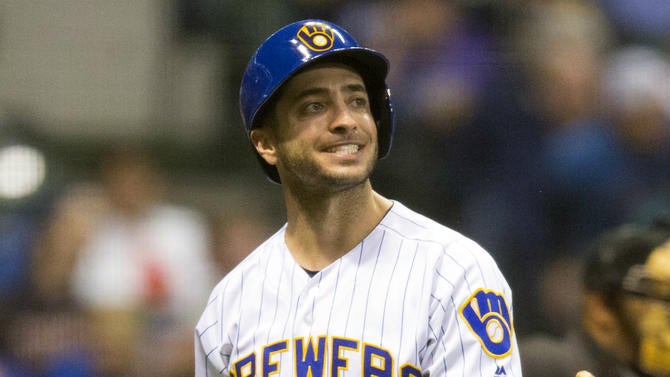


There's a reasonable chance Braun's contract makes it too difficult to deal him before the deadline. He's listed here anyway because, as last year's Cole Hamels trade shows, teams will find a way to acquire impact talent -- whether that talent costs a little or a lot. Braun is nearing his 33rd birthday, but he's an all-star-level hitter all the same, and one who has experience in both corner-outfield positions. For as much as we nitpick cases like this, it's important to remember Braun would absolutely get more on the open market as a free agent; viewed from that perspective, and depending on the prospect cost, he could be a smart play for a big-market team.


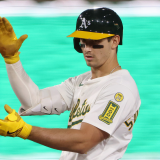
Reddick only recently returned from spending more than a month on the disabled list. Nonetheless, he's expected to be one of the best outfielders on the market -- a two-way contributor whose defense once earned him a Gold Glove award. The A's evidently would like to keep Reddick -- beyond this winter -- but it's always hard to bet on Oakland having the means to keep a pending free agent of this quality.


Remember last deadline, when Bruce was supposed to be headed to the Mets? Or this past winter, when a Bruce-to-Toronto trade was reportedly nixed due to medical woes? The Reds' third try at trading Bruce should be the trick. He's done well to reestablish himself, posting an OPS+ that would tie his career-best mark, and showing that his trademark well-above-average pop is in tact. You can be pretty certain that some contender is going to take Bruce off the Reds' books and place him in the middle of their order.


Another reminder that baseball is weird. A year ago, Valencia was a 30-year-old playing for his fifth organization. He'd join a sixth soon thereafter as a waiver claim. Now he's an intriguing trade target whose 135 OPS+ has come while moving into more of an everyday role. Valencia isn't winning any awards for his defense, but his ability to stand-in at third base should help with is appeal -- meaning he ought to fetch a decent piece. Again, he was on waivers roughly 11 months ago.
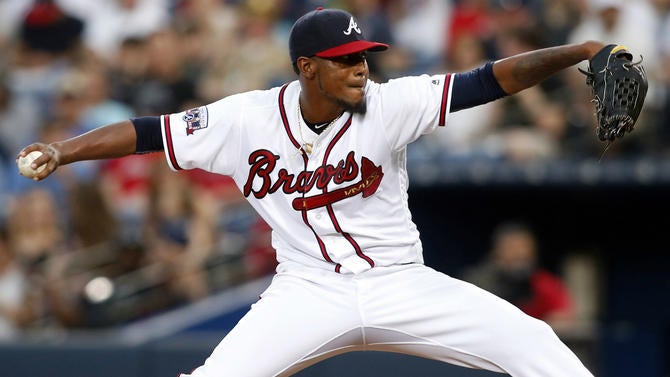

Julio Teheran
View Profile
BAL • SP • #49
ContractSigned through 2019 for $25.3M; club option worth $12M for 2020
Teheran is one of the few young Braves to sign extensions years ago who remains in town. (Freddie Freeman being the other.) Predictably, the confluence of his performance and contract, and the Braves' ongoing rebuild has made his future in Atlanta an open question. Publicly, the Braves have stated it would be difficult to move Teheran, but duh -- what else are they going to say? That it's easy to trade a young, homegrown starter with good stuff and impressive results? The Braves might not get an offer to their liking, in which case they'd obviously stand pat. That established, it wouldn't be too surprising if Teheran is on another team's roster come August.


Santiago made last year's All-Star Game and is one of the Angels' top realistic trade chits, but there's reason for hesitation from buyers. He combines wild tendencies with a worrisome home-run rate that has worsened even as he pitches in a cavernous ballpark. In kind lighting, Santiago looks like a no. 4 type. Anything else, and he looks like a pitcher who might wind up in the bullpen in the not-too-distant future.


One of baseball's best stories over the past year, Hill recently returned from a month-long stay on the shelf. That shouldn't stop contenders from lining up around the countryside to pursue his services. By now, you probably know that he's essentially a slop artist -- to the extent that he's making steady eye contact with the possibility of throwing more bendy things this season than fastballs. It's an unusual methodology, and one that wouldn't work for a pitcher with a lesser curveball. It does work for Hill, though, and that's why he's likely to be someone's Game Two or Three starter come tournament time.


If it feels like Odorizzi is having a disappointing season, that's probably because his efficiency has taken a step backward. He's throwing more pitches per start than previously, yet recording fewer outs -- and it's in large part because he's having more and more pitches spoiled off. Still, Odorizzi is years away from making serious coin, and is a highly athletic 26-year-old with a broad arsenal and a track record of being an above-average big-league starter. Those aren't readily available often, so expect some contender to make a run at taking Odorizzi off the Rays' hands.


Most back-end starters are categorized as either innings eaters or pitchers who can add value over inefficient outings. Hellickson entered the season as neither. Yet that hasn't prevented him from notching at least six innings in nine of his last 10 starts, thereby pushing his seasonal innings-per ratio to the second-highest level of his career. Granted, Hellickson remains the same C-heavy pitcher as before -- as in command, control, and changeup -- but his results figure to earn him a spot at the back of a contender's rotation -- and perhaps even a playoff start.
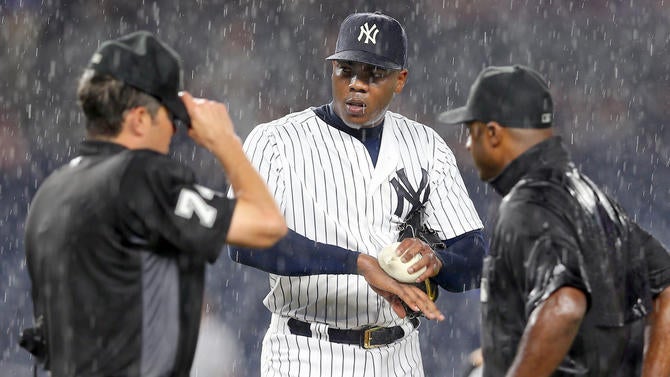


All teams considering Chapman would do well to remind themselves that he responded to an argument with his child's mother by firing his gun multiple times in the garage. If they can get over that -- and, unfortunately, they probably can -- then they can think about his baseball impact. Chapman uses his freakish flexibility to create impossible separation between his upper and lower halves, which in turn creates elite velocity. He's undoubtedly one of baseball's best relievers, and teams are going to rush to make a deal if he's made available. Even if they shouldn't feel good about it.
Arodys Vizcaino
RP
ContractArbitration eligible after 2016; FA after 2019
Trading Vizcaino makes too much sense not to happen. For as effective as he's been over the last year-plus, it's important to remember that injuries and a suspension have limited him to fewer than 100 big-league innings. There are other sustainability questions here, too. Because Vizcaino is the kind of reliever who has to limit quality of contact in order to atone for his walks, he's always going to have an inherently risky profile -- sometimes these types just flame out. Add in how the Braves don't need a lockdown closer at this point, and a trade seems likely -- whether they're sold on Vizcaino remaining good and well for the foreseeable future or not.

Having just returned from the disabled list in early June, Smith is effectively putting on a two-month audition to show contenders he's hearty and hale. He hasn't received his just due over the last few seasons because of where he's pitched, but he's nonetheless developed into a legitimate late-inning lefty since coming over in the Nori Aoki trade. How good is Smith's slider? Batters have whiffed on nearly 60 percent of their swings against it since 2014. So, uh, pretty good. The rebuilding Brewers have little incentive to hold on to Smith, whose remaining years of control ought to make him a cheap, long-term fit at the back of some contender's bullpen.


We profiled Ramirez earlier in the season, when he was being used as a fireman. He's pitched poorly since, which is about how these things go. Still, Ramirez's fastball-changeup combination ought to allow him to succeed over the long run, and his versatility -- he's started, he's relieved in both normal and abnormal capacities -- makes him a fit for darn near every team. Factor in how Ramirez just turned 26 in May, and how he's going to remain cheap for years to come, and there's sufficient reason for other teams to have interest.