
A few small but important tweaks have the Twins in contention in the AL Central
Changes in the outfield and behind the plate have paid huge dividends for the Twins defensively

By
Mike Axisa
•
3 min read

Friday night at Target Field, the Minnesota Twins beat the Detroit Tigers to snap a four-game losing streak (MIN 6, DET 3). The Twins are in the middle of the rebuild, but they're off to a decent start this season, with an 8-8 record and plus-13 run differential through their first 16 games. That is the second-best run differential in the AL and the fourth best in all of baseball.
In the super early-going this season, the single biggest difference between last year's 103-loss Twins and this year's .500 club is the team defense. Check it out:
- 2016 Twins: .681 Defensive Efficiency (29th in MLB)
- 2017 Twins: .756 Defensive Efficiency (First in MLB)
In a nutshell, that .681 Defensive Efficiency tells us the Twins turned only 68.1 percent of all balls in play into outs last season. This year they've converted 78.6 percent of balls into play into outs. That is a massive swing and a big reason why the Twins have a team 3.17 ERA so far in 2017, fourth lowest in baseball. Last year, with nearly the exact same pitching personnel, they had a 5.09 ERA, worst in MLB.
Nothing in baseball is simple, though for the Twins, the reason for their improved defense seems quite obvious: they got Robbie Grossman and Miguel Sano out of the outfield. Grossman was the team's regular left fielder last season while Sano saw plenty of time in right field as part of an ill-fated decision. He tried his best, but Sano is a big man and he isn't mobile enough to play the outfield regularly. Especially not in a spacious ballpark like Target Field.
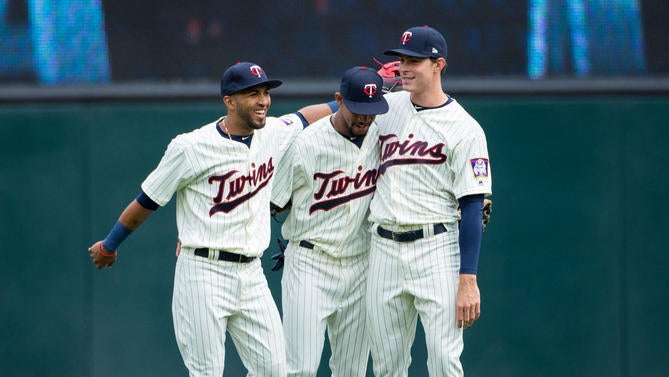
This year Grossman has been moved to designated hitter, while Sano has returned to his natural position, third base. Eddie Rosario and Max Kepler are now flanking Byron Buxton in the outfield, and gosh, it has made a world of difference. The Twins have a fly-ball heavy pitching staff -- they ranked 24th in MLB with a 43 percent ground ball rate last year, and are 27th with a 39.5 percent ground ball rate so far this year -- so swapping out Grossman/Sano for Rosario/Kepler is a huge help.
Furthermore, the Twins also upgraded defensively behind the plate, going from Kurt Suzuki and Juan Centeno in 2016 to Jason Castro and Chris Gimenez in 2017. This won't show up in the Defensive Efficiency but it will show up in the team ERA. Castro and Gimenez are quality pitch-framers. Suzuki and Centeno are anything but. Here are the pitching-framing numbers, per Baseball Prospectus:
Framing Runs | |
2016 Kurt Suzuki | -6.8 |
2016 Juan Centeno | -9.7 |
2017 Jason Castro | +0.2 |
2017 Chris Gimenez | +0.2 |
The 2017 season is still very young, so Castro and Gimenez haven't saved the Twins a ton of runs with their pitch-framing yet, but the fact they're saving them even fractions of a run represents a huge upgrade.
Both Suzuki and Centeno were among the worst pitch-framers in baseball last season. Castro, on the other hand, has a reputation for being one of the best. He and Gimenez have turned plenty of borderline pitches into strikes so far this year, especially relative to Suzuki and Centeno last year, and that has a huge impact on the pitching staff. Again, pitch-framing won't show up in Defensive Efficiency, but it will help keep runs off the board.
One of the biggest knocks against the Twins in recent years was their lack of analytics. They were far behind the times relative to the rest of the league. New chief baseball officer Derek Falvey has gotten the team up to speed analytically since taking over the last year, and that has led to a big improvement defensively, both in the outfield and behind the plate.