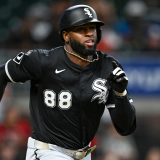

Dee Gordon open to extension with Marlins; what's a fair contract?
Marlins second baseman Dee Gordon is open to signing a long-term extension with the club. What's fair value for the leadoff dynamo who is still three years from free agency?

By
Mike Axisa
•
5 min read

Last offseason the Marlins hit the jackpot with second baseman Dee Gordon. They acquired him from the Dodgers in a seven-player trade -- lefty Andrew Heaney was the main piece going the other way -- and Los Angeles even paid his $2.5 million salary.
Gordon, 27, hit .333/.359/.418 (114 OPS+) in his first season in Miami, winning the batting title and leading all of baseball in hits (205) and stolen bases (58). He did that despite missing 17 days with a thumb injury. Gordon was a very deserving All-Star, though he was unable to participate in the Midsummer Classic due to the injury.
Not surprisingly, the Marlins are showing interest in signing Gordon to a long-term extension. Gordon is open to the idea as well. From Barry Jackson of the Miami Herald:
The Marlins will explore making a multi-year offer to second baseman Dee Gordon, the National League’s batting and stolen base champ, and Gordon said he would be receptive because “I love it here –-- the ballpark, the coaches, the staff.”
The Marlins and owner Jeffrey Loria have a well-earned reputation for being cheap, but they've always been willing to sign their top young players to long-term extensions. Giancarlo Stanton's massive 13-year, $325 million deal is the headliner, but the team also extended Christian Yelich, Hanley Ramirez and Josh Johnson in recent years. They tried to sign Jose Fernandez and Marcell Ozuna as well, but were turned down.
Gordon is under team control through the 2018 season as an arbitration-eligible player, so the Marlins have him for at least another three years. He is a Super Two player, however, meaning he qualifies for four years of arbitration rather than the usual three due to his service time. MLB Trade Rumors projects a healthy $5.9 million salary for Gordon in 2016, his second of those four arbitration years.
Because he's won a batting title and two stolen base titles (and been an All-Star twice), Gordon has a strong arbitration case even though the system is archaic. The three-person panel tends to base judgments on things like RBI and wins and saves, which don't accurately reflect a player's value. Gordon is a speed and defense guy. But still, the batting title and two stolen base titles help.
Gordon comes into the offseason with three years and 154 days of service time, which is more commonly written as 3.154. Not too many players have signed long-term extensions at that service time level in recent years. Eric Hosmer, for example, opted for a two-year contract with his service time at 3.146 before the season. He got some security and the Royals got cost certainty for 2015-16.
A little two-year "bridge" contract to keep Gordon's salary from exploding through arbitration -- if he leads the league in steals again next season, he could win up making over $9 million through arbitration in 2017 -- could make sense from Miami's perspective, but surely they want to lock him up beyond 2018. They'd like to buy out some free agent years.
Here are some players who signed long-term extensions at a similar service time level as Gordon in the last few years.
| Recent Extension for Players Near Dee Gordon's Service Time Level | ||||
| Gordon | D. Mesoraco | K. Seager | M. Brantley | |
|---|---|---|---|---|
| Platform Year WAR | 4.9 | 4.8 | 5.8 | 2.5 |
| Career WAR | 6.6 | 4.2 | 13.2 | 6.3 |
| Service Time | 3.154 | 3.028 | 3.085 | 3.131 |
| Years | ? | 4 | 7 | 4 |
| Dollars | ? | $28M | $100M | $25M |
| Options Years? | ? | 0 | 1 | 1 |
Our selection of players includes no great matches for Gordon. Mesoraco is a catcher, Seager a slugging third baseman, and Brantley sort of a jack-of-all trades outfielder. Gordon is a leadoff hitting second baseman.
More important than playing style is service time. Mesoraco and Seager had significantly less service time when they signed their extensions than Gordon does right now. Brantley is the closest and heck, he seems to be the best fit when you compare his career production at the time of the extension to Gordon.
There's one significant difference: Brantley was not a Super Two player. His earning potential was not as great as Gordon's. Here s what Brantley will earn via the extension compared to Gordon's salary projections.
| Recent Extension for Players Near Dee Gordon's Service Time Level | ||||
| Brantley | Gordon | |||
|---|---|---|---|---|
| Year Before Extension | $527K | $2.5M | ||
| Year One of Extension | $1.5M | $5.9M projected | ||
| Year Two | $5.875M | ? | ||
| Year Three | $7.375M | ? | ||
| Year Four | $8.375M | ? | ||
| Year Five | $11M option | ? | ||
Gordon is projected to earn more in what would be year one of his extension than Brantley earned in year two of his contract. Huge difference! That Super Two status changes everything. It's wonderful for Gordon and not so good for the Marlins.
The Brantley contract can still be a model for a Gordon extension, however. You just have to forget about that first year and treat the second year of Brantley's contract as the first year of Gordon's. Make sense? Something like this might work for Gordon and the Marlins:
2016: $5.875 million
2017: $7.375 million
2018: $8.375 million
2019: $11 million
2010: Option year
That's a four-year contract worth $32.625 million, with a fifth year option. Saying that out loud, it seems awfully light. I imagine Gordon's representatives would want more. I could see them pushing for something where the annual salaries go $5.75 million, $8 million, $10.25 million, $14 million for a total guarantee of $38 million.
One thing that is difficult to account for but must be acknowledged is Gordon's financial situation. He's made north of $3.5 million in his MLB career to date and has another nice payday coming through arbitration this offseason. Also, his father Tom played 21 years in the show and earned over $50 million.
Most players sign long-term extensions because they want the financial security. They give up the chance at the largest possible payday through arbitration and free agency so they can take care of their families and have peace of mind. Most players don't come from wealthy families.
Getting that financial security may or may not be a big deal for Gordon because of his family's situation. He may decide on a number, and if the Marlins don't meet that number, he'll take his chances in arbitration and free agency. Gordon could be in position to play hardball during contract talks.
Either way, Gordon's arbitration case is complicated because he's a unique player, both in terms of style and service time level. Building a contract extension for him using recent examples is rather tough. There's no obvious comparison to be made. Then again, there was no obvious comparison for Stanton, and the Marlins figured that one out.
An extension for Gordon doesn't figure to take as much work and creativity as Stanton's deal, but finding a middle ground may be tough for the two sides. Given his production and rapidly climbing arbitration salaries, the soon the Marlins can sign Gordon, the better.