Drones flying over ballparks without permission concern MLB
MLB used anti-drone security during the All-Star game in July, but didn't try it for the playoffs because of the cost and effectiveness.
By
Dave Brown
•
2 min read
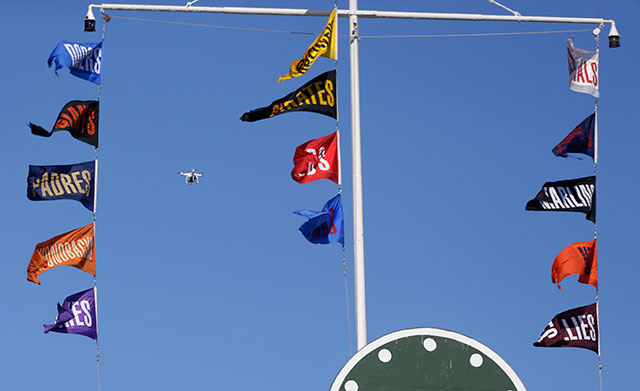
Major League Baseball officials had no warning when a drone hovered over Comerica Park during Game 3 of the ALDS on Oct. 5. The drone posed no threat, it turned out, but players for the Detroit Tigers and Baltimore Orioles, along with umpires and security, didn’t know that until the moment had passed.
The drone that crashed on the White House lawn earlier this week reportedly had evaded radar — which is scary enough — but the machine's owner wasn't anyone acting in a sinister way. The machine just got away from him.
While security at a ballpark isn’t usually a concern in the same way that it is at the White House, MLB officials have put a lot of thought into drones. The New York Times reported Friday that MLB tried an advanced radar system during the All-Star game at Target Field in Minneapolis this past July. The newfangled setup cost "hundreds of thousands of dollars" to operate for one game, and it was able to pick up several drones flying overhead — including one operated by ESPN — but all the system could offer was a warning. It couldn't stop the drones from flying over the park. Based on the cost and the payoff, MLB declined to use the system again for the playoffs.
The Super Bowl kicks off Sunday night, and that event faces similar concerns over drones, the Times writes:
The National Football League will not say what type of system, if any, it will have in place at the Super Bowl in Glendale, Ariz., on Sunday, though the Federal Aviation Administration issued a warning this week that anyone flying drones over an N.F.L. game could be “intercepted, detained and interviewed.”
While drones have not been used in a terrorist attack on American soil, thwarting them is increasingly becoming a challenge for law enforcement and security officials who are charged with protecting large-scale events like the Super Bowl and high-profile public buildings like the White House. The officials have warned that the low-flying devices could be modified to carry explosives, chemicals, biological agents, guns or cameras.
Again, the White House is one setting, but what are they going to do at the University of Phoenix Stadium on Sunday, or at PNC Park the next time it happens there? Blow any strange drones out of the sky? An exploding drone is still bad news over a stadium of 40,000 or more.

Most drones in the United States that are privately operated are used for fun of some sort. Aerial photography, or farmers monitoring their crop fields. Stuff like that. Check it out:
How glorious!
The worry is: What happens when someone with bad intentions goes to fly a drone? Technology is used in some drones already, via microchip, that prevents the machines from invading "no-fly zones" such as airports — but a terrorist could get around this.
It's easy to be frightened by these developments, but there's no good reason for MLB to be in the national security business. Not at those prices — not if we don't have better technology to prevent the drones from flying over stadiums. One reason for optimism: We're probably working on better anti-drone technology. Heck, we better if they can fly into the White House randomly. Someday, hopefully soon, we'll be able to make drones a non-issue. In the meantime, just keep your eyes on the game.