How five defensive gems helped the Cubs win Game 5, stay alive in World Series
The Cubs lived to play another game thanks to the some key defensive plays

By
Jonah Keri
•
7 min read

The Cubs nipped the Indians 3-2 in a heart-stopping elimination game, pushing the series back to Cleveland thanks in large part to five terrific defensive plays.
Chicago's first display of gloved excellence came with one out in the second. Carlos Santana struck a foul toward the Indians dugout. David Ross, the fan favorite ageless catcher who strides to the plate to "Forever Young" and earned a seventh-inning stretch tribute from Eddie Vedder, raced to the dugout railing, hoping to reel it in. The veteran overran the ball slightly, then had it glance off his glove. Luckily, an alert Anthony Rizzo was standing inches away. The Cubs first baseman reached for the ball, had it glance off his body ... then into his glove for a crowd-delighting out. Pete Rose would approve.
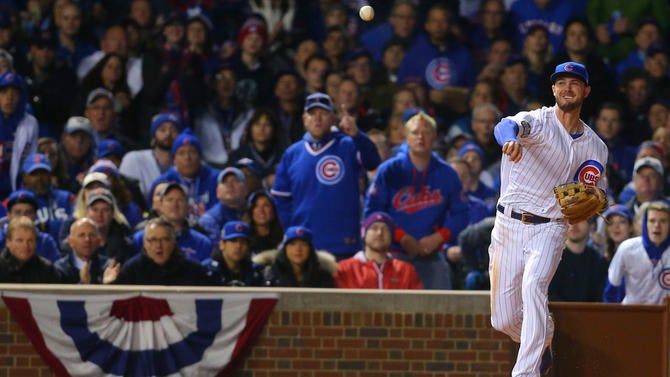
The Indians took the lead one batter later, as Jose Ramirez crushed a juicy, 92-mph Lester fastball into the left-field bleachers. They would do no more damage in the inning, thanks to Kris Bryant. This year's likely National League Most Valuable Player had a rough Game 4, committing two throwing errors in one inning and going 0 for 3, and dropping his World Series batting average to a woeful .071. But when Brandon Guyer ripped a shot up the third-base line behind the bag, Bryant speared it with a diving stop, fired a bullet to first, and got the out after Rizzo pulled off a sweet scoop.
One inning later, the Cubs' $184 million part-time outfielder showed why he found his way back into the lineup, even after months of struggles at the plate. With one out in the top of the third, Indians starter Trevor Bauer laid a couple of surprising swings on the ball. The first one bounced just foul at first base. The second one was another opposite-field slicer, this one down the line and tailing toward the seats that practically hang over the field. Jason Heyward dashed toward the seats, leapt, grabbed the ledge of the stands, reached back ... and pulled off a Spider-Man catch.
After another Ross-Rizzo meetup in the fourth (both raced toward a foul pop, Ross caught it, Rizzo knocked him over, Ross hung on anyway), Addison Russell flashed the leather in the fifth. Santana led off the inning with a ringing double off Lester, setting the stage for a comeback after the Cubs' three-run fourth. When the speedy Jose Ramirez tapped a slow roller to short, it looked like the Tribe might get the tying run on base with nobody out. Instead, Russell charged in, fielded the ball cleanly, and fired a lightning-quick throw to first to get Ramirez by a hair. That play may not have looked quite as spectacular as some of the Cubs' other defensive efforts Sunday night. But it was still a play that few other shortstops make that seamlessly, reminded viewers why Russell is a Gold Glove finalist this season.

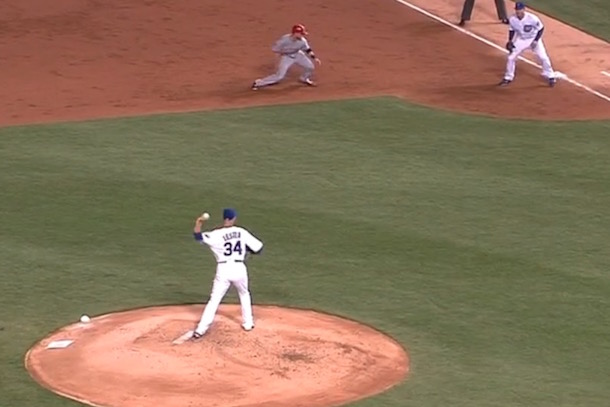
The capper came in the sixth. Rajai Davis laced a one-out single off Lester, then promptly swiped second. Electric shortstop Francisco Lindor then stayed hot, smacking a two-out single to center to cut the Cubs lead to 3-2. With Davis having just stolen a base, Lester allowing a jarring 28 steals against him during the regular season, and his notorious inability to throw to first base and hold runners on rising to the level of national discussion, everyone in the ballpark knew that Lindor would test the veteran lefty.
Sure enough, on the second pitch of Mike Napoli's at-bat, Lindor broke for second. Ross's throw came in low and in good tagging position, though far enough toward first base to pull Javier Baez off the bag. No matter. The incredibly skilled second baseman snagged the ball out of the air, and in a blur, slapped a tag on Lindor just before he could reach the base. Score that play 2-4, inning over.
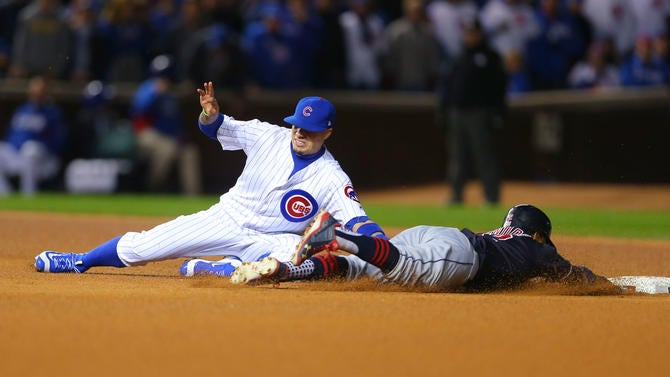
Breaking the play down, we can see multiple competing forces at work, and a reminder of how vexing weird tendencies can be for baseball players. Lester's mental block against throwing to first to keep runners close is so acute, some baserunners will take unimaginably massive leads against him. But as Fangraphs writer Jeff Sullivan wrote during the NLCS against the Dodgers, athletes are creatures of habit. When a player behaves in a way that runs counter to everything they've learned over years of practice and thousands of reps, it can be hard for a player to convince his brain that this new behavior should be exploited. In Lester's case, that's a double-block, one against taking the kind of gigantic lead that the pitcher is allowing, the other to actually take off for second after taking those huge liberties.
If a player merely takes a big lead off Lester, he can get himself into trouble. That happened in Game 1 of the World Series, when Lindor went 1 for 2 in stolen base attempts. And it happened again in Game 5, when he got thrown out to end the sixth. The combination of Lester's better-than-average time to home plate with runners on base, the 39-year-old Ross's ability to maintain a pop time that catchers 15 years his junior would kill to have, and Baez slapping tags on runners better than just about anyone else at baseball does with any play creates a combination that can create invaluable outs for the Cubs.
Defense alone doesn't win ballgames, and the Cubs needed contributions from numerous other sources to keep their season alive. Lester battled through six innings stingy innings, allowing just two runs on four hits, striking out five, walking none, and expending so much energy with every pitch that he asked out of the game once those six frames were done.
Lester did his best job of mixing pitches in the first, striking out Davis, Jason Kipnis, and Lindor in order with three different pitches: a changeup, cutter, and curveball. The rest of the game consisted almost entirely of hard stuff, with just eight curves and five changeups complementing the combined 77 four-seam fastballs, cutters, and sinkers that he threw on the night. Lester's 1-0 cutter to Roberto Perez in the third produced a valuable strike that allowed the lefty to come back in the count and eventually retire that inning's leadoff man. His 2-2 cutter to pinch-hitter Coco Crisp leading off the sixth was a burrowing pitch that induced Crisp to chase and ground out weakly to third, swinging the seven-pitch battle to Lester and netting another valuable out that helped limit the damage in what could have been a game-swinging inning.
Meanwhile, Bryant complemented his second-inning defensive gem with a resurgent night at the plate. With the Indians looking to build on their record-setting five shutouts this postseason and the Wrigley faithful growing restless, short-rest starter Trevor Bauer fired a 1-1 fastball right in Bryant's happy zone, The Cubs slugger didn't miss it, smoking a line drive over the ivy in left-center to tie the game at 1. When Rizzo followed with a solid double on the next pitch, we could finally declare the Cubs offense back in business, enough to string together the hits they'd need for three fourth-inning runs and a lead that would hold for the rest of the game.
Kris Breezy gave his @Cubs fans a souvenir: https://t.co/uqflax1fBS#WorldSeries pres. by @TMobilepic.twitter.com/sUqyHq6zyJ
— MLB (@MLB) October 31, 2016
Aroldis Chapman would do the rest. The controversial but dominant Cubs closer got his earliest call of the season, entering the game with one out in the seventh and a runner on second. He then unleashed his blazing fastball on Indians hitters, chucking 35 of them at an average speed of 100 mph. That included a ludicrous heater to Lindor in the eighth, a 2-2 fireball that hit 102 on the radar gun and clipped the outside black, sending Lindor back to the bench and ending a threat started when Chapman didn't bother trying to cover first on a Davis grounder to first. That defensive lapse and Chapman's complete inability to hold runners on aside, the southpaw closer delivered 42 pitches of misery, retiring eight of the 10 batters he faced, striking out four en route to his eight-out save.
Still, Chapman might have never earned that chance if not the Cubs' defense. For all the hoopla around Bryant and Rizzo at the corners, the big three in the rotation, the 108-year curse, and the fans' love affair at Wrigley, the biggest constant for this team in 2016 has been its ability to save runs with the glove. According to Baseball Info Solutions' Defensive Runs, Chicago's defense saved 107 more runs than the average major league team this year, by far the highest figure in the majors in 2016 and also the highest since DRS started tracking that stat 13 years ago. Having Heyward, Rizzo, Baez, and Russell dazzle in the field was a return to normal for a team that had leaned on those four defensive stars all year long; the defensively underrated Bryant joining the fray after an ugly Game 4 was a welcome bonus.
As the series shifts back to Cleveland, plenty of questions will swirl around both teams. But if you're the wagering type, here's a free piece of advice: Don't bet against the Cubs defense.
Nick Pollack of PitcherList.com contributed research help for this article.