Keri the 10: Dodgers are the new Yankees, Paxton's rise and more MLB observations
The Dodgers' future has arrived, the Giants make a counter move and much more from around MLB

By
Jonah Keri
•
12 min read

 Welcome to this week's edition of Keri The 10! As always, we'll go around the majors with 10 stories that caught our eye from the past seven days. There will be numbers, and occasionally, memes. As always, we will have fun.
1. The Dodgers' future has arrived
The Yankees have long been known as the team that spent everyone else into submission in search of premium talent. But from Gehrig to DiMaggio, Mantle to the dynasty of the 90s, the Bombers could usually thank their own talent pipeline for their best players and most successful years.
The Dodgers, in many ways, are the new Yankees. They've earned a reputation as the new kings of spending, a rep that's well earned given the highest-in-baseball (by a mile) payroll and a jaw-dropping trade five years ago that remains the industry standard for WTFery. But like those Yankees of the 90s, the Dodgers' fortunes could rest on a core four of their own. The final two pieces of that quartet have finally arrived.
Precocious left-hander Julio Urias made his major-league debut last season, becoming the first-ever major-league prospect to have his potential stamped on his Twitter handle. The phenom southpaw's major-league debut was far from perfect: He lasted less than five innings per start in 2016, due to carefully-monitored pitch counts but also shaky command (31 walks in 77 innings pitched, plus many deep counts). Still, the upside was, and is, obvious. Urias punched out 84 batters in those 77 frames last year, making him the 12th-most prolific strikeout pitcher among all starters with as much playing time. Few pitchers in the past decade have flashed the kind of three-pitch potential that Urias does with his fastball, curve, and changeup.
We caught glimpses of that potential on Thursday. After sending him back to the minors to protect his workload at the start of the season, Urias made his first big-league start of 2017 against the Giants, and showed flashes of brilliance. The lefty went 5 2/3 innings, allowing just one run on four hits, while striking out four. The only blemish, again, was command. Urias walked four batters, and needed 90 pitches to record those 17 outs. Still, Urias possesses knockout stuff, owns the upside to be the Dodgers' No. 2 starter in the near future, and is still just 20 years old. That would cause for major excitement, even without this week's other big news ...
... which was the major-league debut of ultra-skilled slugger Cody Bellinger. The Dodgers' top hitting prospect blasted 30 homers in 128 games as a 19-year-old in high-A ball two years ago. Last season, he crushed 26 more long balls while spending all but three games at Double-A, in the process significantly upping his walk rate and slashing his strikeout rate. Then in his first 18 games of this season at Triple-A, Bellinger hit .343/.429/.627, smashing five more homers and stealing seven bases to boot. After making his major-league debut Tuesday, Bellinger was already inserted into the leadoff spot Wednesday against the Giants, and the Dodgers are hoping he can jump-start their offense with Joc Pederson on the disabled list. The early returns have been modest, with a single and two walks in three games. The bigger long-term concern is his propensity to strike out -- he's fanned 27 in 89 plate appearances this season. Still, he's just 21 himself, the Dodgers control his rights through 2023, and his future is bright.
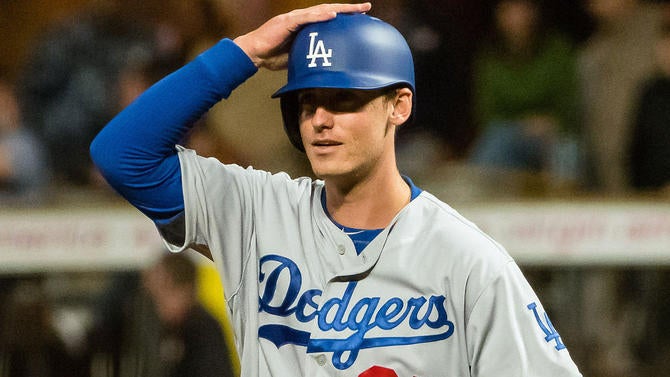
As the Dodgers contended for playoff spots in each of the past five seasons, they were surely bombarded with offers for their best young players. But by hanging onto 2016 NL Rookie of the Year Corey Seager, as well as Urias, Bellinger, and the potential fourth member of L.A.'s core four in Pederson (if he can ever improve his batting eye), the organization has stayed true to its mantra of youth, data, and depth. The only question now is whether the Dodgers can finally nab that elusive World Series trophy to complete the Yankee comparison.
2. The Giants made a counter move
Low on high-impact prospects, the Giants this week promoted their one hitting prospect with the best shot to help the team right away: Christian Arroyo. A first-round pick in the 2013 draft, Arroyo played shortstop, third base, and second base in the minors and projected as a plus bat at those premium positions. He took a step back in 2016, though, batting just .274/.316/.373 at Double-A Richmond. He got off to a much stronger start this year in the friendlier hitting environment of Triple-A Sacramento, though, hitting a massive .446/.478/.692 in 16 games.
That small sample size outburst aside, there are two broader reasons to get excited about Arroyo if you're a Giants fan. First, his skill set -- short swing, line-drive machine, doubles power -- is perfectly suited to AT&T Park, a stadium that murders home-run hitters but handsomely rewards gap-to-gap hitters with its vast dimensions. Second, the Giants offense sorely needs a jolt. San Francisco deploys the second-oldest collection of position players in the National League. And that group has been awful. Even after adjusting for AT&T Park's hitter-punishing confines, the Giants have still fielded the worst offense in the National League this season. Arroyo launching his first MLB home run off former Giant Sergio Romo helped the cause.
How long the 21-year-old Arroyo stays with the big club is an open question, since he's filling Brandon Crawford's lineup spot for now, and Crawford could be back off the bereavement list on Saturday, assuming the groin injury he suffered this week doesn't linger. Still, the outfield is a mess with Denard Span and Jarrett Parker on the disabled list, neither hitting a lick even when they were healthy, the outfield depth behind those two being non-existent, and the lineup in general being lifeless. The smart money's on Arroyo staying up, with Eduardo Nunez shifting to a superutility role, and Brandon Belt continuing to play some left field too.
For a Giants team missing Madison Bumgarner and searching for any kind of spark, talent will play.
3. The Rockies face a dilemma of their own
Eric Thames making $5 million a year while hitting like Barry Bonds definitely counts as the steal of the season so far this year. Still, don't sleep on Mark Reynolds. On a one-year, $1.5 million (that would still only max out at $3.5 million in performance bonuses), the Rockies first baseman has raked to the tune of .317/.374/.634. And yet, one of the most fascinating players in the game might lose his job soon.
That's because Ian Desmond could make his Rockies debut in about a week. The 31-year-old veteran is about to start a rehab assignment, which could lead to him popping up in Colorado's lineup soon. Given his groundball tendencies, fading offensive numbers, and a lack of experience at first base, the Rockies signing Desmond to a five-year, $70 million contract could end up being the worst move of the offseason. Reynolds isn't going to hit like peak Albert Pujols all season long, of course. But it's quite possible he's a superior option at first base both offensively and defensively compared to Desmond. The playing-time crunch could get more acute around mid-May, when talented outfielder David Dahl could return from a rib injury.
Then again, all of this might simply be a great problem to have. The additions of Greg Holland and Mike Dunn have hugely fortified a perennially terrible bullpen. The starting rotation remains a big question mark with Jon Gray out for a few weeks and Chad Bettis fighting cancer. But a team with six losing seasons suddenly having too many good position players for eight lineup spots, and a bullpen that ranked among the league's best before a one-game implosion at Coors Field on Thursday is still a pretty great early-season outcome. Especially for a ballclub with six straight losing seasons.
4. Adam Rosales is the fastest home-run trotter alive
The A's infielder is the Bizarro David Ortiz. Rather than stop after a home run, admire his work, then lope around the bases, Rosales sprints around the bases. Last season, he accounted for 10 of the 11 fastest home-run trots in baseball, as well as the fastest one ever recorded in the Statcast era. On Saturday against the Mariners, he broke his own record, racing home in 15.9 seconds. That journey around the bases on an over-the-wall homer was just .36 seconds slower than the inside-the-park shot Charlie Blackmon hit the day before. It's a damn joy to watch.
After his record-breaking sprint, @arosie7 is monopolizing #Statcast’s fastest home run trots. https://t.co/Hkor4O6Fmy pic.twitter.com/xO17uNJytX
— #Statcast (@statcast) April 22, 2017
5. We have an early nominee for Double Play of the Year ...
... thanks to Kendall Graveman. With runners at the corners and nobody out Thursday night, Angels catcher Juan Graterol tapped a comebacker back to Graveman. The A's right-hander chased speedy Angels outfielder Ben Revere back to first base, then lunged to tag him out right before he got back to third base. What happened next, however, made the play. Trying to take advantage of the rundown, Angels second baseman Cliff Pennington chugged from first base all the way to third. Graveman spotted Pennington coming and ... just watch:
This might be our only back-to-back Oakland highlights of the season. Savor them.
6. Robbie Grossman might be a new man
Last week, we profiled one of the American League's most unlikely early stars, and its current on-base percentage leader, Mitch Haniger. This week, we've got the AL's number-two OBP guy: Robbie Grossman.
If you're not a member of Grossman's immediate family, there's a good chance you might be familiar with his work. Though just 27 years old and only four years removed from his major-league debut, Grossman's already on his fourth organization, having bounced through the Pirates, Astros, and Indians systems. In all those stops, Grossman did one thing extremely well: He drew a ton of walks. In 3,371 minor-league plate appearances covering nine seasons and countless stops, he snagged 472 bases on balls, good for a huge 14 percent walk rate. In 1,224 major-league plate appearances, he's walked 153 times, a 12.5 percent rate -- 19th among 301 hitters since 2013 and in line with notorious walk hounds like David Ortiz and Mike Napoli. Still, even with all those walks, Grossman's career MLB line of .255/.352/.377 isn't particularly impressive for a corner outfielder, and doesn't evoke anything close to Ortiz- and Napoli-level production.
Thing is, Grossman's exploded so far this season. Through his first 18 games, he's batting a robust .286/.437/.411. That already high walk-rate has surged to astronomical levels -- 15 free passes in 71 trips to the plate, a 21.1 percent rate. Grossman's also striking out less often than ever before, slicing his K rate to 15.5 percent. But Grossman's progress goes beyond a few dozen plate appearances this season. As Fangraphs writer Ben Kaspick noted this week, Grossman ranked as one of the worst hitters in the league against left-handed pitching in the first three years of his career, rating as 23 percent worse than league average. Since Opening Day 2016, he's mashed southpaws, batting .281/.393/.436 against them, in a healthy sample of 460 PA.
For a team that's been buoyed by Miguel Sano's dominance and some unlikely run prevention heroes, Grossman's been the unsung hero on a surprise Twins contender.
7. The best hitter in the National League is â¦
... you might be tempted to say Eric Thames, but we need more than 90 plate appearances to anoint the guy, even if he is currently like peak Babe Ruth. Bryce Harper's batting an insane .418/.535/.823 this year, and he has one other monster season under his belt. Then again, he also hit a far more modest .243/.373/.441 last season.
So who is it then? Joey Votto? Kris Bryant? Daniel Murphy? Anthony Rizzo?
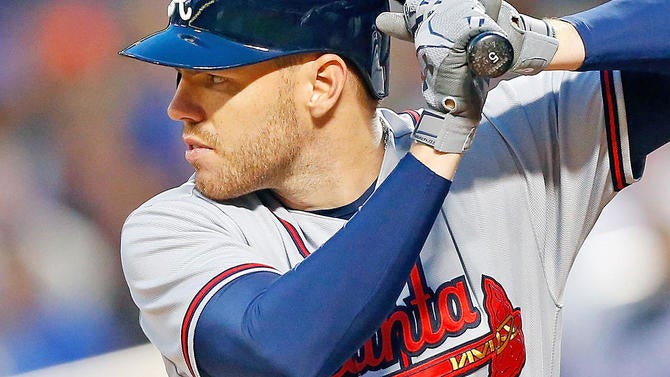
If we're counting from Opening Day 2016 to today, the correct answer is Freddie Freeman. The Braves star first baseman is batting a huge .311/.410/.591 in the past season-and-change, leading the NL in park-adjusted offense over that stretch. The numbers grow even more extreme if we count from June 1 of last season to today. During that span of 128 games, this is what Freeman's done: .335/.450/.706.
If the Braves were good, we'd be holding parades in this guy's honor. If and when that does happen, I call dibs on grand marshal.
8. James Paxton is a man possessed
My favorite breakout pick of the season has steamrolled the league so far this season. On Wednesday, he snuffed out the Tigers offense, firing seven shutout innings, striking out nine and allowing just four hits and one walk. His line through five starts this year: 32 1/3 innings, 39 strikeouts, six walks, 21 hits and zero homers allowed, and a 1.39 ERA. With those off-the-charts numbers, Paxton's been arguably the best pitcher in all of baseball so far this year.
As if his numbers weren't enough, Paxton's also a dyed-in-the-wool Canadian. How Canadian is he? Paxton hails from the same British Columbia town as Jason Priestley. He dons a giant maple leaf tattoo on his arm. Best of all, he's earned a new, kick-ass nickname: Big Maple.
What's he doing to dominate the league? And should we expect his incredible run to continue? For the answers to those questions, let's turn to our weekly pitching correspondent, Nick Pollack of The Pitcher List.
As Pollack notes, injuries curbed Paxton's production over the past three seasons. A lat strain and shoulder tendinitis knocked him out for four months in 2014, a strained middle-finger tendon and torn fingernail cost him nearly four more months in 2014, and an elbow contusion cost him three weeks last season. Pollack picks things up from there:
When Paxton returned from the minor leagues in 2016, he was a different pitcher. Paxton lowered his arm angle where he was able to get plenty more velocity on all of his pitches, while opening the door for a different repertoire. In 2015, Paxton averaged 94.1mph on his four-seam fastball and topped out at 97.5 mph. In 2016, those numbers ballooned to an average 96.7 mph while topping out in triple digits at 100.2 mph. We went from this:
... to this:
That's 100 mph on the black inside corner on a 3-2 pitch to get Mike Napoli looking, and look at the difference in arm-angle as Paxton was now coming closer to a three-quarters arm slot than the trebuchet-esque over-the-top approach.
Paxton's other changes included scrapping a changeup in favor of a cutter that produced a 19 percent whiff rate last season and excellent results again this year, and a wicked knuckle-curve that limited opponents to a tiny .041 isolated power mark in 2016 and remains a nasty weapon today.
With a wipeout three-pitch repertoire that's fueled the sixth-highest strikeout rate in the majors, pinpoint control, and now full health, Paxton could be the key to the Mariners' hopes of snapping the longest playoff drought in baseball. And maybe a Cy Young candidate too.
9. Catching can be a hazardous pursuit
Take appropriate caution:
Honestly can't stop laughing at how my 7-year-old niece plays catcher like an armadillo avoiding a predator 😂 pic.twitter.com/JBHrr6KbFz
— Adam Smoot, Tbh. (@adamsmoot) April 26, 2017
10. BURNING QUESTION OF THE WEEK
This week's burning question comes to us via Twitter from @Don_Bernal:
@jonahkeri Was Tony La Russa decades ahead of his time when he tried "3-3-3" staffs, with A. Miller and Devenski's success? #KeriThe10
— Don Bernal (@Don_Bernal) April 27, 2017
He was, Don. La Russa deserves credit as one of the first architects of the modern bullpen, but also someone who preserved some old-school touches, like using setup men over multiple innings. But even La Russa's 80s managing, and the multi-inning success of Andrew Miller and Chris Devenski, might merely be a prelude to another approach: bullpening.
On Tuesday against the Orioles, in an effort to work around the spectre of bad weather and likely delays, Rays manager Kevin Cash abandoned the idea of using a starting pitcher, and instead rolled out an all-bullpen approach. Nine innings later, five Tampa Bay relievers pulled off arguably the performance of the season: two hits, two walks, no runs, and nine strikeouts. Cash was the former bullpen coach for the Indians under Terry Francona ... and Tito couldn't help but be both stupefied and impressed by his old friend's gambit.
#Indians Francona joking about good buddy Cash managing #Rays pitchers Tuesday (h/t @MLBastian): pic.twitter.com/2wounkfy5W
— Marc Topkin (@TBTimes_Rays) April 26, 2017
Don't be surprised if this isn't the last time we see a team use an all-bullpen approach this season. And if the circumstances are right, don't be surprised if it works again too.