Miguel Cabrera, Cole Hamels, and the miracle of baseball consistency
It's one thing to be good while playing baseball at the highest level. It's something else to be steady.

By
Dayn Perry
•
8 min read

Is anything more elusive in baseball than simple consistency -- maintaining performance across weeks, months, and years? The game seems built, designed to defy getting steady results from one's skills. There's so much precision involved, so much luck, good and bad, that grows from the demands of the game that even the best struggle to be their best at all times. Consider what the two primary prototypes are up against in each encounter ...

The Hitter
It’s having less than half-a-second to discern the type of pitch and whether it’s in a "wheelhouse" location and then firing the hips and the back shoulder to initiate a swing and then transferring weight then barrelling up a round ball with a round bat, all just in time. Misfire, even by a hairsbreadth, and you pop it up or roll it over to the pull side or miss it altogether. There’s about two inches of bat that provide the highest quality of contact -- the kind of contact needed to maybe get it over the fence or past major-league fielders.
It's recognizing these seam patterns in an instant ...
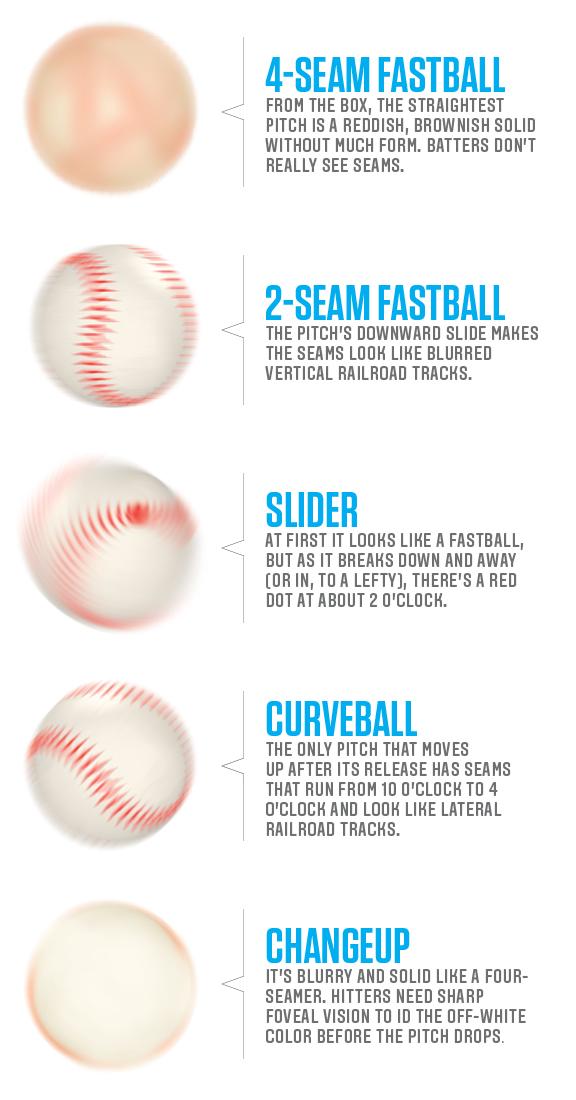
(h/t Reddit)
And then knowing what to do about what you've seen from the best pitchers in the world.
The Pitcher
It’s not only throwing strikes from 60 feet, six inches away, but it’s hitting a mitt-sized target within the strike zone -- command, they call it. It’s wielding that command over backspin pitches like the fastball and the changeup, topspin pitches like breaking balls, and maybe even the sinker, which winds up with a mix of topspin and sidespin. It’s delivering all of those pitches, generally speaking, out of the same arm slot with the same arm speed so as to maybe deceive the best of hitters, who have been bred and trained to figure out what you’re throwing and to attack it in less than half a second. It's doing all those things, except doing them differently each time you face the same hitter, so as to avoid the hazards of predictability.
It’s mastering the seemingly innumerable lifts and drops and levers and twists and rises and falls of the delivery and sequencing them and timing them just so. It’s squeezing the ball with the right finger, putting the right amount of pressure on the seams, pronating or supinating the wrist at just the right instant. It’s doing all of that maybe 100 times a game and then hoping you don’t grind up the machinery of your shoulder or fray and snap the ligament that yokes the top half of your arm to the bottom half. Fail at any of it, and the rest doesn't matter.
It strains credulity to say the odds are leaning against both pitcher and hitter in a zero-sum affair such as this one. Yet it seems that way when you ponder the unsparing physics of it all.
It’s miracle enough to do well, but it’s something beyond that to overlay excellence with steadiness. And that brings us to Tigers first baseman Miguel Cabrera and Rangers ace Cole Hamels -- the two players who, I’d submit, are the paragons of consistency in baseball.
For a time, it would’ve been Albert Pujols, whose St. Louis years were almost tidal in their reliable excellence. Clayton Kershaw and Mike Trout may well be the embodiment after they add more years to their dossiers. To be sure, there are better players than Cabrera and Hamels (though not many better than Cabrera, even in 2016), but it’s the relentless steadiness of each, in defiance of all those mandates ticked off above, that stand out.
First, consider Cabrera. When he debuted as a 20-year-old in 2003 he put up an OPS+ of 106 in roughly half a season. Since this, his OPS+ has ranged from 130 to 190, and for 11 straight seasons he played in at least 148 games. In 2013, I wrote that Cabrera went pretty much a full decade without having a bad month. Well, he’s endured a bad month since that piece ran, but the prevailing point still stands as tall as ever.
Cabrera has produced at a high level despite playing in different home ballparks and different climates. He’s produced despite seeing a different mix of pitches over the years, seeing different velocities over the years. He's thrived despite coming in at the tail end of one of the greatest eras for hitters the game has ever seen and then building his career as the game began structurally to favor the pitcher, eventually to extremes. Cabrera has played through all manner of nagging injuries throughout his career: a finger sprain, quad and oblique soreness, hip problems, biceps inflammation, a ground ball to the face, groin strain, bone spur, back pain -- the kinds of things that sap production even when not severe enough to cause a stint on the DL. Not with Cabrera, though.
For his career, he has a .923 OPS in day games and a .980 mark at night. He has a .994 OPS against fly-ball pitchers and a .946 OPS against ground-ballers. Against lefties, .992; against righties, .951. We could drone on and on.
When it comes to the very rudiments of his task -- deciding when to swing, putting the bat on the ball, and barreling it -- Cabrera is a study in constancy. From his first full season through 2015, here's how his swing percentage, contact percentage on swings, and rate of hard-hit balls have tracked over the years ...

You see implied above a carefully honed process, one from which Cabrera barely wavers. It's not just that he's one of the best hitters in baseball; it's also that he's always one of the best hitters in baseball. Note especially that stretch of straight line when it comes to his swing percentage. I'll wait on you to come to me, he seems to have been saying to the pitcher for most of his career. The numbers and the everyday-ness of those numbers tell the story of this future Hall of Famer.
What of Hamels? In 2016, he'll be angling for his eighth 200-inning season in the last nine years (his "miss" came in 2009, when he accounted for 193 2/3 innings). That's despite breaking his arm from the force of a pitch in high school (an arm, it should be noted, that was already compromised by a street football injury), cracking his pitching hand in a fight as a minor-leaguer, being diagnosed with a degenerative back disease, and almost needing Tommy John surgery late in the 2007 season.
You know it's about more than the workloads with Hamels. His ERA+ over the years has ranged from 97 in 2009 to 152 last season. There's so much randomness and luck baked into the run-based outcomes of a thing like pitching that you might not appreciate the level of compression that's present in even those seemingly far-apart numbers. Even the fundamental indicators with pitching -- the raw language of strikes and walks -- can swing widely from years to year. With Hamels, though, it's not the case. His FIP, which is driven by those baseline skills, has ranged from 3.05 to 3.98, which more visibly speaks to his consistency. What happens, though, when you take Hamels' walks as a percentage of batters faced and subtract it from his strikeouts as a percentage of batters faced (a strong indicator of command and control)? You get this trendline ...

As you can see, Hamels has stayed within the (very excellent range) of 15 to 18 percent, roughly speaking. He's done this even as the league-wide K%-BB% figure has tracked upward. Sure, you'd prefer your pitcher to track upward along with the league-wide trends, but this is about Hamels being the pitcher he is regardless of what goes on around him. He's changed teams, he's aged, he's dealt with injuries. He's also shown an unwavering base of skills even though his deep pitch mix has evolved over the years ...

(Chart via Brooks Baseball)
Hamels has gone from a guy who throws his fastball more than half the time to a guy who throws five different pitches that range from 12 to 30 percent usage. The end results, though, vary far less than you'd think, even after a decade or so of pitching at the highest level.
Baseball is built -- from the bones outward -- to defy predictability or evenness. And often (almost always?) it does. Have Mike Trout in your lineup and stalking his territory in center field like a jackal? Fine. You can’t have him run off tackle 30 times in a game or let him take 35 shots from the floor. Rather, he’ll bat at most one out of every nine times and have no say as to whether the ball is hit to him in the field. Clayton Kershaw at the front of the rotation? Physiology and the prerequisites for retiring the contemporary hitter (i.e., using your best stuff and deepest effort on almost every pitch) won’t permit him to take the mound more than 33, 34 times in a season at most. In part, those built-in limitations -- that the contributions of the individual are necessarily limited -- allow teams to defy our expectations, for better or worse, year after year.
The game is also unpredictable at an individual level -- a round bat striking a round ball into an expanse of field that usually comes to about 12,000 square feet of fair territory per fielder. As sports go, those are the constituent elements of randomness. Still and yet, some players manage to be who we know them to be year after year after year. In a way, that consistency is more impressive than on-balance greatness. In the cases of Miguel Cabrera, hitter, and Cole Hamels, pitcher, though, they give us both -- almost all the time.