MLB Hot Stove: Here is the best available of what's left on the reliever market
A look at 10 relievers worth checking out

•
5 min read

The bullpen market has begin to shake out over the past week. All the best closers have found homes and, bit by bit, we're beginning to see the top middle relievers and setup men do the same. The Miami Marlins, for instance, have signed a pair of relievers to multi-year deals -- a strong indication the ice is melting. But with so many teams seeking bullpen help -- from the Minnesota Twins and Milwaukee Brewers to the Los Angeles Dodgers and Washington Nationals -- this is a good time to reflect on what remains.
As such, let's take a look at 10 relief pitchers who merit attention. Note that the pitchers are presented in alphabetical order.
Joe Blanton
RP
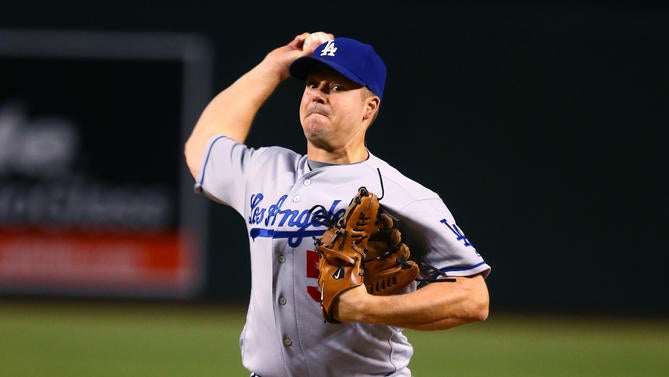
Since returning from a year-long vacation in 2015, Joe Blanton has posted a 150 ERA+ and 3.79 strikeout-to-walk ratio in 156 innings. He's embraced the short-spurt lifestyle by leaning heavier on his secondary pitches. To wit, he threw his slider more than 40 percent of the time last season, while his curveball and changeup accounted for an additional 30 percent of his total pitches. Normally, you'd worry a pitcher that reliant upon bendy stuff would have trouble throwing strikes; not Blanton, who issued 22 unintentional walks in 80 innings. He was overused in the postseason -- and allowed seven runs in three innings in the NLCS as a result -- but he makes sense as a rubber-armed setup man all the same.


Jerry Blevins might not have been the happiest individual concerning Mike Dunn's three-year, $18 million agreement with the Colorado Rockies -- Dunn was, in all likelihood -- but you can bet he smiled. The reedy Blevins is one of the best left-handed relievers in baseball. He's held same-handed batters to a .588 OPS throughout his career, and has been more effective against righties than you'd think -- albeit in part because his managers have cherrypicked which right-handed batters he faced. Blevins does his work with a 90 mph fastball and a slow curve, and makes up for the lack of frills with consistently good results.


While everyone recalls Santiago Casilla blowing nine saves during the regular season, his overall numbers were better than you'd think: he finished with a 115 ERA+; a 3.94 FIP that was just a smidge worse than his career 3.88 mark entering the season; and new personal bests in strikeout (more than 10 per nine) and strikeout-to-walk rates (3.42). There are negatives worth acknowledging, too: the San Francisco Giants gave up on him; left-handed hitters have an OPS north of .840 against him these past two seasons; and he'll celebrate his 37th birthday next July. But he's an accomplished high-leverage reliever with a mid-90s fastball. He should be drawing more interest than what's been reported.


If it feels like Neftali Feliz has been around forever, consider that he won't turn 30 until May ... of 2018. Feliz's arsenal remains spry, as he continues to throw upper-90s fastballs and a slider that resulted in a whiff on 45 percent of the swings taken against it. There are legitimate negatives worth discussing here. Feliz pitched significantly worse during the second half, as his ERA rose from 2.88 to 3.52 and his strikeout-to-walk ratio plunged from 4.44 to 2.90. That he walked more than three batters per nine is no surprise -- that he did so while yielding nearly two home runs per nine is. His youth, arm strength, and late-game experience makes him a tantalizing target. Yet Feliz in concept is better than Feliz in reality.


Greg Holland is a wild card. He missed last season while recovering from Tommy John surgery, and hasn't appeared in a big-league game since September 2015. Back then, he was a fastball-slider pitcher who sat in the mid-90s and generated about 50 percent groundballs. Now? Holland has been clocked in the upper-80s during his workouts. How much velocity he stands to regain, and how he'll fare without the extra mileage is anyone's guess. Holland is probably headed for a short, incentive-laden deal to a contender.


How much does defense matter? Daniel Hudson seems like a good litmus test. His high-90s fastball and quality secondaries (including a high-grade changeup) give him the appearance of a legitimate late-inning stud. Yet Hudson's ERA last season was an unsightly 5.22. Blame the ballpark and the majors' worst defense, but Hudson's unlikely to receive the acclaim or pay he deserves -- and there's no telling whether he'll slot in as someone's setup man come opening day. Maybe in a year's time? We'll find out.



Sergio Romo is younger than you think -- he won't turn 34 until March. That birthday will come a half-year after he threw fewer than 50 innings in a season for the first time since 2011 (due to a strained flexor). Romo has always been a slider-first pitcher, but last season he took it to a new extreme, throwing the pitch more than 60 percent of the time. Some people think roses are fickle, manipulative flowers; others think they're beautiful. The same is true with right-handed specialists. If you have room in your heart for them, you'll want Romo in your bullpen; if you don't, you won't. Either way, he's going to spam sliders.


Nobody remembers Fernando Salas' time as the St. Louis Cardinals closer, and many won't remember his 17 dominant appearances with the New York Mets. But you should remember Salas as an effective middle reliever with a three-pitch mix: a rising low-90s fastball and two secondaries (changeup and curve) that each come in harder than 84 mph. Salas is always going to be prone to the long ball by virtue of throwing a fairly straight heater up in the zone a lot, but he's a desirable quantity provided he's pitching middle relief.


Formerly a teammate of Salas' in Los Angeles, Joe Smith allowed a career-high eight home runs last season, including four in 14 innings with the Chicago Cubs. Smith's best sees him sink and slide the opposition from a sidearm slot -- a combination that makes him highly effective against right-handed batters. That he missed time last season due to a bum hamstring provides teams with a convenient reason to overlook his struggles -- and to bank on a return to form in 2017.

It wasn't long ago Drew Storen was the closer on a playoff team. By the end of last season, however, he was essentially a right-handed specialist for the Seattle Mariners. Storen has lost mileage on his fastball, and seems destined to pitch closer to the middle of games than the end of them. Still, so long as you aren't lost in a time warp, he could be an effective sixth- or seventh-inning arm. That counts for something.