More than just momentum for MLB return to Montreal
Montreal once again welcomed MLB exhibition games which were met with massive crowds, but there's much more than that in play for Major League Baseball to return to Quebec.

By
Jonah Keri
•
7 min read

MONTREAL -- It’s been 12 years since the Expos played their last game in Montreal. For a while, it seemed that nobody remembered, and nobody cared.
Now, everything is different. When the Toronto Blue Jays and Boston Red Sox took the field in Montreal last weekend, it marked the third straight season that fans packed decrepit, gigantic Olympic Stadium...for mere exhibition games.
In year one, the Jays and New York Mets drew more than 96,000 fans, combined, for the two games. In year two, the Jays faced the Cincinnati Reds, and again 96,000-plus showed up. This year, the scope of Red Sox Nation and proximity of its fans promised to make this the biggest weekend of baseball enthusiasm that the city had seen in a long, long time.
Still, the journey from baseball being dead and buried in Montreal to a major league team returning to the city becoming a real possibility has been a surreal one, filled with momentum no one could have seen coming as recently as four years ago. And what transpired last weekend in la belle province was a microcosm of all the euphoria and optimism that’s built up lately in Montreal.
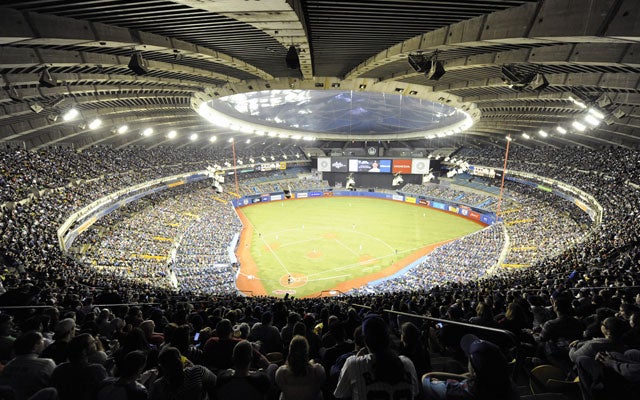
As they had done in each of the first two years, event organizers planned to honor a cavalcade of former Montreal Expos. Friday night’s roll call was a stroll through memory lane. Jose Vidro, the sweet-swinging second baseman and one of the franchise’s final stars. Vladimir Guerrero, the force of nature who ran like a gazelle, threw like a rocket, and launched baseballs from his shoetops. Marquis Grissom, the All-Star center fielder and catalyst for the ‘94 Expos, the greatest team that never got to prove its stuff. Ellis Valentine, the wildly talented but star-crossed outfielder who washed out of the game early due to drug abuse and injuries, only to rebuild his life and return to the field 29 years sober.
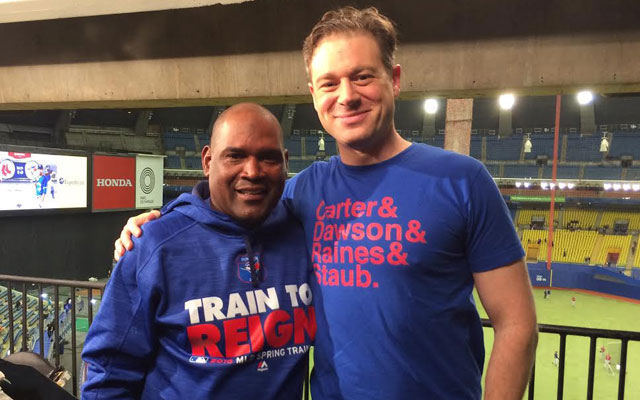
The two stars of the night consisted of one Hall of Famer, and a former player who could soon get there. Tim Raines led the National League in Wins Above Replacement for a decade, reached base more times than Honus Wagner, Roberto Clemente, or Tony Gwynn, racked up the highest stolen-base success rate of all time for anyone with nearly as many attempts, and remains one of only five players with 800 or more steals -- with the other four all enshrined in Cooperstown.
Those objective criteria acknowledged, I should offer some truth: Raines is also my favorite player of all time. When Canadian broadcasting giant Rogers Sportsnet asked me to do a pre-game TV hit with Raines sitting next to me on set, 41-year-old objective journalist Jonah quickly gave way to six-year-old Jonah, cheering like mad for the blazingly fast rookie who swiped an incredible 71 bases in 88 games. If any doubt about personal bias remained, it was shattered by two wardrobe choices. First, the blue Carter & Dawson & Raines & Staub T-shirt I wore on set instead of the more TV-appropriate jacket and tie. Second, the special-edition Cooperstown pin given to me by the town’s mayor Jeff Katz, which I then presented to Raines on air. Raines paused for a moment, looked into the camera, and said he would carry that pin with him every day as a token of good luck, until the results of the next election are announced in January 2017, his final year on the ballot. We both choked up a bit.
The crowd saved its most thunderous ovation, though, for Pedro Martinez. On numbers alone, Pedro’s Expos days didn’t approach those of Raines, Andre Dawson, Gary Carter, or even old veterans like Steve Rogers or Tim Wallach. But Pedro’s four years in Montreal were still spectacular. In his very first home game in 1994, he took a perfect game into the eighth inning, only to plunk Reds outfielder Reggie Sanders with an errant fastball. That pitch triggered a brawl, while that game instantly made him a fan favorite. Three years later, his 305 strikeouts, 1.90 ERA and NL Cy Young award in 1997 would further resonate with Expos fans.
But it was his emotion and impassioned speeches that cemented his legendary status in Montreal. When Pedro told the packed house at the Big O Friday night that he desperately wanted to see a team return to the city, we immediately flashed back to a night in October 2004. Then, less than a month after the Expos had played their final game, and mere moments after the Red Sox had broken one of the notorious losing streaks in sports history, Pedro chose to bypass shoutouts to Yaz and Teddy Ballgame, and instead pay homage to his friends back home in Quebec.
Pedro returning to the place where he became a star culminated a four-year buildup. When Gary Carter died in February 2012. The resulting outpouring of emotion also triggered a call to action. When Warren Cromartie returned to Montreal to honor his former teammate later that year, he found scant evidence that the Expos had ever played there; there were no banners at Olympic Stadium, no ballcaps in downtown shops, nor any other snippets of treasured memories. So Cromartie, along with pockets of fans, set out to change all that. There were Expos reunions, with some ex-players returning for the first time in 20 or 30 years. There were heartfelt ceremonies, such as when the city of Montreal renamed a street next to Jarry Park (the former home of the Expos) as Rue Gary-Carter.
By the time the Blue Jays and events promoter Evenko cooked up an annual two-game exhibition series, the locals were ready. Walking through the tunnel from Pie-IX Metro station under the stadium that first night back in 2014 was an unforgettable experience. So many people flooded the hallways that foot traffic ground to a complete stop. Rather than get angry or frustrated, the swarm of fans started singing “Let’s Go Expos.” Many cried. All this for a team that had moved away a decade earlier, following a season in which crowds of no more than a few thousand were frequent.
That’s what made the attendance number announced on Saturday so unbelievable. For the two games in Montreal last weekend, Olympic Stadium drew a total of...106,102 fans.
Now, drawing a bunch of fans to two exhibition games doesn’t mean that Montreal could guarantee packed houses for 81 games a year. Acquiring a team would be a huge task too, given how rarely MLB teams relocate (it’s only happened once in the past 40 years, that team was the Expos, and MLB viewed the situation as Chernobyl-esque by that point). If relocation of a troubled franchise doesn’t pan out, there’s always expansion -- but that would require a second expansion city to make it work, not to mention an incredibly expensive process to get it done. Add the cost of bringing a team back to Montreal through either means with the cost of building a state-of-the-art downtown stadium, and the total bill could easily approach $1.5 billion. And that’s in U.S. dollars. Convert that number to Canadian dollars given the current ugly exchange rate, and you’re talking about a potential cost of around $2 billion for Major League Baseball to come back to Montreal.
Still, the momentum is starting to build. At first there was little more than theoretical feasibility studies, plus some optimistic words from a mayor who loved the Expos. Things have progressed from there. Commissioner Rob Manfred has said on multiple occasions that he sees Montreal as a potentially suitable home for a major league franchise down the road.
Last weekend brought even more signs of hope. There was Stephen Bronfman, a former minority owner of the team and son of original owner Charles Bronfman, revealing to reporters that he’s working on a baseball plan for the city, and that well-heeled investors are doing the same behind the scenes. And while the amount of money required to finance a team would need to come from either big corporations or spendy billionaires, Montreal’s baseball movement got another pleasant surprise when Pedro announced that he’d back the project in spirit...and with actual money out of his own pocket.
Many hurdles remain, and Montreal has years to go and billions of dollars to find if it hopes to make its baseball dreams come true. But for a city that wasn’t thinking about any of this just a few short years ago, the mere idea of having these dreams sure beats no one ever dreaming them in the first place.