No, you're not imagining it: The Dodgers are taking their sweet time this postseason
If it seems like the pace of Dodger playoff games is a little slow, there's a reason

By
Dayn Perry
•
3 min read

As the Dodgers head back to Chicago down 3-2 in the NLCS against the Cubs with ace of aces Clayton Kershaw set to go in Game 6, it's worth remembering that the point is to win games, not necessarily win them in brisk fashion.
The Dodgers have won a lot of games this season, and winning the World Series is still squarely within their range of possibilities. As for the "brisk" part of things, well, the Dodgers aren't faring so well on that less important front.
If, in the course of consuming the 2016 postseason, it's occurred to you that games involving the Dodgers are taking longer than other games, then know that it's not your imagination. On this front, let's have a look at the average game time of each 2016 postseason series (in "hours:minutes" format) and apply some context with the average total runs per game for each series ...
| Postseason series | Avg. time of games | Total runs/game |
  | 3:31 | 7.33 |
  | 3:16* | 10.67 |
  | 4:01 | 8.60 |
  | 3:30** | 7.50 |
| | 2:53 | 4.00 |
| | 3:34 | 8.60 |
*Includes one 10-inning game that spanned 3:21.
**Includes one 13-inning game that spanned 5:04.
Now for some quick observations on the numbers you see above.
- As you can see, the Dodgers are the common element in the two series with the longest average game times this postseason.
- As noted above, the Giants-Cubs NLDS is in the running only because Game 3 went 13 innings and lasted more than five hours. That's obviously less a function of the pace than the score being tied. Scale the minutes-per-inning pace of that game down to nine innings, and you have a three-and-a-half hour game.
- Yes, the Dodgers and their opponents have scored a lot of runs in their series, but note that the highest-scoring series of the postseason -- Rangers-Blue Jays in the ALDS -- comes in at just 3:16 in terms of average game time. As you can see, that series also includes an extra-innings game.
- You see it plainly above, but it's worth noting: The Dodgers-Nationals NLDS averaged more than four hours per contest.
- The Dodgers-Cubs NLCS overall figure is being propped up by the 2:45 Game 2, in which the Dodgers behind Clayton Kershaw prevailed 1-0. The other four games of the series have average a run time of 3:47. Obviously, the Kershaw game and swiftness thereof are rightly part of the overall series calculus, but it's definitely an outlier.
So what's going on with all this? First, it must be noted that playoff games tend to run longer than regular season games. The between-inning breaks are a bit longer, and players perhaps tend to be more deliberate at the plate and on the mound given the increased stakes. Some years, postseason games run as much as a half-hour longer than regular season tilts, on average.
During the 2016 regular season, the Dodgers' average game time ran 3:10, which is the fifth-longest in MLB. This postseason, their games are averaging 3:48, so that's a big leap even by the standards of regular season vis-Ã -vis postseason. Part of it, surely, has been the competition, as the Nationals (ninth) and Cubs (11th) each ranked fairly in high in average game time this season. On the other hand, the Cubs proved against the Giants (tied with the Dodgers for fifth in average game time) that two slow-paced teams don't necessarily yield an inordinately slow series.
As for what's driving the Dodgers' October pace, the runs are part of it, as noted, as are the more frequent pitching changes. Also, though, a number of key Dodger pitchers take a long time between pitches. During the regular season, Dodger pitchers tied for third with the longest time between pitches.
On an individual level, Pedro Baez, at 30.2 seconds between pitches, was the the slowest hurler in all of baseball in 2016. Among pitchers with at least 50 innings this season, Kenley Jansen ranked 12th with an average of 27.7 seconds between pitches. Josh Fields is another who takes his time.
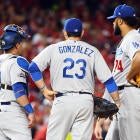
On the other side of thing, Dodger hitters also took a longer-than-average amount of time between pitches at the plate. Anecdotally, this postseason it seems like L.A.'s hitters are calling time at the plate with notable frequency, especially Joc Pederson. Mound conferences between catcher and pitcher also seem to be in abundance.
It's a number of things, as you're surely aware. However, they all add up to a Dodgers pace that may be described as "methodical to excess."
The good news moving forward? It's Kershaw on the bump in Game 6.