Will Curt Schilling make the Hall of Fame despite recent controversy?
Schilling is no stranger to internet fights

•
3 min read

The 2017 Baseball Hall of Fame class will be announced on Jan. 18. We're using the interim period to examine each of the 34 candidates on the BBWAA ballot. Remember that a player must be named on at least 75 percent of submitted ballots to be enshrined into Cooperstown.
If you're tuning in late, we've already poked at the candidates who will be removed from the ballot after one season. Recently, we've turned our attention to the players earning serious consideration -- and determining whether they merit entry into the Hall or not.
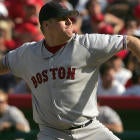
Today, the individual on the hot seat is Curt Schilling. Woo boy.
Schilling's candidacy is a polarizing mess that forces voters (and those who follow along with the home edition) to examine the character clause's demarcations and to ponder questions we would rather leave untouched -- all the while leaving no middle ground on which to stand.
For the uninformed, Schilling's tweets and comments in recent years have formed an absurd highlight reel, as well as a syzygy of undesirables that includes Nazis, Islamophobia, media lynching and uncomfortable comments about children. Much of this has come through the sharing of internet memes -- a fittingly absurd twist to a bizarre story, all things considered.
Schilling, as he is wont to do, has shared his thoughts on the matter -- stating he would be en route to Cooperstown had he not supported President-elect Donald Trump.
Whether or not you subscribe to that hypothesis, Schilling had actually gained support in recent years. He opened his eligibility in 2013 by earning 38.8 percent of votes. That rate dropped nearly 10 percentage points the following winter, yet rebounded to 39.2 percent in 2015. Last winter, Schilling broke the 50 percent mark for the first time. He could do so again this voting season, though his current 51.8 percent rate figures to slide -- along with most everyone else's -- when private ballots are counted.
Schilling's off-field doings would probably matter less if he were a slam-dunk candidate based on his on-field accomplishments. Instead, his worthiness hinges on your perspective, since he ended up closer to 200 wins than the magical 300. He authored one of the most memorable moments in recent postseason history, won an NLCS and World Series MVP nearly a decade apart, made six All-Star Games and finished as the Cy Young Award runner-up on three occasions. He also led his league in wins twice and was a throwback-style workhorse in an era where such a thing is nearing extinction, both of which appeal to old-school voters.
For the new-school bunch, Schilling accumulated more wins above replacement than the average Hall of Fame pitcher already inducted. It's not as though he was a compiler, either -- he finished with an ERA+ north of 120 in each of his final two seasons. Among pitchers with at least 300-plus starts, he ranks 21st in WAR and 20th in ERA+ -- albeit just 65th in wins. Depending on your bent, you could state, then, Schilling is one of the 20, 25 best starters of all time. Or you could not. Again, it's up to you.
You can argue Schilling should be in or out based on how you approach the character clause, statistical analysis and the weighing of memorable and/or big-game moments. Everyone's formula is different, and the interpretation -- of Schilling's play and say -- ensures few will agree on each aspect. It's just amusing, in a sense, to think Schilling's enshrinement would feel more like a fait accompli had he opted for steroids over sociopolitical commentary.
Other Hall of Fame cases: Posada | Ramirez | Guerrero | Rodriguez | Sosa | Wagner | Walker | Kent | McGriff | Smith | Mussina | Martinez | Bonds | Clemens