Will Trevor Hoffman get in to the Hall of Fame? The case for and against him
Hoffman is second all-time in saves, but he's no lock for induction in his second year of eligibility

By
Mike Axisa
•
4 min read

Leading up to the announcement of the 2017 Baseball Hall of Fame class on Jan. 18, we're examining each of the 34 candidates on this year's BBWAA ballot. By way of reminder, a candidate must be named on at least 75 percent of submitted BBWAA ballots in order to be elected into the Hall of Fame.
We've already looked at the numerous candidates who are certain to fall off the ballot after only one year (candidates receiving less than five percent drop off the ballot). Now we're looking at those hopefuls who figure to have meaningful Hall of Fame support and perhaps even earn induction at some point. Up next is ninth-inning maestro Trevor Hoffman.
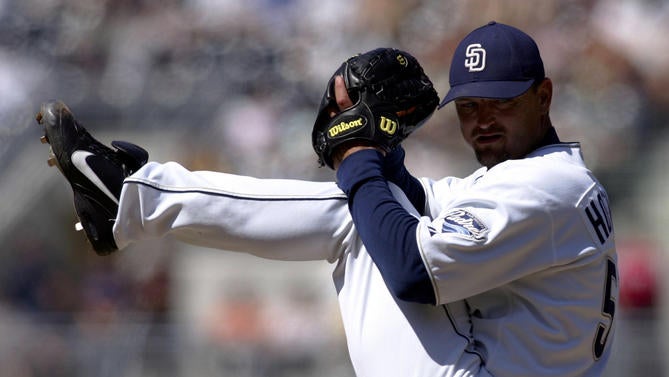
Hoffman, who played 18 seasons with mostly the Padres from 1993-2010, had a very unique career path. He started out as a light-hitting minor league shortstop with the Reds before transitioning to the mound. The Marlins selected him in the 1992 expansion draft, and after a half-season in Florida, Hoffman was traded to San Diego as part of the Gary Sheffield blockbuster. Sheffield is on this year's Hall of Fame ballot as well.
In his 18 seasons Hoffman was a seven-time All-Star who twice led the NL in saves (1998, 2006) and received Cy Young votes in four seasons (1996, '98, '99, 2006). He also received MVP votes in five seasons (1996, '98, '99, 2005, '06). Hoffman finished second in the Cy Young voting in both 1998 and 2006. He finished as high as sixth in the MVP voting (1999).
The case for Hoffman
Hoffman's Hall of Fame case is built on his longevity at a position not known for it. Few relievers stick around long enough to reach six years of service time and free agency. Pitch nearly two decades like Hoffman? Forget it. That's extremely rare.
Throughout his 18 years in the league, Hoffman pitched to a 2.87 ERA that was 41 percent better than average when adjusting for outside factors such as his home ballpark and offensive levels around the league. He managed a 1.06 WHIP with 9.4 K/9 and 2.5 BB/9 in 1,035 appearances and 1,089 1/3 innings.
Hoffman closed basically his entire career; he took over as San Diego's closer in 1994 and remained his team's unquestioned ninth-inning guy until 2009, his penultimate season. Here is the all-time saves leaderboard:
- Mariano Rivera - 652
- Trevor Hoffman - 601
- Lee Smith - 478
- Francisco Rodriguez - 430
- John Franco - 424
Hoffman was the first pitcher in baseball history to reach both 500 saves and 600 saves before being passed by Rivera. Heck, he was so good they named an award after him -- the Trevor Hoffman Award is now given annually to the NL's best relief pitcher. When they name an award after you, you know you've had a heck of a career.
The case against Hoffman
The argument against Hoffman's Hall of Fame candidacy revolves around two things. First, his lack of postseason success. Hoffman went 4 for 6 in postseason save chances and allowed six runs in 13 innings. He also blew the save and took the loss in the 2006 All-Star Game and the 2007 NL wild-card tiebreaker game:
Simply put, Hoffman's big game resume leaves a lot to be desired. He pitched in one World Series, in 1998 with the Padres, and in his only appearance of the series he blew the save and took the loss.
Furthermore, Hoffman was not quite as dominant as his peers. Billy Wagner struck out 63 more batters in 189 1/3 fewer innings, for example. Mariano Rivera allowed 32 fewer earned runs in 194 1/3 more innings in a ballpark far more friendly to hitters.
Among relievers with at least 100 career saves, Hoffman is eighth all-time with an 88.8 percent save percentage, behind guys like Eric Gagne (91.7 percent) and Joe Nathan (89.1 percent). Among all relievers, he's seventh all-time with 28.0 WAR, right behind Lindy McDaniel (28.7).
The save total is truly incredible. We don't see that kind of longevity often. The question is whether that saves total is enough to get Hoffman into Cooperstown, because relative to the game's other top relievers, Hoffman was not as dominant, and he didn't fare as well in big games.
Will he make it?
Almost certainly. As of this writing Hoffman has appeared on 73.5 percent of the publicly available Hall of Fame ballots, according to Ryan Thibodaux's tracker. Seventy-five percent is needed for induction, so Hoffman is right on the bubble. The tracker covers roughly half the total ballots that will be cast this year.
Keep in mind this is only Hoffman's second year on the Hall of Fame ballot -- he received 67.3 percent of the vote last year. Even if he doesn't get in this year, Hoffman has another eight years on the ballot to get over the 75 percent threshold. It's inevitable that he'll be inducted into Cooperstown at this point. The only question is when, this year or next?
Other Hall of Fame cases: Posada | Ramirez | Guerrero | Rodriguez | Sosa | Wagner | Walker | Kent | McGriff | Smith | Mussina | Martinez | Bonds | Clemens | Schilling | Raines | Sheffield