
The $27.5M question: How will Bills interpret wording in Tyrod Taylor's deal?
Taylor's bonus payment is guaranteed for injury 'if he is unable to perform football services" in 2017

•
3 min read
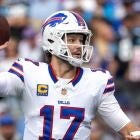
The Buffalo Bills and the NFLPA could be headed to a showdown over the fine print of Tyrod Taylor's contract after the quarterback underwent surgery for a sports hernia Thursday. Taylor has $27.5 million in potential injury guarantees in his contract, with the Bills having until the third day of the league year in March to determine if they are going to pick up his five-year option.
It remains to be seen how quickly Taylor heals from his surgery -- in general, a sports hernia could be anywhere from a six- to 10-week recovery from this surgery if all goes well -- and what kind of market forms for him elsewhere. I've been reporting for weeks that the Bills front office had determined not to pick up that hefty option for 2017 -- though they could try to re-sign him at a lesser rate -- and had been angling for a quarterback change in December. Taylor was inactive for Week 17 after seeing a groin specialist that week.
Here's where it gets tricky.
Per the wording of his contract, if he is released before the third day of the league year, Taylor's $27.5 million bonus payment is guaranteed for injury "if he is unable to perform football services" in 2017. That is open for interpretation. The NFL management council could take the view that the wording in that contract means that as long as Taylor passes a physical and is able to play at some point in 2017, then that injury guarantee is voided. I spoke to several contract guys for NFL teams -- not in Buffalo -- who read it as such.
However, NFLPA sources said that if Taylor is released by the Bills in March and is still recovering from a surgery at that point, then they would likely interpret him as being entitled to that guaranteed money (which would then be deferred by offsets in a new contract if at some point he was healthy enough to sign with another club). It's hardly rare for these two entities to have differing opinions on such issues, and depending on the rate at which Taylor heals, there could be a case brewing in arbitration to determine how this shakes out. That's obviously a considerable amount of money, and this is an injury that could certainly have some leeway as to when one is truly, fully healthy. And the timing of if/when another team was to sign Taylor could factor into any potential battle over the injury guarantee as well.
"Depending on when he is healthy, I could definitely see this being something that we have to get the legal team involved in," one union source said.
Whatever Taylor was to earn on the open market -- and I personally believe he would be pursued by several teams -- it remains to be seen whether or not he could get $30 million at the time of signing. And the mere wording of the Bills' statement on Taylor's surgery included some clues as to what could be brewing, with the union and the league office taking note of the passive wording that Taylor "elected to have surgery this morning." Hence some wiggle room as to whether their medical people would have deemed that procedure necessary or not.
Of course, had the Bills not utilized this unusual -- and many salary cap experts would say, unnecessary -- structure with Taylor's contract, putting such a massive balloon bonus potential due one year into the deal, they could have avoided all of this anyway. A two- to three-year deal would have made plenty of sense, with Taylor set to make under $1 million in 2016 and coming off his first year as an NFL starter. He had little leverage and was eager to do a reasonable extension of any sort.
Agents and NFL management people were somewhat dumbfounded with this deal at the time, and even more so now. A pay-as-you-go structure, with rolling one-year guaranteed base salaries in the $10-$15 million range (which have been commonplace in deals for young quarterbacks like Andy Dalton, Colin Kaepernick and Ryan Tannehill in recent years) would have achieved the same goal economically, with a far lesser injury guarantee in the balance.
Regardless, a messy situation at the end of the season with Taylor's imminent benching and the impending in-season firing of Rex Ryan threatens to complicate the coaching search with some uncertainty about what Taylor might cost the Bills in 2017 (whether he plays there or not). Bills GM Doug Whaley and his staff were very high on rookie Cardale Jones this season, though his brief stint under center in Week 17 did not go well and it remains to be seen if the new coach would look at him as the potential starter in 2017.