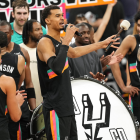
The InBounds: Tim Duncan or Marc Gasol for best center in the NBA?
With Dwight Howard having a down year, the All-NBA First Team center position is up for grabs between Tim Duncan and Marc Gasol. Who should get it?

By
Zach Harper
•
8 min read
It’s been a while since we had to really wonder about which center would get the honor of being on the All-NBA First Team.
For five straight seasons, Dwight Howard has been given the honors and deservedly so. He has been the best center in the NBA for at least half a decade. The last time anybody took the honors over him was in 2006-07, when either Tim Duncan or Amar’e Stoudemire took the honors (it depends on how you want to classify either).
However, Dwight has fallen off in many aspects of his game due to various injuries and chemistry problems with his new team (but mostly injuries), and Andrew Bynum has yet to play a second of basketball for the Philadelphia 76ers. That leaves the door wide open for a new center to emerge in the All-NBA First Team discussion.
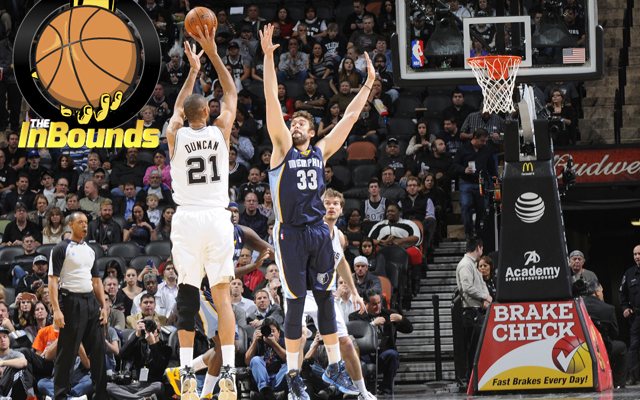
The two candidates who make the best case for being the top center in the league this year are Duncan from the San Antonio Spurs and Marc Gasol of the Memphis Grizzlies. The fact that Duncan is even able to put himself in this conversation at the age of 36 is an incredible testament to how he prepares himself for the grind of the regular season while still finding the focus and ability to remain this effective. And Gasol has gone from an afterthought in a shrewd move by the Lakers to acquire his brother, Pau, to being praised nightly as one of the best defensive centers in the league.
So, which of the two players should end up getting the nod for All-NBA First Team this season? Let’s break it down.
Offense
The way the two centers are used is quite different on a game-to-game basis. Gasol isn’t exactly a pound-it-into-the-post type of player with a high usage. You want to give him the ball at the elbow and let him dissect the defense with passes to roamers on the perimeter or cutters into the lane. He can play high-low with Zach Randolph in a devastating way. But rarely are you using him as a high-volume scorer in any way.
In fact, the average field goal attempts for any player who logs at least 30 minutes is 13.3. Gasol has taken 14 or more shots just 16 times in 65 games this season.
Duncan, on the other hand, is a center who is asked to score much more. While he’s also moving the ball to guys stalking the 3-point line and cutting through the lane or running their man into him for a dump-off pass, Duncan is one of the guys in San Antonio asked to take a big part of the scoring load. He’s not quite averaging 30 minutes per game, yet he has taken 14 or more shots 29 times in 56 games.
This is extrapolating from quite a broad split here, but the key to the Spurs being successful with Duncan playing appears to be his ability to make half of his shots (there’s obviously more to than just that with San Antonio, but we’re speaking generally here). When Timmy makes less than 50 percent of his shots in a game this season, the Spurs are 13-9. When he hits 50 percent or higher on his attempts from the field, the Spurs are an astounding 30-4, and only one of those four losses has come in the past two months.
For the Grizzlies, their lower usage creator of a big man’s passing appears to be the split between winning and losing. When Gasol finishes a game with three assists or fewer, the Grizzlies are 19-12. When he has been able to get four assists or more in a game this season, Memphis’ record improves to 25-9. It’s not a huge jump, but it’s the difference between being the fifth seed in the West and being the third seed.
Duncan’s ability to affect the game with his offense appears to be far greater than Gasol’s, although Marc has never been asked to do what Timmy is asked to do. There’s probably a reason for that, though.
Defense
It’s remarkable what Duncan is able to do on the defensive end of the floor after 16 seasons and at the age of 36. He’s not just getting by defensively and finding a way to contribute; he’s anchoring the third-best defense in the NBA. His timing on blocked shots is still as good as ever, and his fading athleticism hasn’t affected his ability to protect the rim at all. He struggles to recover a little bit in pick-and-roll situations, but that’s to be expected.
However, what Gasol has become on the defensive end is so impressive that he’s getting talked about for Defensive Player of the Year this season. Gasol isn’t a guy who blocks a lot of shots. He gets fewer than two blocks per game, but his impact on defense shows that there is so much more than just knocking shots away from the rim.
Gasol is arguably the best defensive center when he’s on the perimeter. The league has gone to a pick-and-roll heavy attack because the play is so difficult to defend without hand-checking allowed to slow down the guards. Defending that has become one of the essential elements of having a good defensive unit. Gasol leads the second-best defensive team in the NBA because he can hedge on screens and recover in a way that makes the opponent look like they’re just treading water in the pick-and-roll.
Mike Prada of SB Nation had a wonderful breakdown of Gasol’s defense against the Clippers the past week, and it highlights a lot of what you’d want to see from your big man. The thing about Gasol is you just can’t score consistently against him in any way. When a player isolates against him, they score just 0.66 points per possession and shoot 33.3 percent. Try posting him up, and you’re going to get just 0.63 points per possession while shooting 33.3 percent.
There just isn’t a situation (even when he gets switched out onto guards on the perimeter) in which it looks like he’s going to struggle defensively. As admirable as Duncan has been for his age and the effect that he has on his team’s defense, Gasol is by far the better defensive player.
Impact on the floor
It’s hard to fully judge single-player net differential in such a small sample size of not even one full season because most stat heads will tell you a two-year sample size of this kind of thing is a much better field of data to play with. However, when you’re basing an argument on a regular-season award, the small sample size is kind of what you have to go off of.
The on/off data for Duncan shows the Spurs are certainly better with him on the court than not. They do quite well even when Timmy isn’t in the game. They score 106 points per 100 possessions and give up just 100.5 points per 100 possessions. When he is on the court, the offensive rating improves to 108.6 and the defensive rating improves to 97.0. His impact basically improves San Antonio by 6.6 points per 100 possessions.
For Gasol, his impact is mainly on the Grizzlies’ defense. With their center off the floor, Memphis has an offensive rating of 99.1 and a defensive rating of 102.2. But when he’s on the floor, those numbers improve to an offensive rating of 102.2 and a defensive rating of a paltry 95.7. That’s a difference of 9.6 points per 100 possessions.
Tale of the Tape

So who gets the All-NBA First Team nod so far and why?
In the tale of the tape, Duncan’s offense and efficiency shines through. The advanced stats love him, and he slips by in just enough categories to earn nine checkmarks compared to Gasol’s eight. But here’s why he isn’t getting my imaginary vote for All-NBA First Team.
One big key is the durability. Could Duncan play more minutes and not miss so many games with mysterious ailments that might incur a fine? I bet he could. The Spurs are very intelligent with how they manage their guys’ minutes and, therefore, Duncan’s durability gets put into question (possibly unfairly). Gasol is out on the court a lot more than Duncan is, and that definitely factors into everything for me.
However, the biggest reason why I’m giving Gasol the nod is his impact on the floor since the Grizzlies traded away Rudy Gay. Since Jan. 30, the Grizzlies have an offensive rating of 98.1 and a defensive rating of 109.3 when Gasol is on the bench. When he’s in the game, the offensive rating improves to 105.1 and the defensive rating is a ridiculous 94.7. That’s a net differential swing of 21.6 points per 100 possessions.
As a guest on The Basketball Jones’ Friday podcast last week, Zach Lowe of Grantland.com said (and I’m paraphrasing here) that many people around the league figured a big reason the Grizzlies needed to trade Gay was to redistribute some of those shots that he was taking and let Gasol get more involved on those possessions that often turned into isolation plays.
Since the deal, the Grizzlies have to have their center on the court. He anchors their defense, and he helps move what is often a stagnant offense. You start getting into an entire debate about All-NBA First Team and whether it should mean having the best season or being the most valuable at your position.
For Memphis Grizzlies center Marc Gasol, I think he qualifies for both in the 2012-13 season.