Lightning CEO apologizes to Army captain over ticket policy mess
The Lightning were forced to apologize to a season ticket holder, who is also an Army captain, after their restrictive ticket policy nearly led to his season tickets being revoked.

By
Chris Peters
•
5 min read
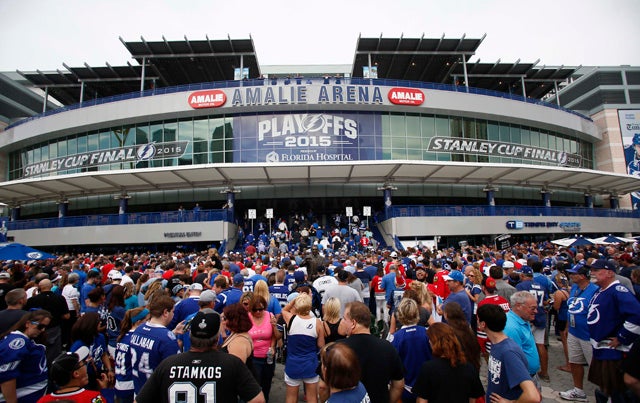
Much has been made of the Tampa Bay Lightning’s restrictive ticket policies during the Stanley Cup Playoffs. Fans that wanted to buy tickets to the postseason games over Ticketmaster could only do so if they had a Florida drivers’ license. Additionally, the team barred fans wearing opposing team colors from specific areas of the arena. The team is doing everything it can to keep opposing fans out of Amalie Arena.
The team has drawn a lot of criticism for the policy, often from media in opposing teams’ markets, but various spokesmen for the team have often said they refuse to apologize for doing all that they can to protect home-ice advantage.
But now the team is apologizing to one of its season ticketholders after it "went too far" in trying to prevent that fan from selling his seats on the secondary market. That fan just so happens to be an Army captain who can’t use his tickets because he’s stationed at Fort Knox for training during the postseason.
The fan in question is Captain Paul Dhillon, who bought Lightning season tickets this year after buying a partial season package last year. Normally stationed in Tampa where he is an assistant professor at the University of South Florida’s ROTC program, Dhillon had been trying to sell his tickets on third-party sites like StubHub.com, as he did for about half of his season package.
This is a fairly common practice for season ticket holders as it’s pretty tough to make it to 41 games a year. Only Dhillon found the Lightning’s new playoff ticket policy to be a bit restrictive to even him, one of the team’s loyal customers.
As he has tried to sell his tickets on secondary markets, he said the Lightning front office has threatened to move his seats or cancel them for the rest of the playoffs and next season. It temporarily blocked his ability to manage his tickets online and said he would have to pick up his tickets in person at the arena if he wants to use them.
Dhillon — who attends Tampa Bay fan events with his young child and wife, owns a Lightning vanity license plate that reads "5 HOLE," and was even honored in full uniform on the team's jumbotron as a "Hero of the Game" last spring — said he never agreed not to sell his seats when he bought the season ticket package or when he re-upped for 2015-16.
"I'm willing to comply with any policy they show me in writing but they're just making up stuff as they go," Dhillon, 32, said. "I really feel that they're strong-arming me into complying with what the Lightning want."
According to Dhillon, there was nothing in his season ticket agreement that barred him from reselling the tickets.
Though the Lightning had dealt with a swath of criticism, which even included a subtle jab from Chicago mayor Rahm Emanuel, this is the kind of publicity that should embarrass them. And based on the reaction from the team, it absolutely did.
Lightning CEO Tod Leiweke told the Tampa Bay Times that the policy may have gone too far.
"If a gentleman serving our country feels he was slighted, oh my god, we owe him an apology," Leiweke told the Times.
Leiweke noted that in leaner years for the franchise, the team’s arena was overrun with opposing fans. That led to complaints from Lightning fans that did go there, which is part of why this policy exists now, apparently.
"I specifically apologize to this (captain),” Leiweke told the Times. “I'm not going to apologize for our efforts to make sure this building is our home."
Dhillon says he was threatened with having his account canceled by the team if he failed to comply, and at one point was locked out of his account. Remember, this is a customer who has a right to his seats, who also physically cannot attend the games because of duties with the U.S. Army.
Threatening actual Lightning fans for doing what they want with the tickets they bought, military or not, is beyond questionable customer relations. The secondary markets being what they are, and now that there are legal and safer means to resell tickets, fans have every right to make a purchase and recoup their costs or turn a profit on those seats. It happens in every sport, in just about every city.
Dhillon told the Times that he attempted to sell the tickets again through Ticketmaster’s resale website, believing that the ticket policy would be in place automatically. It wasn’t, though. He sold his $290 tickets for $2,600 each. According to the Times, that’s when the team allegedly said they were going to take the rest of his tickets for the series before backtracking a day later and allowing him to give the tickets to a friend if he couldn’t attend.
The lengths to which the Lightning have gone to protect home ice is in some ways admirable. They want their building to be partisan in a big, big way. Whatever advantage they as an organization can provide to the team on the ice is worth pursuing.
This specific instance has shown, as Leiweke said, it can go too far.
Critics have said this shows they lack faith in their own fan base. NHL commissioner Gary Bettman said the opposite, saying that it shows the team is so confident in the local fanbase’s ability to turn out that they can put such restrictions in place. He also said the team can do what they want with their tickets and their building, without offering his own opinion of it in his remarks prior to Game 1.
Up until this point, the policy has been not much more than a thing for opposing fans to complain about. Now it’s a bigger issue because the team has been exposed by one of its own fans, someone that has made a legitimate investment of time and money into the team, who has gone so far as to buy a Lightning vanity plate.
The worst part of it all is that these policies are not terribly successful in keeping opposing fans out. Blackhawks fans travel extremely well and were in large number for Game 1. These restrictions can only go so far, but the Lightning seem to be trying to stretch those boundaries as far as they possibly can.
It’s a bad look for an organization that is no doubt on the rise, no doubt generating more and more local fan support and that will in all likelihood be competitive for years to come. The apology has been made to Dhillon, but perhaps this was a good lesson learned for a franchise that should be rewarding its most passionate fans instead of punishing them.